Published: March 14, 2014
By Jim Lichtman
Last year, NBC News reported that America’s teenagers scoredbelow the international average in math, and only average in science based on a report from a 2012 Program for International Student Assessment.
Fortunately, 1,700 science students from around the country did not have time to pay much attention to the study.
Each year since 1998, Intel, the computer chip corporation sponsors the Intel Science Talent Search (Intel STS). The program “is the nation’s oldest and most prestigious pre-college science competition. It honors exceptional high school seniors for their scientific research and their potential as future leaders in the scientific community.”
The purpose of the competition, Intel says, is to “inspire innovation in science, technology, engineering and math, and to recognize notable achievements by the next generation of scientific leaders.”
And the rewards given by Intel are generous, indeed. Ten are selected from 40 finalists. The grand prize winner receives $100,000; Second, $75,000; Third, $50,000; Fourth, $40,000; Fifth, $30,000; Sixth and Seventh receive $25,000; Eight, Ninth and Tenth receive $20,000 and the remaining 30 finalists receive $7,500.
The announcement of this year’s winners came at a celebration of science in Washington, D.C.
In a press release (Mar. 11) Intel writes, “From new cancer treatments to an exploration of how technology affects the adolescent brain, the innovative research of America’s future scientists, engineers and inventors took center stage in the nation’s capital today. Honoring high school seniors with exceptional scientific promise, Intel Corporation and Society for Science & the Public (SSP) recognized the winners of the Intel Science Talent Search, the nation’s most prestigious pre-college science and math competition.
“Eric S. Chen, 17, of San Diego won the top award of $100,000 from the Intel Foundation for his research of potential new drugs to treat influenza. His interdisciplinary approach combined computer modeling with structural studies and biological validation, with a focus on drugs that inhibit endonuclease [I can’t even pronounce this, much less understand it!] an enzyme essential for viral propagation. Eric, the co-president of his school’s fencing team and a junior Olympics qualifier, hopes his work will lead to a new class of drugs to control flu outbreaks during a pandemic, allowing time for a vaccine to be developed.
“Second-place honors and $75,000 went to Kevin Lee, 17, of Irvine, Calif., who developed a mathematical model to describe the shape of the heart as it beats using the principles of fluid mechanics. Kevin’s faster and computationally efficient model could provide insights into arrhythmia and may lead to better treatments for the disease.
“Third-place honors and $50,000 went to William Henry Kuszmaul, 17, of Lexington, Mass., who developed a new approach to the mathematics of modular enumeration, which has applications to a wide number of problems in computer science, bioinformatics and computational biology.”
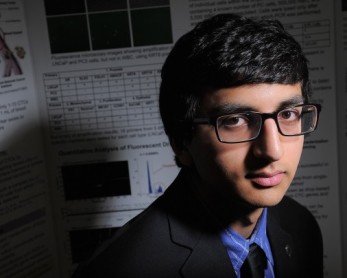
Neil Davey, pictured above, one of the 40 finalists began his research with a question: “How, he wondered, could he effectively detect and isolate circulating tumor cells in a cancer patient’s bloodstream?”
“The idea,” the 18-year-old explains, “is that you would be able to accurately diagnose cancer at a much, much earlier stage.”
18-year-old Shaun Datta, of Gaithersburg, Maryland was awarded Tenth Place for his work in physics with this compelling title “Saturated Nuclear Matter in the Large Nc and Heavy Quark Limits of Quantum Chromodynamics.”
Me, I have trouble picking talent out of the final selections in NBC’s The Voice competition. I’m just glad that once a year, Intel takes the time, interest and money to acknowledging and reward the pursuit of excellence and the students, who clearly demonstrate the diligence and perseverance in seeking to not only advance their own knowledge, but choose work that contributes mightily to society.
Congratulations Intel and all 1,700 students who entered last year’s competition.
Comments
Recent Commentaries

The Clock is Still Ticking. But Now It’s Ticking for CBS
June 3, 2026

God Has Chosen Donald Trump
June 1, 2026
The White House as Profit Center
May 29, 2026

Is Ethics Dead? – Conclusion
May 28, 2026
Is Ethics Dead? – Part II
May 27, 2026
Is Ethics Dead? – Part I
May 25, 2026
The Late Show with Stephen Colbert EndsTonight and I Have a Few Words to Say About It
May 21, 2026
Trump Trifecta
May 20, 2026
The Greatest Sentence Ever Written
May 18, 2026

Article II Clarified
May 14, 2026
Read More Articles
The Latest... And Sometimes Greatest
If It Looks Like a Duck…
Donald Trump has never hidden his disdain for anyone or any institution he believes stands in his way. Near the top of that list is...
May 11, 2026
A Tale of Two Voices
Two voices, both alike in reach and power, Speak into a divided world. One feeds grievance. The other calls for grace. Influence still carries power....
May 8, 2026
How Do We Manage Division?
Recently, I found myself returning to a question I’ve asked in different forms for years: what does it actually take to hold a country together...
May 5, 2026
The Supreme Court is Broken. How Do We Fix It?
As distilled from an email update from Michael Waldman, President and CEO of the Brennan Center for Justice. On Wednesday, the Supreme Court struck down...
May 1, 2026
Leadership as a Moral Act
Britain’s King Charles III spoke to a chamber that, for a moment, set aside party labels—Democrat and Republican—and listened not as factions, but as participants...
April 29, 2026
Unity is Not a Declaration. It’s a Discipline.
How does a country move from argument to action? The shooting at the White House Correspondents’ Dinner is not an isolated event. It is part...
April 27, 2026