Published: May 5, 2026
By Jim Lichtman
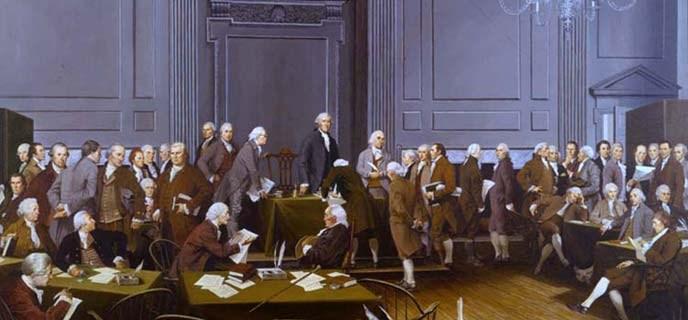
1787 – The Constitutional Convention
Recently, I found myself returning to a question I’ve asked in different forms for years: what does it actually take to hold a country together when its people don’t agree?
We like to believe the Constitution emerged from unity, shared purpose and a kind of moral alignment that made agreement certain. It didn’t.
As Max Farrand makes clear in The Framing of the Constitution of the United States, the men who gathered in Philadelphia in 1787 were not of one mind. They arrived divided—by region, by competing interests, and by a deep suspicion of power, especially each other’s.
What they built was not a system to eliminate division. It was a system to manage it.
That distinction carries weight, especially now.
Division is not new. What is new is the belief that it must be defeated, rather than governed. Disagreement is increasingly treated as illegitimate—something to silence—rather than as a condition to be structured and contained. The framers understood what we are in danger of forgetting: in a free society, division is inevitable. The ethical question is not whether it exists, but how we choose to respond to it.
Their answer was restraint, not rhetorical restraint, structural restraint. That was the choice they made, and it is a standard now facing its toughest test.
A Congress divided into two chambers so that power would not move too quickly. An executive constrained not by personality, but by design. A system of checks and balances grounded in a clear-eyed understanding of human nature: ambition will press against limits, and those limits must hold.
What we are living through now makes that design impossible to ignore. The strain across our institutions and the open effort to bend process to outcome reflect the very pressures the framers anticipated. They did not rely on virtue alone. They built a system to withstand its absence. That is the ethical foundation: not the hope that leaders will always do the right thing, but the insistence that they operate within limits, whether they want to or not.
Because power, left to itself, does not remain neutral. It rationalizes. It begins to serve its own continuation.
The Constitution pushes back against that instinct. Quietly. Firmly.
But it does something else as well, and this is where honesty matters. In managing division, it also compromised with it. The accommodations around slavery were not acts of principle. They were concessions, decisions made to preserve a fragile union at the expense of moral clarity. The document held the country together, but it did not resolve its deepest injustice.
It reminds us that even the most carefully constructed systems reflect the limits of the people who create them. The Constitution is not a statement of perfection. It is a framework built under pressure—capable of correction, if we are willing to confront what it left unresolved.
And that brings the question back to us.
We are not being asked to return to some past unity—because it never truly existed. What is being asked of us is harder: to practice a discipline that has grown more difficult over time—the discipline of managing division without surrendering to it, of keeping power within its limits even when it is inconvenient, even when it feels justified to push beyond them.
The Constitution does not promise agreement.
It requires accountability.
And that is the urgent question facing citizens now: are we willing to uphold the very limits we expect others to honor?
Comments


Recent Commentaries
All The President’s Targets
October 13, 2026
Integrity Doesn’t Require a Megaphone
October 12, 2026
WHOSE PURPOSE DOES THIS SERVE?
October 9, 2026

Choreographer of Disaster
October 5, 2026
I Am Not a Politician, and I Have No Partisan Loyalties
October 2, 2026
A Man of Incorruptible Integrity
September 29, 2026

HUMAN VALUES: NOT SPECIFIED
September 23, 2026
You Can’t Do That.
September 21, 2026
I AM SICKENED
September 18, 2026
The Courage to Defend a Principle
September 17, 2026
Read More Articles
The Latest... And Sometimes Greatest
The Better Angels Among Us
By all appearances, we are becoming less the land of the brave than the land of resentment. Every day is Groundhog Day: same arguments, same...
September 14, 2026
We Remember
On September 11, 2001, nearly 3,000 people were killed in terrorist attacks in New York, at the Pentagon, and aboard Flight 93 in Pennsylvania. More...
September 11, 2026
Mister Roberts!
One of my favorite movies is Mister Roberts, the 1955 comedy-drama set aboard the USS Reluctant in the Pacific during World War II. Henry Fonda...
September 8, 2026
Where’s the Character
In 1984, Wendy’s ran a television commercial featuring the redoubtable Clara Peller, staring at an enormous hamburger bun. Inside was a burger patty smaller than...
August 7, 2026
It Was Important Then. It is Important Today
Freedom of speech in America is under attack, not only when people are denied the right to speak, but when lies, intimidation and the deliberate...
August 3, 2026
When Political Identity Replaces Ethical Judgment
The political and cultural landscape has become a minefield of conflicting beliefs, many now rooted less in public policy than in personal identity. One of...
July 31, 2026