Published: January 23, 2017
By Jim Lichtman
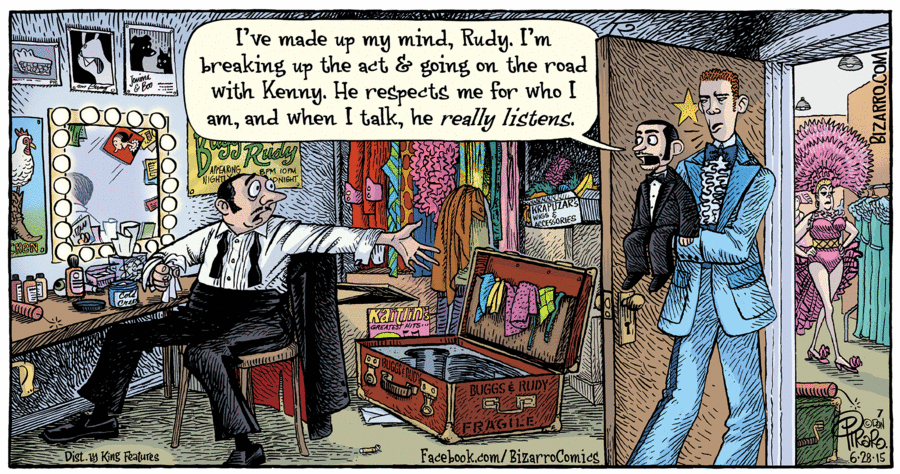
courtesy Dan Piraro, Bizarro.com
Waiting at a small regional airport for a connecting flight, I passed through the security area and am sitting in the lounge waiting for the plane to load when another passenger, carrying two large bags, approaches the security check point.
This was after 9/11, when security measures at airports had significantly increased.
With no passengers standing in line, the large man walks up, notices the security personnel and immediately says, in a loud voice, “Okay, you got me! I’ve got a bomb in this case, and a bomb in this other case, too.”
While it clearly appeared the man was joking or annoyed that he had to go through the process, security personnel quietly informed him, “Sir, we will need to inspect both bags and perform a complete security search of you.”
The security agent was polite throughout the process, but I could tell that she was not happy about all this.
The man, on the other hand, was even more annoyed and kept up his complaints until two very large security officials arrived to witness the unpacking and searching of the passenger and his bags.
Fortunately, this slight delay did not seem to impact the schedule and everyone silently moved on to their next destination.
Sadly, such has not been the case with others who, because a variety of reasons, have run around security barriers causing massive delays at much larger airports – all of which could easily have been avoided if these individuals had the good sense to respect a process that’s in place to keep us all safe.
In his book, Civility – Manners, Morals, and the Etiquette of Democracy, Yale Law Professor Stephen L. Carter writes that “sacrificial civility is a moral obligation. But very little in contemporary political theory teaches us much about the discipline of our desires for the sake of others.
“Conservatism teaches us to worship our property, liberalism teaches us to worship our rights. Both teach us to worship ourselves, but neither one teaches us to yield our own desires for the sake of others. So where do we go to learn the language of sacrifice? In a nation where both discourse and behavior are dominated by the political ethic of victory-at-any-cost and the market ethic of getting-mine, where do we learn to put aside our own desires and even needs for the sake of the larger good? By now, the answer should be obvious, even if controversial. We go to our churches, our synagogues, our mosques, and our temples. In short, we go to God.”
The second commandment: “Love thy neighbor as thyself.”
However, Carter continues, “We look at our neighbors, and we see people who hate or lie or kill or cheat or in other ways do enormous damage – and then we turn to God and are told that we should love them. This must seem a tremendous burden, but it is a burden that we must take up if we are to reconstruct civility and strengthen it against all the many threats it faces.”
In ethics, as in religion, it all comes down to the Golden Rule: “Do unto others as you would have them do unto you.”
Easy to say. Difficult to do, sometimes. And, if we are not treated with the respect we expect, it can be painfully difficult.
In my book, What Do You Stand For? – Stories about Principles That Matter, there is a story that I return to, frequently. It comes from Hampton University student Courtney Thompson.
“…I visited Mombasa, Kenya, a country rich in land, culture, and tradition. The roads were filled with vendors, consumers, workers in transit, tourists, the poor, and the homeless. The first days, Hashim, the friend that I traveled to visit, gave willingly to many suffering from severe conditions of destitution and utter helplessness, often exchanging larger bills for easy-to-dispense change. After observing his daily routine of selflessly giving, I reflected upon the ideal symbolized in the counsel ‘do unto others as you would have them to do unto you.’ Before I could censor my thoughts, inwardly I questioned, ‘But what about when others are unable to do unto you?’
“The answer came as Hashim’s willingness to give continued over the course of the remaining weeks. ‘You must give to the world more than the world gives to you.’
“Indeed, this was the real essence represented by the Golden Rule.
“In that experience,” Thompson writes, “I learned more than I had in a lifetime about the gift of giving. I have since accepted and faithfully practiced the true application of this principle in my life with one modification. Though the change is a single word, the difference is profound. I have resolved that for the rest of my life, not only will I do unto others; I will do unto others, unconditionally.”
“Unconditionally.” That’s what got my attention.
Not only do I have to give more, I must do it, unconditionally.
Whenever I am challenged… (oh, come on, Jim!). All right, whenever, I’m pissed-off at someone – usually because of their obvious selfishness, I strive to remember Hashim’s moral: “You must give to the world more than the world gives to you.”
And Courtney’s: Unconditionally.
Comments
Recent Commentaries

HUMAN VALUES: NOT SPECIFIED
September 23, 2026

You Can’t Do That.
September 21, 2026

I AM SICKENED
September 18, 2026
The Courage to Defend a Principle
September 17, 2026

The Better Angels Among Us
September 14, 2026

We Remember
September 11, 2026

Mister Roberts!
September 8, 2026

Where’s the Character
August 7, 2026
It Was Important Then. It is Important Today
August 3, 2026

When Political Identity Replaces Ethical Judgment
July 31, 2026
Read More Articles
The Latest... And Sometimes Greatest
Principles Matter.
A few nights ago, I was watching The Way We Were, a film I’ve seen more times than I can count. This time, a single...
July 28, 2026
All the President’s Men 2.0
“Politics had infiltrated every corner of government—a strong-arm takeover of the agencies by the Nixon White House.” —Bob Woodward and Carl Bernstein, All the President’s...
July 23, 2026
The Threat to November Is Already Here
“Cunning, ambitious, and unprincipled men will be enabled to subvert the power of the people and to usurp for themselves the reins of government.”—George Washington’s...
July 20, 2026
Jon Ossoff and the Conscience of Atticus Finch
I’ve written about Georgia Senator Jon Ossoff before, but after watching his questioning of Jay Clayton, President Trump’s nominee for director of national intelligence (DNI),...
July 17, 2026
Hearts and Minds
There’s a moment in Cool Hand Luke when Luke, played by Paul Newman, is returned to a prison camp after escaping. Determined to break his...
July 16, 2026
The Ethics of Belonging
I recently read a book by a man who has learned some of life’s hardest lessons and, by his own account, is still learning them...
July 14, 2026