Published: April 13, 2026
By Jim Lichtman
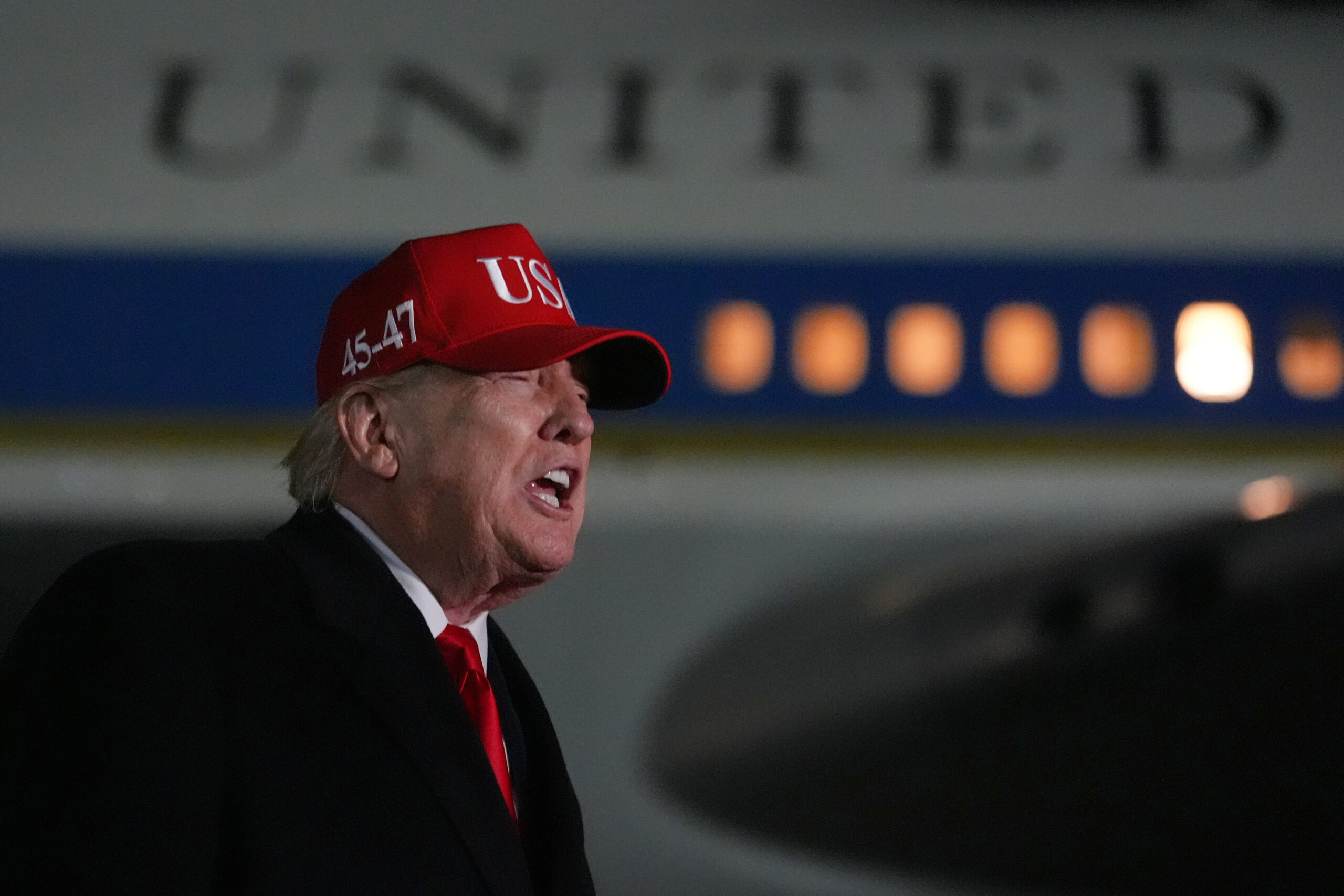
President Donald Trump speaks with reporters at Joint Base Andrews, Md., Sunday, April 12, 2026, after he returned from Miami. (AP Photo/Julia Demaree Nikhinson)
Question: How low can Donald Trump go?
Answer: Low enough to attack the head of the Catholic Church and, by extension, 1.4 billion Catholics.
His latest descent comes in the form of an attack on Pope Leo XIV. Not over policy. Not over governance. But something far more telling: moral authority.
In a post on his social media site, Truth Social, Trump said he does not “want a Pope who criticizes the President of the United States because I’m doing exactly what I was elected, IN A LANDSLIDE, to do.”
Trump went on to criticize the Pope as “very liberal,” and accused him of political bias, and suggested he owes his position to Trump’s own presence in power. “If I wasn’t in the White House Leo wouldn’t be in the Vatican.” Then, as if to complete the performance, he circulates an image of himself in the likeness of Jesus Christ—laying hands, emitting light, a spectacle of self-anointed divinity.
There is a difference between confidence and delusion. One builds trust. The other demands belief.
The Pope, for his part, did not speak Trump’s name. He did something far more unsettling for the president, he spoke of God. He warned that “God does not listen to the prayers of those who wage war,” echoing the prophet Isaiah: “Even though you make many prayers, I will not listen. Your hands are full of blood.”
That is not politics. That is Scripture.
And it lands exactly where it should.
Because this moment is not about whether a Pope is “liberal” or a president is “strong.” It is about whether power recognizes any authority beyond itself. Whether it bends to something higher, or simply crowns itself.
Jesus never claimed power through spectacle. He rejected it. He turned away from those who mistook dominance for righteousness. “Blessed are the meek,” he said. Not the loud. And not the self-declared saviors.
And yet here we are, watching a President recast criticism as disloyalty and faith itself as something to be branded and tossed to his faithful like communion wafers. The danger is not disagreement between a Pope and a President. That’s happened before. The danger is blurring the boundary between moral truth and moral manipulation. It happens when one begins to impersonate the other.
There is a difference between leadership and performance, a difference between faith and its imitation.
We are watching that difference disappear in real time.
And the cost is not political.
It is moral.
Comments
Leave a Comment

Recent Commentaries
All The President’s Targets
October 13, 2026
Integrity Doesn’t Require a Megaphone
October 12, 2026
WHOSE PURPOSE DOES THIS SERVE?
October 9, 2026

Choreographer of Disaster
October 5, 2026
I Am Not a Politician, and I Have No Partisan Loyalties
October 2, 2026
A Man of Incorruptible Integrity
September 29, 2026

HUMAN VALUES: NOT SPECIFIED
September 23, 2026
You Can’t Do That.
September 21, 2026
I AM SICKENED
September 18, 2026
The Courage to Defend a Principle
September 17, 2026
Read More Articles
The Latest... And Sometimes Greatest
The Better Angels Among Us
By all appearances, we are becoming less the land of the brave than the land of resentment. Every day is Groundhog Day: same arguments, same...
September 14, 2026
We Remember
On September 11, 2001, nearly 3,000 people were killed in terrorist attacks in New York, at the Pentagon, and aboard Flight 93 in Pennsylvania. More...
September 11, 2026
Mister Roberts!
One of my favorite movies is Mister Roberts, the 1955 comedy-drama set aboard the USS Reluctant in the Pacific during World War II. Henry Fonda...
September 8, 2026
Where’s the Character
In 1984, Wendy’s ran a television commercial featuring the redoubtable Clara Peller, staring at an enormous hamburger bun. Inside was a burger patty smaller than...
August 7, 2026
It Was Important Then. It is Important Today
Freedom of speech in America is under attack, not only when people are denied the right to speak, but when lies, intimidation and the deliberate...
August 3, 2026
When Political Identity Replaces Ethical Judgment
The political and cultural landscape has become a minefield of conflicting beliefs, many now rooted less in public policy than in personal identity. One of...
July 31, 2026
How timely your post Jim! How very sad what this President is saying and doing.
Moral?