Published: January 16, 2015
By Jim Lichtman
Dartmouth has a history as a top Ivy League college. Long esteemed for its schools of medicine, engineering, business as well as liberal arts, Dartmouth has now gained another distinction.
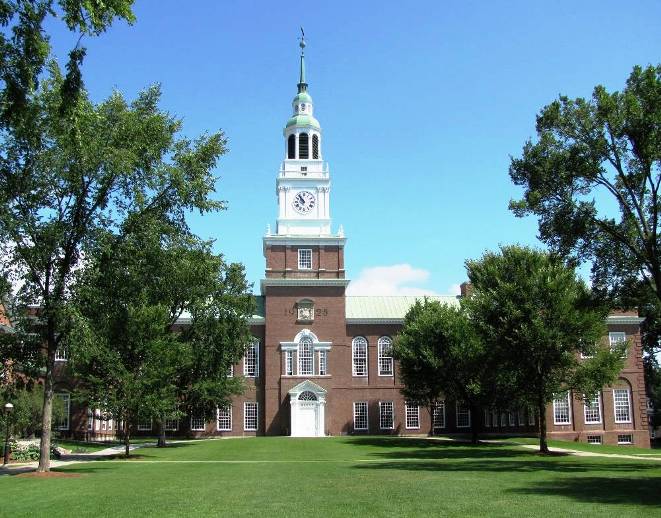
The Boston Globe reported (Jan. 8), that “Up to 64 Dartmouth College students — including some athletes — could face suspension or other disciplinary action for cheating in an ethics class this past fall.”
The last time I reported on cheating in school was March 28, 2014. It came from a story written by former Washington Post columnist and current high school teacher Colman McCarthy about the necessity some students feel to cheat in order to get into a good college or career.
The most popular justifications offered to McCarthy:
“I would cheat,” one student wrote, “because I am trying to secure my grade so colleges would want me.”
Another said, “If I’m failing the course and I need a good grade to graduate, then yes, I would cheat.”
“I would cheat because why not? It hurts nobody and the only outcome is a better grade for myself which boosts my chances for better future.”
Apparently, cheating is alive and thriving even in Ivy League schools such as Dartmouth.
“Dartmouth officials,” the Globe reported “said students implicated in the cheating scandal misrepresented their attendance and participation in the undergraduate course, ‘Sports, Ethics & Religion.’
“The class used electronic hand-held ‘clickers,’ registered to individual students, to answer in-class questions. Officials at the Hanover, N.H., college said the students charged with cheating either gave their clickers to classmates instead of attending class themselves, or helped others cheat by using the clickers to answer questions on their behalf.
“Administrators were alerted to the possible cheating after the professor, Randall Balmer, chairman of the religion department, noticed that the electronic system was receiving a significantly higher number of responses than the number of students he could see sitting in front of him in the lecture hall.
“Balmer said the irony of the situation — alleged cheating in an ethics-related course — is inescapable, and he called the matter ‘very sad and regrettable on many levels.’
“ ‘A lot of the students will probably come away with a stain on their transcripts,’ Balmer said by phone Thursday. ‘And, a level of trust that is so necessary for students and teachers has been betrayed, and I feel sad about that.’
“Balmer said he initially suspected 43 of the class’s 280-some students of cheating. The matter was taken up by Dartmouth’s judicial affairs office, which launched an investigation. More students came forward to say they had participated in the practice, he said, and the number of students facing judicial hearings grew to 64.
“ ‘The academic honor principle is a foundational element of a Dartmouth education,’ College spokeswoman Diana Lawrence said in a statement. ‘The integrity and excellence of that experience require trust between our faculty and students. For this reason we treat all academic honor code violations as major misconduct.’
“Balmer said he developed the course in part to appeal to the interest of student-athletes, who made up a sizable portion of the class. He said he did not know the number of athletes accused of cheating, and a spokesman for the school’s athletics department declined to comment Thursday.
“Balmer said he considered failing students who he believed had cheated, but decided instead to lower their final grade by one letter.
“About half of the implicated students have approached him and ‘expressed abject apology,’ he said. Only a few students have complained, telling him they feel his decision to lower their final grade was unfair, he said.
“For his part, Balmer says he believes honor was once ‘very much a part of our society,’ but that notion has faded over the decades. ‘I think honor no longer is something that has a lot of resonance in society, and I suppose in some ways it’s not surprising that students would want to trade the nebulous notion of honor with what they perceive as some sort of advantage in professional advancement,’ he said.”
So, how can we encourage academic integrity?
In 2004, ethicist Michael Josephson and Melisa Mertz put out a handbook for teachers, parents and students. Based on their experience, they advocate a T.E.A.M. approach.
Teach:
Define – Be sure your child or student really understands the basic terms.
Discuss – Young people often do not think about the implications of their actions and often hide behind shallow reasoning and rationalizations to justify cheating, plagiarism or other forms of dishonesty. It is important, therefore, to guide them through a rigorous analysis of the nature and impact of dishonesty. Every parent, teacher and coach ought to look for opportunities to initiate a serious discussion about this.
Enforce:
Rules of Conduct – Establish clear and simple rules of conduct specifying expectations concerning integrity and consequences for cheating or other forms of dishonesty. Parents: though expectations are often more informal in a home setting, your child might benefit from the emphasis provided by a written document on the importance of integrity.
Acknowledgment – Use some sort of formal acknowledgment of the expectations, such as:
– Signed Acknowledgment: Require each youngster to sign the code or statement: “I have read and understand the rules regarding integrity and realize that serious consequences will result if I violate these rules.”
– Oral Acknowledgment – Require each student separately (not together in a group) to affirm that he or she “understands the rules regarding integrity and that serious consequences will result if I violate these rules.”
– Praise and Discipline – Honest behavior — including efforts to discourage classmates from cheating, and in some cases, reporting cheating — should be praised. Likewise, serious disciplinary sanctions (sufficient to demonstrate the importance of the rules and to discourage those who might break them) must be consistently imposed.
Advocate:
Endorse and Encourage: Look for opportunities in your interactions to endorse and
encourage integrity by clearly and unequivocally stating your admiration and respect for people who are honest, and your firm expectation that your children/students are good enough and strong enough to resist temptations to cheat or otherwise sacrifice their integrity.
Inspire: Seek to inspire youngsters to value their personal integrity, credibility and reputation by telling stories and repeating or posting quotations.
Model:
Review – Seeking input from your children or students, consider systematically whether there are areas that you or the school should work on to do a better job of modeling integrity, discouraging and preventing cheating and of enforcing your rules against cheating. If there are areas where you think you could be better, commit to improve.
Honesty – Be certain you are scrupulously honest in your dealings.
“The challenge for all people of ambition,” Josephson says, “is to recognize that the pursuit of success creates constant temptations to sacrifice integrity and that there is a point at which the price of success makes its fulfillment worthless.”
Changing Cheaters: Promoting Integrity and Preventing Academic Dishonesty, can be downloaded for you to read and pass along to those who can benefit.
Comments
Leave a Comment


Recent Commentaries

November 4, 2026
October 20, 2026

Has America Lost Its Way?
October 16, 2026
All The President’s Targets
October 13, 2026

Integrity Doesn’t Require a Megaphone
October 12, 2026

WHOSE PURPOSE DOES THIS SERVE?
October 9, 2026

Choreographer of Disaster
October 5, 2026
I Am Not a Politician, and I Have No Partisan Loyalties
October 2, 2026

A Man of Incorruptible Integrity
September 29, 2026

HUMAN VALUES: NOT SPECIFIED
September 23, 2026
You Can’t Do That.
September 21, 2026
Read More Articles
The Latest... And Sometimes Greatest
I AM SICKENED
Tonight, protesters are surrounding the Kennedy Center, the living memorial to John F. Kennedy and the heartbeat of Washington’s cultural life. They are there because...
September 18, 2026
The Courage to Defend a Principle
In 1998, at the height of the Clinton-Lewinsky scandal, Secret Service Director Lewis Merletti was driving to work when a radio report stopped him cold....
September 17, 2026
The Better Angels Among Us
By all appearances, we are becoming less the land of the brave than the land of resentment. Every day is Groundhog Day: same arguments, same...
September 14, 2026
We Remember
On September 11, 2001, nearly 3,000 people were killed in terrorist attacks in New York, at the Pentagon, and aboard Flight 93 in Pennsylvania. More...
September 11, 2026
Mister Roberts!
One of my favorite movies is Mister Roberts, the 1955 comedy-drama set aboard the USS Reluctant in the Pacific during World War II. Henry Fonda...
September 8, 2026
Where’s the Character
In 1984, Wendy’s ran a television commercial featuring the redoubtable Clara Peller, staring at an enormous hamburger bun. Inside was a burger patty smaller than...
August 7, 2026
As a now “veteran” alumnus of Dartmouth, the great 60-year Class of 1955, the cheating revelation has disturbed those of us who know, as Daniel Webster said, “She is a small college, sir, but there are those who love her.”
Unfortunately, just as America’s innate mores, family structure, patriotism and ethical foundations have eroded in our lifetimes, most in our Class are pleased that some of the egregious behaviors that now exist on most US campuses, are finally being exposed, prosecuted and consequences delivered. For too long and too many administrations at too many great schools, drug use, sexual harassment, discrimination, cheating and alcohol abuse have been covered up and denied, in the name of admission applications and financial donations. At least Dartmouth, now in the spotlight, has hopefully made some serious first steps at correction. Thank you, Jim.