Published: June 7, 2025
By Jim Lichtman
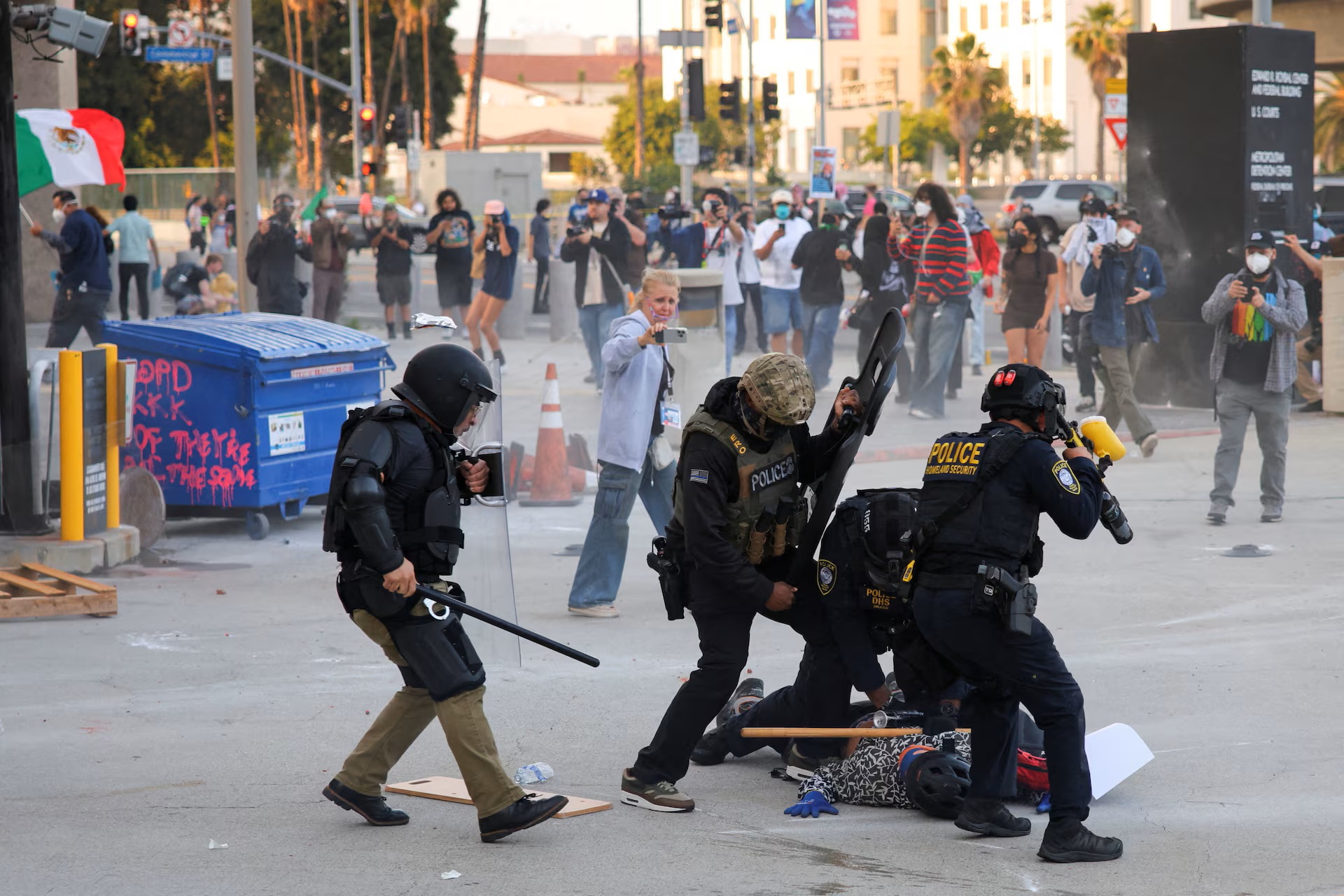

Two images of the protests taking place in Los Angeles

Donald Trump’s words are rarely accidental. His instinct for rhetorical impact—whether blunt force or performative affection—has always served a purpose: to reward loyalty, punish defiance, and bend public will to his own.
That contrast was on full display again this week.
Amid protests erupting across Los Angeles following sweeping ICE raids, Trump issued a public threat, then federalized 2,000 National Guard troops to respond to what he called “lawlessness.” His statement pulled no punches:
I do not condone burning cars in the streets. But Trump’s response wasn’t about restoring order—it was about asserting dominance. His message was a declaration of executive supremacy, dripping with contempt for state leadership. The tone was coercive and deliberately inflammatory. He didn’t just vow to enforce immigration law—he promised to crush protest with federal force, bypassing local authority entirely.
Now contrast that with Trump’s infamous remarks on January 6, 2021, as rioters stormed the U.S. Capitol in an attempt to overturn a democratic election:
“We love you. You’re very special.”

That message wasn’t about restoring order. It was about protecting his political faithful. The tone was gentle, even affectionate—offered to a crowd that had just smashed windows, injured police officers, and threatened lawmakers.
And long after the violence was over, after the deaths, the arrests, and the investigations, Trump didn’t condemn it. He doubled down. He referred to January 6 not as an illegal assault on democracy, but as “a day of love.”
The dissonance is impossible to ignore.
When immigrants protest and city leaders resist federal raids, Trump responds with the language of domination. But when armed extremists ransack the Capitol in his name, he offers validation and praise.
The through line in both moments is clear. Trump’s loyalty isn’t to the law—it’s to those who serve him. Resistance, even if legal or constitutional, is treated as betrayal. Conversely, loyalty, even if expressed through violence, is honored.
His California statement assumes that state authority must submit to federal force—particularly when that force aligns with his agenda. There’s no room for partnership, no tolerance for dissent. He mocks, then overrides.
On January 6, he did the opposite. Faced with a violent mob targeting democracy itself, he did not condemn. He coddled.
This isn’t just a tale of two crises. It’s a playbook. When people challenge Trump’s policies, he deploys force. When they uphold his power, he shows love.
And it raises a larger question: What kind of leadership praises insurrection while punishing protest?
Trump’s tone may shift—bluster in one moment, benevolence in the next—but the goal is constant: personal loyalty above democratic norms.
So when he says, “the Federal Government will step in and solve the problem… the way it should be solved,” he’s not just announcing a deployment. He’s warning any city or state that refuses to fall in line.
And when he says, “We love you,” or calls January 6 “a day of love,” he’s not offering calm. He’s offering thanks.
This isn’t about law and order. It never was.
It’s about power—and who gets to wield it without question. Trump governs not by principle but by proximity. If you’re close to him, you get a pass. If you resist, you get punished.
In Donald Trump’s America, loyalty isn’t earned—it’s enforced. And democracy is just an obstacle.
UPDATE:
A reader responded, writing, “I don’t see under the definition of a protest’ that includes the looting of stores, setting fires to private property, destroying police dept. property, defacing public property, and attacking innocent people with thrown objects. Isn’t that what war zones look like? Don’t Soldiers go to war zones?”
The reader is right to draw a clear line between peaceful protest and violence. The demonstrations in Los Angeles began peacefully, focused on immigration and ICE operations. But they quickly escalated in many areas into looting, arson, vandalism, assaults on officers, and blocked freeways—criminal acts that prompted the deployment of police who called for additional support. The response was to the violence, not the protest.
Since Friday, debate has followed over whether the President was justified in unilaterally calling in the state’s National Guard. When I wrote this commentary, events were still unfolding, and I did not have all the facts until the following day. No excuse. Next time, I’ll wait.
What stands out is the contrast. The President labeled the L.A. protesters “insurrectionists,” yet has repeatedly downplayed the January 6 attack–calling thousands of attackers, many who called for the hanging of Vice President Pence–“Patriots,” even describing January 6 as “a day of love.”
Let me be clear: All acts of violence should be called out for what they are—and addressed with the appropriate and lawful response they require.
Comments
Leave a Comment
Recent Commentaries
Same Price. Same War. Different Truth
March 25, 2026

Who Writes This Stuff: Jim or A.I.?
March 23, 2026
Loyalty vs. Conscience
March 19, 2026
When Will This Madness End!?
March 18, 2026

When Government Threatens the Truth
March 16, 2026
Separating Fact from Rhetoric
March 12, 2026
Lindsay Vonn’s Gold Medal Moment
March 12, 2026

Teaching an Algorithm Right from Wrong
March 9, 2026
Now, More Than Ever
March 6, 2026
Peace Is Not an Elective
March 2, 2026
Read More Articles
The Latest... And Sometimes Greatest
Revelations
In 1927, Sinclair Lewis gave America a character it did not want to recognize in the mirror: Elmer Gantry. Gantry is loud, magnetic, insatiable —...
February 26, 2026
The Story of Chips, and The Cost of Looking Away
It’s just a photograph: a wartime dog sitting alert, ears up, wearing a military harness. But the story about a World War II sentry dog...
February 23, 2026
It’s Time to Talk About Respect
A cancer has been growing in our national life, so embedded in our culture that we’ve stopped acknowledging it. In the 1940s and the decades...
February 18, 2026
Adversity and Perseverance
“How you climb a mountain is more important than reaching the top.”— Yvon Chouinard “Every new adjustment is a crisis in self-esteem”—Eric Hoffer “Retreat, Hell!...
February 16, 2026
Who Decides What’s Seen?
There are moments when a single arrest tells us more about the state of the country than a thousand speeches. The recent detention of Don...
February 12, 2026
The Death of Shame
Over the past several months, I’ve written commentaries revisiting moments in our history when individuals confronted serious challenges and rose to meet them — to...
February 9, 2026
I don’t see under the definition of a “Protest” that it includes the looting of stores, setting fires to private property, destroying the police dept. property, defacing public property, and attacking innocent people with thrown objects.
Isn’t that what war zones look like?
Don’t Soldiers go to war zones?
Joe S.