Published: November 24, 2025
By Jim Lichtman
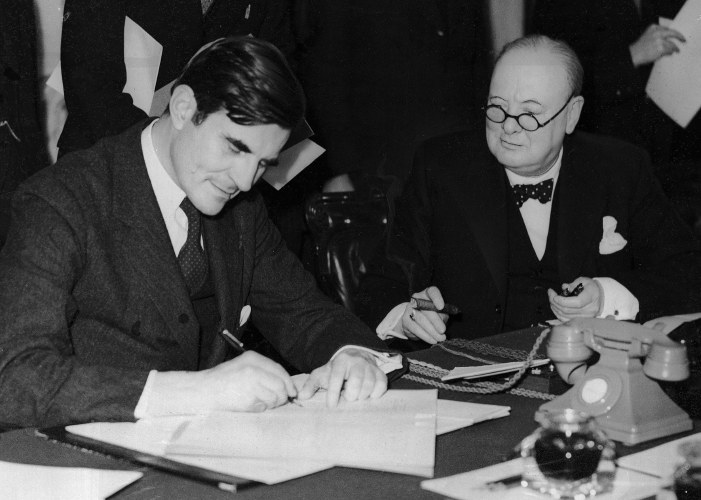
During his years in wartime London, U.S. Ambassador John Gilbert Winant absorbed the suffering around him. He was known for walking the streets during the Blitz, talking with ordinary people, sharing in their daily fears, helping to strengthen their resolve. Londoners remembered him for his compassion and accessibility. Historians consistently note how deeply he internalized the city’s suffering.
He carried the weight of something few ever see—holding the line between an American president and a British prime minister. Winant became the quiet bridge between Roosevelt’s deliberate caution and Churchill’s urgency and fire, steadying two powerful allies at a moment when the world couldn’t afford a crack in that partnership.
Winant was increasingly drawn into Churchill’s world, politically, and in ways he never expected, personally. Separated from his wife and carrying the weight of two nations’ hopes, he developed a close relationship with Churchill’s 27-year-old daughter, Sarah. Their friendship brought a brief light into a lonely stretch of his life. She was young and full of energy, everything that stood in contrast to his quiet steadiness. Their bond was real, but fragile. Winant hoped she might return with him to Concord, but she was still hungry for the stage and film, and wasn’t ready for anything like the modest life he proposed.
When he returned to America, Winant found no role that matched the weight of what he had lived through. Washington had moved on. The country had moved on. He had not. The qualities that made him shine in London—his decency, humility, and instinct for service—now left him out of step with a political world driven more by calculation than principle.
By the fall of 1947, professionally adrift and emotionally spent, Winant could no longer find his way back to the life he had left before the war. His death by his own hand that November was not only a personal tragedy but a loss to a country that never fully understood how much it owed him.
Republican Governor, Ambassador to the Court of St. James, confidant of Churchill and Roosevelt, John Gilbert Winant reminds us that moral leadership, honest, steady, humane, and unselfish, still carries power.
In spending time with his life and legacy, I’ve come not simply to appreciate Winant, but to honor him for his devotion to service and his unwavering faith in the better angels of our nature. Here was a man who, despite the overwhelming pressures of war, held fast to moral clarity, convincing two nations that freedom was not only possible but worth every sacrifice to defend.
Winant brought to Britain something no treaty could guarantee: a faith in the goodness of ordinary people, even in the darkest hours.
Next up: Winant delivers a Thanksgiving to remember.
Comments
Recent Commentaries
WHOSE PURPOSE DOES THIS SERVE?
October 9, 2026

Choreographer of Disaster
October 5, 2026
I Am Not a Politician, and I Have No Partisan Loyalties
October 2, 2026
A Man of Incorruptible Integrity
September 29, 2026

HUMAN VALUES: NOT SPECIFIED
September 23, 2026
You Can’t Do That.
September 21, 2026
I AM SICKENED
September 18, 2026
The Courage to Defend a Principle
September 17, 2026
The Better Angels Among Us
September 14, 2026

We Remember
September 11, 2026
Read More Articles
The Latest... And Sometimes Greatest
Mister Roberts!
One of my favorite movies is Mister Roberts, the 1955 comedy-drama set aboard the USS Reluctant in the Pacific during World War II. Henry Fonda...
September 8, 2026
Where’s the Character
In 1984, Wendy’s ran a television commercial featuring the redoubtable Clara Peller, staring at an enormous hamburger bun. Inside was a burger patty smaller than...
August 7, 2026
It Was Important Then. It is Important Today
Freedom of speech in America is under attack, not only when people are denied the right to speak, but when lies, intimidation and the deliberate...
August 3, 2026
When Political Identity Replaces Ethical Judgment
The political and cultural landscape has become a minefield of conflicting beliefs, many now rooted less in public policy than in personal identity. One of...
July 31, 2026
Principles Matter.
A few nights ago, I was watching The Way We Were, a film I’ve seen more times than I can count. This time, a single...
July 28, 2026
All the President’s Men 2.0
“Politics had infiltrated every corner of government—a strong-arm takeover of the agencies by the Nixon White House.” —Bob Woodward and Carl Bernstein, All the President’s...
July 23, 2026