Published: November 25, 2025
By Jim Lichtman
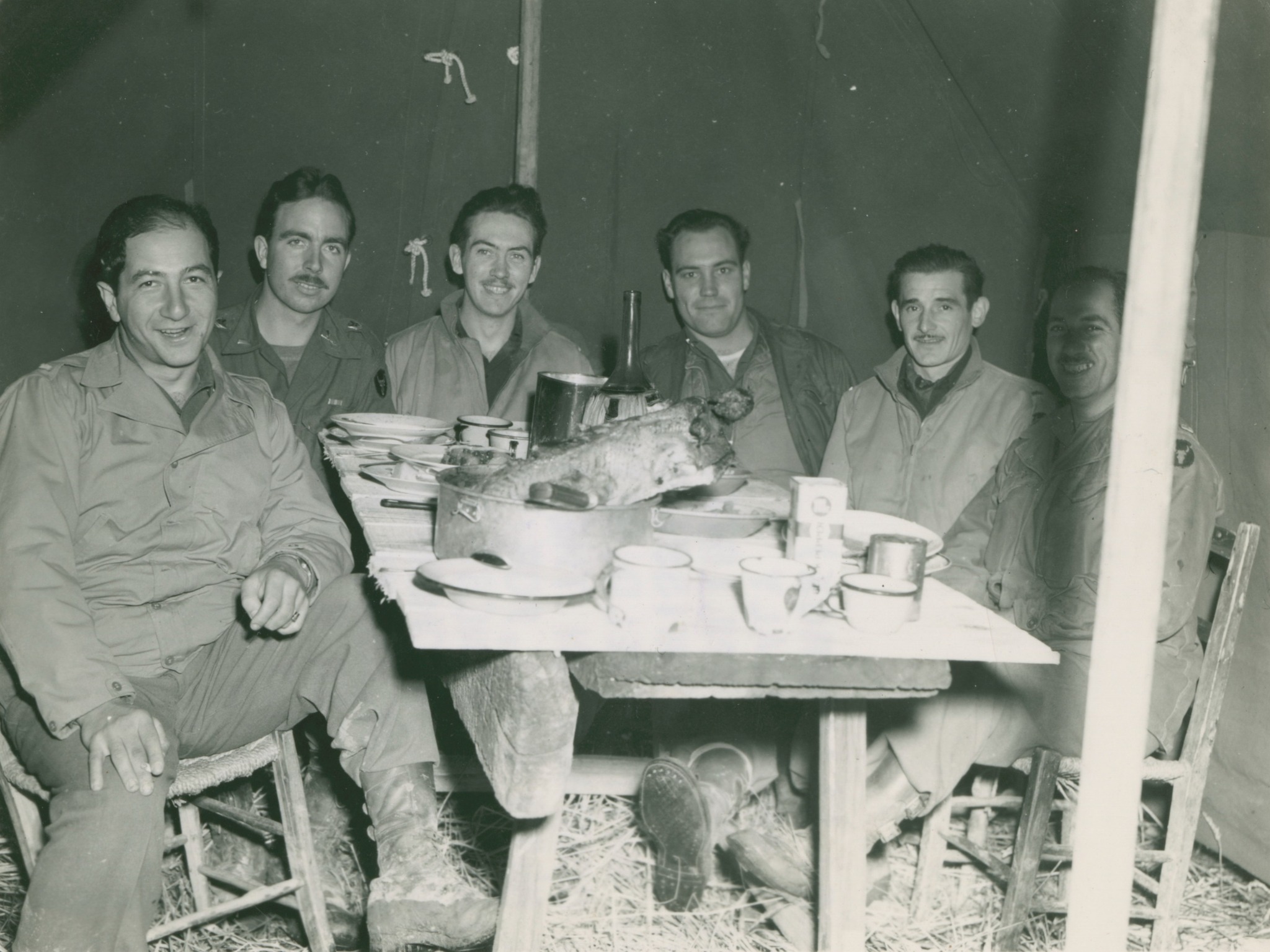
In a war that hammered away and left families lying awake at night counting the seconds between sirens, John Gilbert Winant, America’s ambassador to Britain, kept looking for ways to bring a little light into all that darkness.
As Thanksgiving approached, thousands of young Americans scattered across London felt the distance from home: no familiar table with family, just a cold meal in a battered city that swept broken glass off the sidewalks every morning. Winant understood that for many of them, the hardest part wasn’t the danger, it was the loneliness.
Under Winant’s direction, the U.S. Embassy opened its doors to any American serviceman who could make it there. There were no holiday closures, no restrictions, just a simple commitment that those fighting for their country deserved a place that reminded them of it. Hundreds of turkeys were shipped in (no small feat in a world run on ration books and perilous supply lines). Embassy staff worked nonstop preparing food. And as the crowd grew long, the gratitude grew louder.
Winant walked that line, greeting the men one by one, asking where they were from, looking them directly in the eye, and thanking them. What made it remarkable wasn’t just the food, but the quiet decency and kindness behind it. In the middle of a global crisis, he provided something deeply human: a place of belonging.
And that’s what stays with me as I move through the biographies and the speeches that reveal who he was.
Winant’s Thanksgiving wasn’t about sentimentality; it was about responsibility. He understood that a nation doesn’t stay strong because of its monuments. It stays strong because its people hold fast to the basic but essential obligations they owe each other, especially in difficult times: to tell the truth; treat others with respect; to look beyond themselves and consider the common good; and to step up when something is wrong. Simple commitments, but they’re what keep a free society from coming apart.
In a speech to British coal miners poised to strike over low pay, Winant’s words not only calmed the room but ended the strike.
“We must remember that it is the things of the spirit that in the end prevail. That caring counts. That where there is no vision, people perish. That hope and faith count, and that without charity there can be nothing good.”
In 1943, in a city dimmed by war, an American ambassador brightened the darkness just a little.
We could use that kind of brightness again.
Comments
Recent Commentaries
WHOSE PURPOSE DOES THIS SERVE?
October 9, 2026
Choreographer of Disaster
October 5, 2026
I Am Not a Politician, and I Have No Partisan Loyalties
October 2, 2026
A Man of Incorruptible Integrity
September 29, 2026

HUMAN VALUES: NOT SPECIFIED
September 23, 2026
You Can’t Do That.
September 21, 2026
I AM SICKENED
September 18, 2026
The Courage to Defend a Principle
September 17, 2026
The Better Angels Among Us
September 14, 2026
We Remember
September 11, 2026
Read More Articles
The Latest... And Sometimes Greatest
Mister Roberts!
One of my favorite movies is Mister Roberts, the 1955 comedy-drama set aboard the USS Reluctant in the Pacific during World War II. Henry Fonda...
September 8, 2026
Where’s the Character
In 1984, Wendy’s ran a television commercial featuring the redoubtable Clara Peller, staring at an enormous hamburger bun. Inside was a burger patty smaller than...
August 7, 2026
It Was Important Then. It is Important Today
Freedom of speech in America is under attack, not only when people are denied the right to speak, but when lies, intimidation and the deliberate...
August 3, 2026
When Political Identity Replaces Ethical Judgment
The political and cultural landscape has become a minefield of conflicting beliefs, many now rooted less in public policy than in personal identity. One of...
July 31, 2026
Principles Matter.
A few nights ago, I was watching The Way We Were, a film I’ve seen more times than I can count. This time, a single...
July 28, 2026
All the President’s Men 2.0
“Politics had infiltrated every corner of government—a strong-arm takeover of the agencies by the Nixon White House.” —Bob Woodward and Carl Bernstein, All the President’s...
July 23, 2026