Published: November 30, 2011
By Jim Lichtman
On Friday, November 4, Central Pennsylvania’s Patriot-Newswas the first to break the story on allegations of sex abuse on at least 8 young boys by former Penn State football coach Jerry Sandusky that go back as far as 1998. In ’02, staffer Mike McQueary personally witnessed another attack by Sandusky.
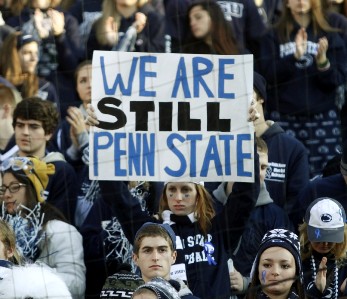
Since that time, anyone with a microphone, camera crew or blog has inundated the media with details – the most surprising of which turned out to be that head coach Joe Paterno failed to contact local police when he learned of the incident. In a matter of days we go from Paterno’s statement of deep regret to a statement by the University’s Board in which both Paterno and University President Graham Spanier are fired.
In 2005, the same year I was speaking at Penn State on ethics, the university’s standards and conduct officer, Vicky Triponey had e-mailed president Spanier saying, “The Coach is insistent he knows best how to discipline his players… I think he was saying we should treat football players different from other students in this regard.”
During the Q&A portion of my talk, not a single question was raised by students, teachers or administrators concerning any of these allegations. Not the slightest hint of scandal was mentioned. And this is typical. When allegations of misconduct occur within organizations, the usual response is to close ranks, protect the reputation of the organization and deal with the consequences internally and quietly… very quietly.
Sadly, history has shown us that whenever serious conduct violations are exposed, the cover-up becomes as bad as the crime.
So, what can we learn from the Penn State scandal?
Everyone thinks it can’t happen to them until it does.Never think, for a moment, that you can get by on your sterling reputation alone. Paterno and officials at Penn State were guilty of moral hubris.
No one is above the rules. An ethical person chooses to do more than the law requires and less than the law allows. Although McQueary and Paterno both followed the legal rules by reporting the incident up the university chain, they should have taken the additional steps to go to the police with what they knew. How many other young boys might have been spared abuse had they done so?
Everyone makes mistakes. Admit them as soon as possible, because if you don’t someone else will, eventually. Take corrective actions for all stakeholders involved. Work to the best of your ability to put measures in place to insure that mistakes are not repeated.
Appoint an ethical ombudsman, someone students, administrators and teachers can contact regarding any issue that comes up. Interim president Rodney Erickson has announced this step.
Erickson said that the scandal is “a tragedy for many lives and it will take all of us some time to come to grips with the full magnitude of the damage that has been done.” But, he added, “I want all Penn Staters to know that our future is still bright [and that] our core values … will define this university long after we’ve gone. [Those values:] honesty, integrity, excellence and community.”
However, ethical values are not just another set of values on an organization’s Mission Statement. They should be treated as ground rules by which you pursue all your other values in terms of the way you treat students, teachers, administrators, trustees, everyone.
On-going ethics training: for all teachers, administrators and staff.
Ethicist Michael Josephson reminds us of the three C’s of ethics: Commitment, Consciousness and Competency.
“First, let’s enhance ethical commitment by pointing out the practical benefits of trusting relationships.
“Second, let’s increase the consciousness of ethics by considering the consequences of choices in terms of ‘stakeholders.’ Who will be helped or harmed by the action? Determine whether a decision will violate any of your core ethical values, or principles.
“Third, let’s stress competent, moral reasoning. Evaluate facts in light of ethical principles. Distinguish facts from informed opinions, speculation or assumptions. And try – to the best of your ability – to anticipate any possible unintended consequences.”
If we are ever going to return to a higher standard of leadership, we need to understand that ethics is not about what we say or what we intend, it’s about what we do. How we utilize our principles in small ways, as well as those that challenge the courage of our convictions, will, ultimately determine the purpose and course of our lives.
Yes, they are still Penn State, but the shame surrounding the school will remain for some time to come.
Comments

Recent Commentaries
I Am Not a Politician, and I Have No Partisan Loyalties
October 2, 2026
A Man of Incorruptible Integrity
September 29, 2026

HUMAN VALUES: NOT SPECIFIED
September 23, 2026
You Can’t Do That.
September 21, 2026
I AM SICKENED
September 18, 2026
The Courage to Defend a Principle
September 17, 2026
The Better Angels Among Us
September 14, 2026

We Remember
September 11, 2026
Mister Roberts!
September 8, 2026

Where’s the Character
August 7, 2026
Read More Articles
The Latest... And Sometimes Greatest
It Was Important Then. It is Important Today
Freedom of speech in America is under attack, not only when people are denied the right to speak, but when lies, intimidation and the deliberate...
August 3, 2026
When Political Identity Replaces Ethical Judgment
The political and cultural landscape has become a minefield of conflicting beliefs, many now rooted less in public policy than in personal identity. One of...
July 31, 2026
Principles Matter.
A few nights ago, I was watching The Way We Were, a film I’ve seen more times than I can count. This time, a single...
July 28, 2026
All the President’s Men 2.0
“Politics had infiltrated every corner of government—a strong-arm takeover of the agencies by the Nixon White House.” —Bob Woodward and Carl Bernstein, All the President’s...
July 23, 2026
The Threat to November Is Already Here
“Cunning, ambitious, and unprincipled men will be enabled to subvert the power of the people and to usurp for themselves the reins of government.”—George Washington’s...
July 20, 2026
Jon Ossoff and the Conscience of Atticus Finch
I’ve written about Georgia Senator Jon Ossoff before, but after watching his questioning of Jay Clayton, President Trump’s nominee for director of national intelligence (DNI),...
July 17, 2026