Published: November 20, 2009
By Jim Lichtman
There’s a scene late in the film The Emperor’s Club when William Hundert, a teacher who believes that character is the path to true success, dispenses a final lesson to an errant student.
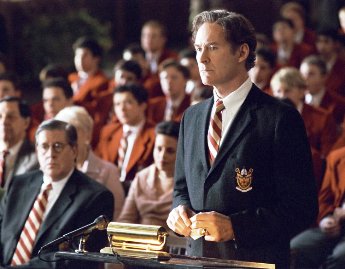
“All of us, at some point,” Hundert tells an older but no wiser Sedgewick Bell, “are forced to look at ourselves in the mirror and see who we really are.”
Earlier, Hundert faced his own moment in the mirror when he changed the grade on Bell’s final freshman essay allowing the student to compete in an academic contest. At the time, Hundert rationalized his choice believing that this means would offer the troubled Bell the chance to rise to both academic and ethical excellence.
So, does the end justify the means?
My own teacher, Michael Josephson, would call Hundert’s actions consistent with the doctrine of consequentialism. A theory “based on the notion that the ethics of an act is best determined by the consequences produced. Consequence-based decision making models allow the ethical person to evaluate competing ethical values in terms of likely and intended results.”
In short: the end result can justify the action taken even if that action may be ethically questionable.
I was thinking about this in comparing and contrasting two recent events. Board members for The New Museum for Contemporary Art in New York approved the loan of a substantial art collection by one of their own trustees for a major exhibition to be held at the museum. Even though the result of the action serves to benefit the public in seeing works that have never been shown in the United States, the ethically questionable action would also allow one of their own trustees to benefit by enhancing the value of his collection particularly if he chooses to sell or donate any or all of it.
“The major shortcoming of pure consequentialism,” Josephson points out, “is the ease with which it can be manipulated by self-serving rationalizations to produce situational ethics and an ‘end justifies the means’ credo which elevates expediency over principle.”
However, there are times when consequentialism works.
Freshman Representative Joseph Cao was the lone Republican to vote in favor of the House version of the Health Care bill. “I felt last night’s decision was the right decision,” Cao said, “even though it was not the popular decision for my party. At the end of the day, I had to make a decision of conscience based on the needs of the people in my district.”
Whether you agree or disagree with the health care bill is not the point. Cao put his principles and the needs of his constituents before the needs of his party and his own political career.
That’s the kind of decision Professor Hundert would offer up as example of living a life of principle; for at the end of the day, when faced with the difficult choices that ultimately come our way, it is our principles, or lack thereof, that will determine who we really are.
Comments


Recent Commentaries

November 4, 2026
October 20, 2026

Has America Lost Its Way?
October 16, 2026

All The President’s Targets
October 13, 2026
Integrity Doesn’t Require a Megaphone
October 12, 2026

WHOSE PURPOSE DOES THIS SERVE?
October 9, 2026

Choreographer of Disaster
October 5, 2026
I Am Not a Politician, and I Have No Partisan Loyalties
October 2, 2026

A Man of Incorruptible Integrity
September 29, 2026

HUMAN VALUES: NOT SPECIFIED
September 23, 2026

You Can’t Do That.
September 21, 2026
Read More Articles
The Latest... And Sometimes Greatest
I AM SICKENED
Tonight, protesters are surrounding the Kennedy Center, the living memorial to John F. Kennedy and the heartbeat of Washington’s cultural life. They are there because...
September 18, 2026
The Courage to Defend a Principle
In 1998, at the height of the Clinton-Lewinsky scandal, Secret Service Director Lewis Merletti was driving to work when a radio report stopped him cold....
September 17, 2026
The Better Angels Among Us
By all appearances, we are becoming less the land of the brave than the land of resentment. Every day is Groundhog Day: same arguments, same...
September 14, 2026
We Remember
On September 11, 2001, nearly 3,000 people were killed in terrorist attacks in New York, at the Pentagon, and aboard Flight 93 in Pennsylvania. More...
September 11, 2026
Mister Roberts!
One of my favorite movies is Mister Roberts, the 1955 comedy-drama set aboard the USS Reluctant in the Pacific during World War II. Henry Fonda...
September 8, 2026
Where’s the Character
In 1984, Wendy’s ran a television commercial featuring the redoubtable Clara Peller, staring at an enormous hamburger bun. Inside was a burger patty smaller than...
August 7, 2026