Published: January 25, 2012
By Jim Lichtman
That was the front page headline on the Concord (New Hampshire) Monitor, Tuesday, January 17.
One day earlier, Professor Stephen Ambra and I screened the film Good Night and Good Luck about the journalistic stand news icon Edward R. Murrow took against Senator Joseph McCarthy’s 1950s “Red” scare tactics. The film was part of ourContemporary Ethical Issues class at the New Hampshire Technical Institute. The post-film discussion focused on the responsibilities of journalism – both then and now.
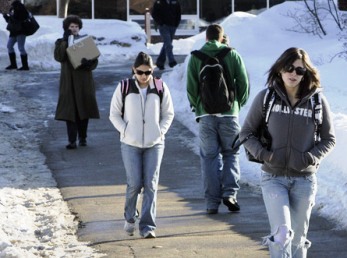
At the end of the day, a reporter from the Monitor showed up to interview students regarding pending state legislation that would allow weapons on college campuses throughout the state.“NHTI class debates weapon ban’s end,” writes reporter Sarah Palermo. “Ask an ethics class a question and be prepared for debate. Back and forth, forth and back, students in the applied ethics class at NHTI pondered, debated and postulated…”
Now, I was there when the reporter showed up to interview several students at the end of our scheduled class. She asked permission to speak with the students about the pending gun legislation and Steve and I agreed. However, after reading the article the following day, I decided that this was an opportunity to follow-up on our “responsibility and the press” discussion.
I read the headline and opening and asked students if they found any problems. Several pointed out that the opening implied that the class, as a whole, had a discussion about the gun issue. We had not.
I read through the balance of the story, asking those students who were quoted if their statements were, in fact, accurate. They agreed, however, one student pointed out that the reporter began recording her interview without first asking. “It would have been respectful,” the student said, “if she had asked us first.”
Another student, familiar with reporters, added that “When you see a reporter openly place a recording device in front of you, you know you’re going to be recorded.” Most of the class agreed, but several favored good manners.
Near the end of the news story, however, another student was quoted as saying, “an armed society is a polite society.”
While he acknowledged making the statement, he was concerned. “Those aren’t my feelings. [The reporter] made it sound like I was in favor of the legislation and I’m not!”
Two other individuals confirmed that this was, in fact, a mischaracterization of the student’s position.
“Is anyone familiar,” I asked, “with a newspaper’s policy when it comes to accurately reporting an individual’s statement?”
One student mentioned that she had been an intern at a local paper and that it was important to get both the words and position of anyone interviewed correct.
At the end of our discussion, I pointed out that the article listed the reporter’s email and phone number. “Do you think we should contact the reporter about the inaccuracies?” I asked.
Most of the class agreed, but no one volunteered to write or call. I asked the student who had been misrepresented if he was interested in contacting the reporter.
“No, not really,” he said.
“Would you mind if I did?” I asked.
“No problem.”
Later that day, I spoke with Sarah Palermo at the Monitor and relayed the points made by the class. She listened and thanked me.
The next day, the paper printed a correction regarding the mischaracterization as well as the false impression that the topic was discussed during class. After reading the corrections to the class, they applauded the fact that the reporter promptly corrected the errors.
While the class believed the reporter’s mistake was an honest one, the message was clear: it’s important to hold the media or anyone else accountable for errors whether intentional or not.
Comments

Recent Commentaries
I Am Not a Politician, and I Have No Partisan Loyalties
October 2, 2026
A Man of Incorruptible Integrity
September 29, 2026

HUMAN VALUES: NOT SPECIFIED
September 23, 2026
You Can’t Do That.
September 21, 2026
I AM SICKENED
September 18, 2026
The Courage to Defend a Principle
September 17, 2026
The Better Angels Among Us
September 14, 2026
We Remember
September 11, 2026
Mister Roberts!
September 8, 2026
Where’s the Character
August 7, 2026
Read More Articles
The Latest... And Sometimes Greatest
It Was Important Then. It is Important Today
Freedom of speech in America is under attack, not only when people are denied the right to speak, but when lies, intimidation and the deliberate...
August 3, 2026
When Political Identity Replaces Ethical Judgment
The political and cultural landscape has become a minefield of conflicting beliefs, many now rooted less in public policy than in personal identity. One of...
July 31, 2026
Principles Matter.
A few nights ago, I was watching The Way We Were, a film I’ve seen more times than I can count. This time, a single...
July 28, 2026
All the President’s Men 2.0
“Politics had infiltrated every corner of government—a strong-arm takeover of the agencies by the Nixon White House.” —Bob Woodward and Carl Bernstein, All the President’s...
July 23, 2026
The Threat to November Is Already Here
“Cunning, ambitious, and unprincipled men will be enabled to subvert the power of the people and to usurp for themselves the reins of government.”—George Washington’s...
July 20, 2026
Jon Ossoff and the Conscience of Atticus Finch
I’ve written about Georgia Senator Jon Ossoff before, but after watching his questioning of Jay Clayton, President Trump’s nominee for director of national intelligence (DNI),...
July 17, 2026