Published: December 2, 2020
By Jim Lichtman
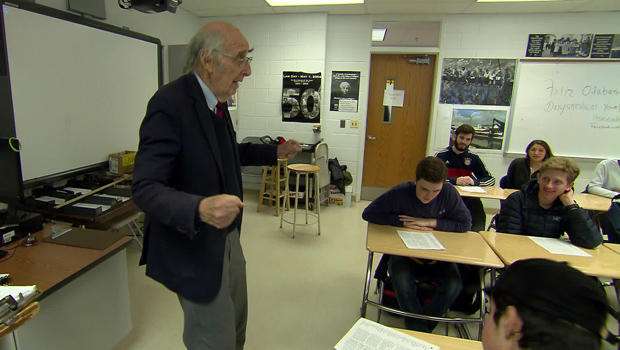
In his Peace Studies class at Bethesda-Chevy Chase High School, Colman McCarthy engages students in his chosen religion: nonviolence and peace.
“If peace is what every government says it seeks,” McCarthy writes, “and peace is the yearning of every heart, why aren’t we studying it and teaching it in school?”
In Reverend McCarthy’s weekly sermon, “studying peace through nonviolence is as much about getting the bombs out of our hearts as it is about getting them out of the Pentagon budget.”
And that is precisely the purpose of his high school class. (It’s a shame that Pentagon officials don’t attend his class. They might actually learn how to cut the arms budget.)
Regardless, McCarthy has enlisted guest speakers from Nobel laureates to the school’s cleaning lady who fled El Salvador. All have something to teach the class. All are volunteers, just like McCarthy who doesn’t receive a paycheck for his work.
“Students,” McCarthy writes, “or at least the wary ones, often say they are glad former flower children like me occasionally turn up on college faculties, but in the real world nonviolence won’t work and hasn’t worked. Look what happened, they say, to Jesus, Gandhi, King, and a lot of other pacifists.
“I answer with the only honest reply available. Nonviolence is a risky philosophy to live by. It is no guarantee of safety. All that can be said of it is that it’s less a failure than violence. Those who prefer violent force,” McCarthy stresses, “must justify the deaths of this century’s 78 million war victims. The number is a 500 percent increase over the last century.”
A recent profile on CBS Sunday Morning has moved McCarthy’s religion of peace back onto the front burner of our attention. And considering all the fire and dysfunction that defines our nation’s capital, we need lawmakers who understand that the only way we can even begin to bridge the divide in the country is through peace.
“We can’t become what we need to be by remaining what we are,” Oprah Winfrey says. And Colman McCarthy instructs his students in becoming what we all need to be: peacemakers.
While McCarthy may be facing an uphill battle, he causes his students to think — think about their responsibility, not only to their local community but the the world community.
At the beginning of each semester, McCarthy asks his students if they can identify the following: U.S. Grant, Robert E. Lee, Dwight Eisenhower, George Patton, William Westmoreland, Jane Adams, Jeannette Rankin, A.J. Muste, Adin Ballou and Dorothy Day.
“All can identify the first five,” McCarthy says, “but it’s rare if anyone knows the second five, all believers or practitioners of nonviolence.”
I would add one more name to that list: Colman McCarthy.
Comments
Leave a Comment
Recent Commentaries
WHOSE PURPOSE DOES THIS SERVE?
October 9, 2026
Choreographer of Disaster
October 5, 2026
I Am Not a Politician, and I Have No Partisan Loyalties
October 2, 2026
A Man of Incorruptible Integrity
September 29, 2026

HUMAN VALUES: NOT SPECIFIED
September 23, 2026

You Can’t Do That.
September 21, 2026
I AM SICKENED
September 18, 2026
The Courage to Defend a Principle
September 17, 2026
The Better Angels Among Us
September 14, 2026
We Remember
September 11, 2026
Read More Articles
The Latest... And Sometimes Greatest
Mister Roberts!
One of my favorite movies is Mister Roberts, the 1955 comedy-drama set aboard the USS Reluctant in the Pacific during World War II. Henry Fonda...
September 8, 2026
Where’s the Character
In 1984, Wendy’s ran a television commercial featuring the redoubtable Clara Peller, staring at an enormous hamburger bun. Inside was a burger patty smaller than...
August 7, 2026
It Was Important Then. It is Important Today
Freedom of speech in America is under attack, not only when people are denied the right to speak, but when lies, intimidation and the deliberate...
August 3, 2026
When Political Identity Replaces Ethical Judgment
The political and cultural landscape has become a minefield of conflicting beliefs, many now rooted less in public policy than in personal identity. One of...
July 31, 2026
Principles Matter.
A few nights ago, I was watching The Way We Were, a film I’ve seen more times than I can count. This time, a single...
July 28, 2026
All the President’s Men 2.0
“Politics had infiltrated every corner of government—a strong-arm takeover of the agencies by the Nixon White House.” —Bob Woodward and Carl Bernstein, All the President’s...
July 23, 2026
Yes Jim, we could all learn from these peacemakers: Colman McCarthy, Jane Adams, Jeannette Rankin, A.J. Muste, Adin Ballou and Dorothy Day.
An inspiring commentary about a remarkable individual; thanks!