Published: April 23, 2018
By Jim Lichtman
Barbara Bush died last week. The 92-year old former first lady had been struggling for the last few years with health issues, and when the family recently announced that she would not seek further medical treatment, the disclosure of her death did not come as a surprise.
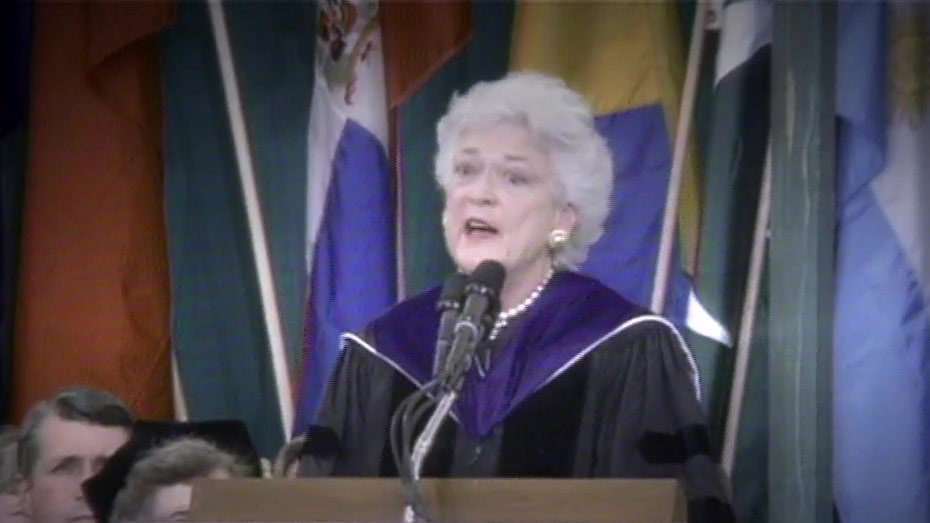
Peggy Noonan, former speech writer to Ronald Reagan, wrote (Apr. 21), that “Barbara Bush reminded us how normal American political figures used to act before this garish age.”
Former Florida Governor Jeb Bush, whom Mrs. Bush selected to give the official family eulogy, said of his mother, “She was our teacher and role model on how to live a life of purpose and meaning.”
“Susan Baker,” The Washington Post reported (Apr. 21), “the wife of former secretary of state James Baker and Barbara Bush’s longtime friend and confidante, called her a ‘vibrantly beautiful human being.’ ”
While all the tributes were both accurate and heartwarming, they’re also a reminder of how much has changed in political discourse.
Mrs. Bush will be remembered for teaching all of us just how to behave as she did in her commencement address to Wellesley College, June 1, 1990. One part of that speech remains particularly relevant today.
“Wellesley, you see, is not just a place,” Bush said, “but an idea … an experiment in excellence in which diversity is not just tolerated but is embraced.
“The essence of this spirit was captured in a moving speech about tolerance given last year by a student body president of one of your sister colleges. She related the story by Robert Fulghum about a young pastor, finding himself in charge of some very energetic children, hits upon a game called Giants, Wizards, and Dwarfs. ‘You have to decide now,’ the pastor instructed the children, ‘which you are … a giant, a wizard or a dwarf?’
“At that, a small girl tugging at his pants leg, asked, ‘But where do the mermaids stand?’
“The pastor tells her there are no mermaids.
” ‘Oh yes there are,’ she said. ‘I am a mermaid.’
“Now this little girl knew what she was, and she was not about to give up on either her identity or the game. She intended to take her place wherever mermaids fit into the scheme of things. Where do mermaids fit into the scheme of things? Where do mermaids stand … all of those who are different, those who do not fit the boxes and the pigeonholes? ‘Answer that question,’ wrote Fulghum, ‘and you can build a school, a nation or a whole world.’
“As that very wise young woman said,” Bush concluded, ” ‘Diversity … like anything worth having … requires effort.’ Effort to learn about and respect difference, to be compassionate with one another, to cherish our own identity … and to accept unconditionally the same in others.”
The Constitution and Bill of Rights enumerate what “We, the people” believe in, but something more, something that can be found when we read between the lines of those documents through the optics of history — from individual rights to Civil Rights, women’s rights to Gay rights — we have a corresponding responsibility to treat others with honesty, respect, decency, tolerance and fairness.
While we may disagree about the details on issues, the thing that distinguishes us as Americans is that we endeavor to “hold these truths to be self-evident: that all men [and women] are created equal…”
And when we face the harsh realities of dissent, as we have in the past and will continue to do so in the future, “We must,” as former New York Governor Mario Cuomo said, “get the American public to look past the glitter, beyond the showmanship, to the reality, the hard substance of things. And we’ll do it not so much with speeches that will bring people to their feet as with speeches that bring people to their senses.”
If we wish to succeed as a country, let’s try to come together as Americans first, recognizing that we are bound together not only as a country of ideals but a set of principles that remind us that we can always do better.
As for me, I stand with the mermaids.
Comments


Recent Commentaries
I Am Not a Politician, and I Have No Partisan Loyalties
October 2, 2026
A Man of Incorruptible Integrity
September 29, 2026

HUMAN VALUES: NOT SPECIFIED
September 23, 2026
You Can’t Do That.
September 21, 2026
I AM SICKENED
September 18, 2026
The Courage to Defend a Principle
September 17, 2026
The Better Angels Among Us
September 14, 2026
We Remember
September 11, 2026
Mister Roberts!
September 8, 2026
Where’s the Character
August 7, 2026
Read More Articles
The Latest... And Sometimes Greatest
It Was Important Then. It is Important Today
Freedom of speech in America is under attack, not only when people are denied the right to speak, but when lies, intimidation and the deliberate...
August 3, 2026
When Political Identity Replaces Ethical Judgment
The political and cultural landscape has become a minefield of conflicting beliefs, many now rooted less in public policy than in personal identity. One of...
July 31, 2026
Principles Matter.
A few nights ago, I was watching The Way We Were, a film I’ve seen more times than I can count. This time, a single...
July 28, 2026
All the President’s Men 2.0
“Politics had infiltrated every corner of government—a strong-arm takeover of the agencies by the Nixon White House.” —Bob Woodward and Carl Bernstein, All the President’s...
July 23, 2026
The Threat to November Is Already Here
“Cunning, ambitious, and unprincipled men will be enabled to subvert the power of the people and to usurp for themselves the reins of government.”—George Washington’s...
July 20, 2026
Jon Ossoff and the Conscience of Atticus Finch
I’ve written about Georgia Senator Jon Ossoff before, but after watching his questioning of Jay Clayton, President Trump’s nominee for director of national intelligence (DNI),...
July 17, 2026