Published: June 6, 2019
By Jim Lichtman
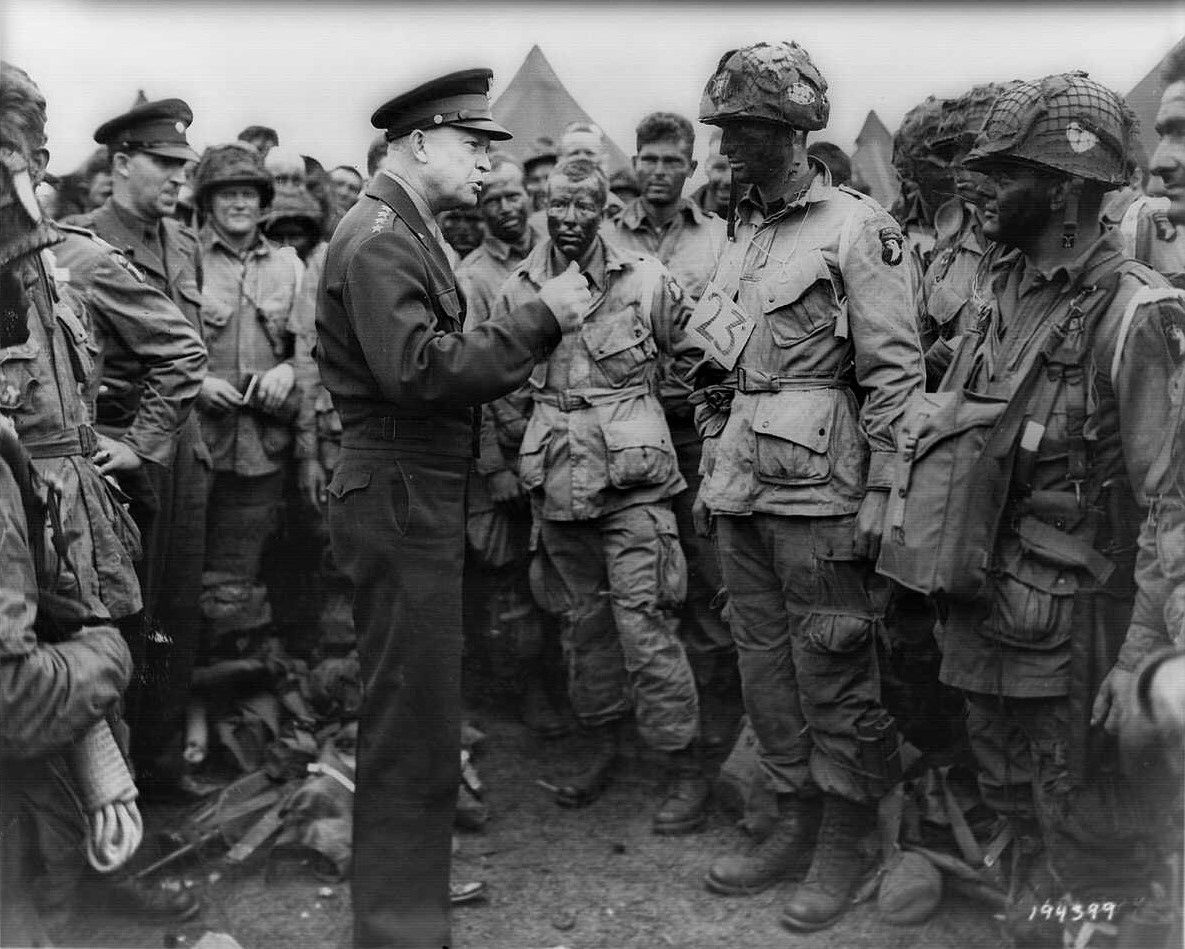
Photo: Library of Congress
June 5, 1944, Allied Supreme Commander General Dwight D. Eisenhower had under his command the largest invasion task-force in history: 175,000 British, American and Canadian assault troops; 5,000 vessels; 20,000 vehicles; and 11,000 aircraft.
His directive –
“You will enter the continent of Europe and, in conjunction with the other United Nations, undertake operations aimed at the heart of Germany and the destruction of her armed forces. The date for entering the Continent is the month of May, 1944. After adequate channel ports have been secured, exploitation will be directed towards securing an area that will facilitate both ground and air operations against the enemy.”
The Allied invasion of Europe took place 75 years ago this day under thick clouds and rough seas.
Despite years of planning, Eisenhower – the 53-year old general everyone called Ike – told a paratrooper, “I’ve done all I can. Now it’s up to you.”
He told his driver, Kay Summersby, “I hope to God I’m right.”
History records that, despite terrible losses on the beaches at Normandy, the Allies did succeed.
However, history records another little-known story of a pencil-scribbled speech Eisenhower had prepared on June 4 in the event the invasion failed, as Scott Simon relates in a story on NPR (June 8, 2013).
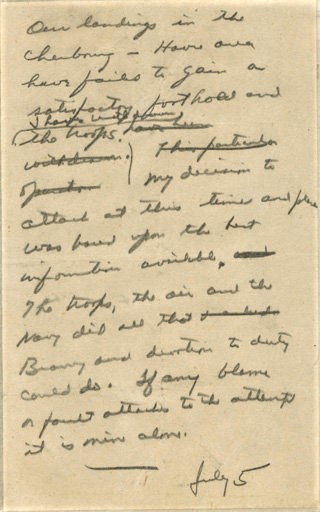
The Dwight D. Eisenhower Presidential Library said that the president mistakenly dated the message July 5 instead of June 5.
“Our landings in the Cherbourg-Havre area have failed to gain a satisfactory foothold and I have withdrawn the troops,” Eisenhower wrote. “My decision to attack at this time and place was based upon the best information available. The troops, the air and the Navy did all that bravery and devotion to duty could do. If any blame or fault attaches to the attempt it is mine alone.”
Eisenhower’s succinct and humble words, reveal the character of a leader. Note that he says, “My decision,” and “If any blame or fault attaches to the attempt it is mine alone.” He takes full responsibility for any possible failure.
“Eisenhower,” Simon writes, “put the note in his wallet” and moved on with the task in front of him, “…Germany and the destruction of her armed forces.” It didn’t end until the liberation of France on August 25, 1944.
Comments
Leave a Comment


Recent Commentaries
All The President’s Targets
October 13, 2026
Integrity Doesn’t Require a Megaphone
October 12, 2026
WHOSE PURPOSE DOES THIS SERVE?
October 9, 2026

Choreographer of Disaster
October 5, 2026
I Am Not a Politician, and I Have No Partisan Loyalties
October 2, 2026
A Man of Incorruptible Integrity
September 29, 2026

HUMAN VALUES: NOT SPECIFIED
September 23, 2026

You Can’t Do That.
September 21, 2026

I AM SICKENED
September 18, 2026
The Courage to Defend a Principle
September 17, 2026
Read More Articles
The Latest... And Sometimes Greatest
The Better Angels Among Us
By all appearances, we are becoming less the land of the brave than the land of resentment. Every day is Groundhog Day: same arguments, same...
September 14, 2026
We Remember
On September 11, 2001, nearly 3,000 people were killed in terrorist attacks in New York, at the Pentagon, and aboard Flight 93 in Pennsylvania. More...
September 11, 2026
Mister Roberts!
One of my favorite movies is Mister Roberts, the 1955 comedy-drama set aboard the USS Reluctant in the Pacific during World War II. Henry Fonda...
September 8, 2026
Where’s the Character
In 1984, Wendy’s ran a television commercial featuring the redoubtable Clara Peller, staring at an enormous hamburger bun. Inside was a burger patty smaller than...
August 7, 2026
It Was Important Then. It is Important Today
Freedom of speech in America is under attack, not only when people are denied the right to speak, but when lies, intimidation and the deliberate...
August 3, 2026
When Political Identity Replaces Ethical Judgment
The political and cultural landscape has become a minefield of conflicting beliefs, many now rooted less in public policy than in personal identity. One of...
July 31, 2026
We need more leaders like Ike. Thanks for the great article, Jim.