Published: September 14, 2018
By Jim Lichtman
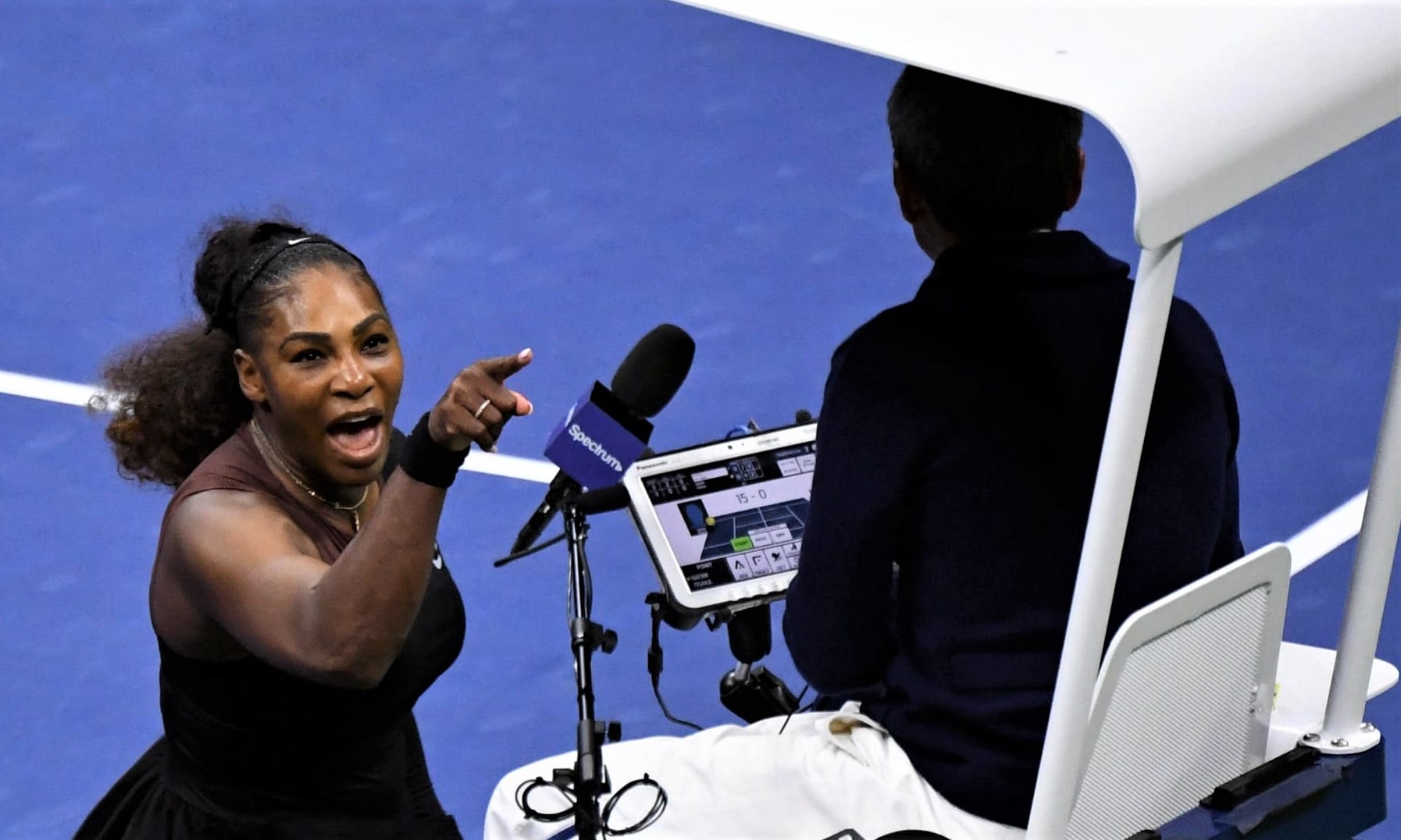
Last Saturday’s U.S. Open Women’s final should have been an incredible moment for Japan’s Naomi Osaka. It wasn’t, thanks to some excessive anger by a professional who should know better.
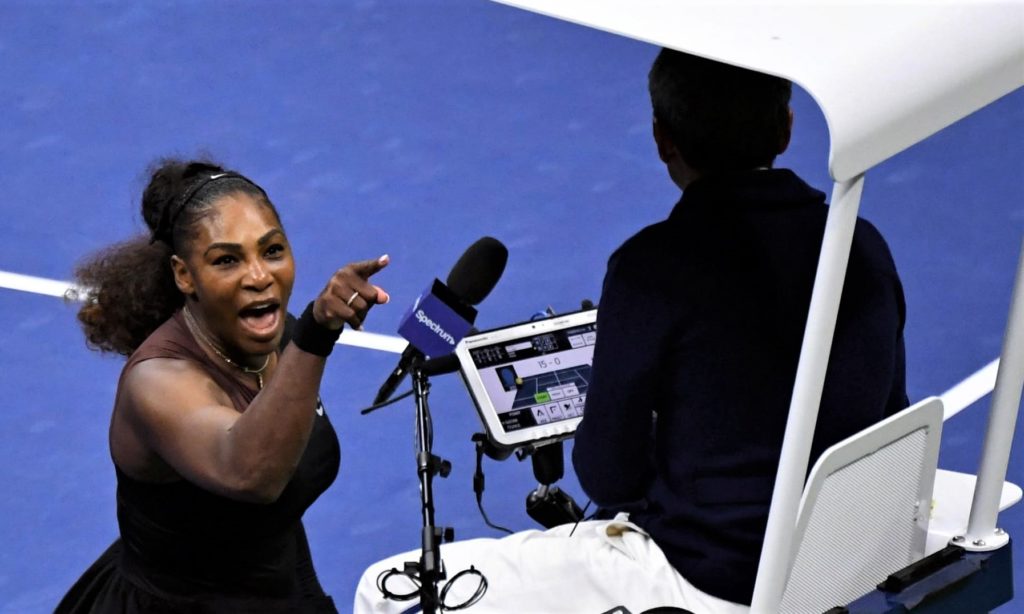
The 20-year old Osaka, soft-spoken and shy, was in tears after winning the match on what Williams and others have labeled a double-standard by chair umpire Carlos Ramos when he called Williams on three violations: coaching signals from the sidelines, slamming her racket into the court, and verbally bullying the umpire.
Osaka had taken the first set 6-2 and was leading in the second when Ramos gave a warning to Williams for coaching from the sidelines. (Williams’ coach, Patrick Mouratoglou, later admitted to the offense.)
However, “A few games later,” New York Times reporter Ben Rothenberg writes (Sept. 9), “Williams slammed her racket and broke it. That garnered a penalty point in Osaka’s favor. Still steaming from the previous warning, Williams fumed at the chair umpire and, as tensions rose on the court and in the crowd, she received a game penalty that gave Osaka a 5-3 lead, one game from the title.”
Things quickly deteriorated.
While Williams, and supporters in the crowd were clearly unhappy, most could not hear what was transpiring on the court. The U.K’s Daily Mail (Sept. 9), supplies this transcript.
After being penalized for throwing her racket early in the second set:
“This is unbelievable. Every time I play here, I have problems.
“I didn’t get coaching, I didn’t get coaching. I didn’t get coaching. You need to make an announcement that I didn’t get coaching. I don’t cheat, I didn’t get coaching. How can you say that?
“You owe me an apology. You owe me an apology. I have never cheated in my life. I have a daughter and I stand for what is right for her and I’ve never cheated. You owe me an apology.”
After losing her service game to trail 4-3 in the second set:
“I never got coaching. I explained that to you and for you to attack my character, then something is wrong. You’re attacking my character. Yes, you are. You owe me an apology.
“You will never, ever, ever be on another court of mine as long as you live. You are the liar. When are you going to give me my apology? You owe me an apology.
“Say it, say you’re sorry. Then don’t talk to me, don’t talk to me. How dare you insinuate I was cheating? You stole a point from me. You’re a thief, too.”
After being docked a game:
“Are you kidding me? Are you kidding me? Because I said you were a thief? You stole a point from me. I’m not a cheater. I told you to apologize to me. Excuse me, I need the referee, I don’t agree with that.”
With tournament referees:
“This is not right… [INAUDIBLE]… He said I was being coached but I was not being coached. That’s not right. You know me. You know my character. This is not fair. This has happened to me too many times. This is not fair. To lose a game for saying that is not fair. Do you know how many men do things that are much worse than that? This is not fair. …
At the post-match press conference:
“…I’ve seen other men call other umpires several things. I’m here fighting for women’s rights and for women’s equality and for all kinds of stuff. For me to say ‘thief’ and for him to take a game, it made me feel like it was a sexist remark. He’s never taken a game from a man because they said ‘thief.’ It blows my mind. …”
Not very serene.
But Williams has a point. There is a clear double-standard between men and women in more areas than behavior. I’ve seen it in the workplace. However, the place to make her objections known is in respectful dialog with tournament officials, and post-game press conference, not through hostile words shouted at an umpire during a match.
I’m a big fan of Serena Williams, clearly the greatest women’s tennis player of her generation, but in excusing her own actions because men get away with it is a false defense for bad behavior.
She’s also wrong about Ramos “…who works primarily on the men’s tour, [and] is known for being one of the strictest umpires, notably giving time violations to the slow-moving Rafael Nadal where other umpires are more lax,” Rothenberg adds.
However, there was another person on the court that Serena forgot about… her very able opponent Naomi Osaka. Growing up, Osaka not only idolized Williams but her dream was to play in a women’s final against Williams. She got her wish, but didn’t bargain for the consequences. At the awards presentation moments later, Osaka was in tears from unseating her idol and no doubt due to all the negative commotion.
Williams not only owes Ramos an apology, she owes Osaka a big one.
Nonetheless, while fans were booing during the awards ceremony, Serena became the sports leader she’s shown in the past.
“Let’s give everyone the credit where credit’s due and let’s not boo anymore,” Williams told the crowd, then turned and whispered encouragement to Osaka.
And they listened.
Bottom line: everyone has a bad day. Under the spotlight and pressure of competition, even idols say things they may regret.
Comments

Recent Commentaries
You Can’t Do That.
September 21, 2026
I AM SICKENED
September 18, 2026
The Courage to Defend a Principle
September 17, 2026
The Better Angels Among Us
September 14, 2026

We Remember
September 11, 2026
Mister Roberts!
September 8, 2026
Where’s the Character
August 7, 2026
It Was Important Then. It is Important Today
August 3, 2026

When Political Identity Replaces Ethical Judgment
July 31, 2026
Principles Matter.
July 28, 2026
Read More Articles
The Latest... And Sometimes Greatest
All the President’s Men 2.0
“Politics had infiltrated every corner of government—a strong-arm takeover of the agencies by the Nixon White House.” —Bob Woodward and Carl Bernstein, All the President’s...
July 23, 2026
The Threat to November Is Already Here
“Cunning, ambitious, and unprincipled men will be enabled to subvert the power of the people and to usurp for themselves the reins of government.”—George Washington’s...
July 20, 2026
Jon Ossoff and the Conscience of Atticus Finch
I’ve written about Georgia Senator Jon Ossoff before, but after watching his questioning of Jay Clayton, President Trump’s nominee for director of national intelligence (DNI),...
July 17, 2026
Hearts and Minds
There’s a moment in Cool Hand Luke when Luke, played by Paul Newman, is returned to a prison camp after escaping. Determined to break his...
July 16, 2026
The Ethics of Belonging
I recently read a book by a man who has learned some of life’s hardest lessons and, by his own account, is still learning them...
July 14, 2026
The Best of Us
“We choose to go to the Moon in this decade and do the other things—not because they are easy, but because they are hard.” When...
July 9, 2026