Published: June 25, 2026
By Jim Lichtman
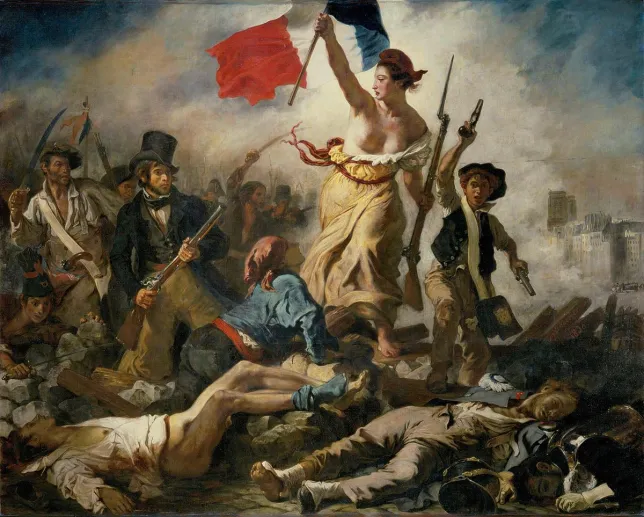
Eugene Delacroix, Liberty Leading the People, 1830
Lately, I’ve been reading more history, mostly to educate myself. But the other night, I opened Lord Acton’s Lectures on the French Revolution and didn’t get far before I sat up in bed. I was reading about France two centuries ago, but I couldn’t stop thinking about the comparisons to Washington today.
To be honest, most of what I remember about the French Revolution comes from Les Misérables (the musical, not the book). But Acton wasn’t simply retelling history. He was examining what happens when a society loses faith in its institutions. When it becomes certain of its own righteousness. When it begins to believe that power, if claimed in the name of “the people,” no longer needs restraint.
Acton identifies one of the most dangerous ideas unleashed by revolutionary politics: the belief that “the people” cannot be wrong. Once that idea takes hold, democracy no longer protects liberty; it begins to threaten it. Minority rights become obstacles. Institutions become barriers. Opposition becomes treason. And leaders who claim to speak for the people begin to behave as though the law itself must give way.
That is the warning for Washington. The danger does not come only from tyranny imposed from the top. It can also come from democratic language stripped of democratic restraint. It comes from leaders who invoke “the people” while weakening the institutions that protect the people from power itself.
Lord Acton, the 19th-century British historian and moral philosopher, spent his life studying the relationship between liberty and power. Best remembered for his warning that “power tends to corrupt, and absolute power corrupts absolutely,” Acton saw in the French Revolution a timeless lesson: democracy is not protected by passion alone. It survives only when liberty is joined to conscience, and power is held in check by law.
The French Revolution began with the language of liberty. It spoke of the people, justice, equality. It spoke of freedom from erratic power. But Acton saw something deeper and more dangerous. He saw trust in institutions weakening, leaders drunk on certainty, and citizens persuading themselves that noble purposes could justify violence.
That is why the French Revolution remains a cautionary tale for today’s Washington.
A democracy does not collapse only when a tyrant storms the palace. It begins to fail when law becomes an inconvenience, and opponents become traitors.
Washington today is not Paris in 1789. But the warning is unmistakable.
When political leaders claim to speak for “the people” while weakening the very institutions that protect the people, liberty is already in danger. When courts, Congress, the press, civil servants, and constitutional limits are dismissed as obstacles, democracy begins to lose the guardrails that keep passion from becoming power.
Acton understood another danger: the temptation to treat loyalty as a substitute for conscience. “Patriotism,” Acton writes, “cannot absolve a man from his duty to mankind.” That line matters now because patriotism, when stripped of humility and moral responsibility, can become a permission slip for corruption and blind allegiance.
Acton’s great lesson is that democracy requires more than elections. It requires character. It requires humility, truth, respect for law, and the willingness to lose without trying to destroy the system itself.
The warning for Washington is simple:
A republic is not saved by anger or vengeance. It is saved by conscience and leaders strong enough to restrain themselves.
Comments
Recent Commentaries

Hearts and Minds
July 16, 2026

The Ethics of Belonging
July 14, 2026

The Best of Us
July 9, 2026
The Standard Washington Set
July 6, 2026
Who We Were. Who We Are…
July 4, 2026
Are We Still Worthy of What They Declared?
July 3, 2026
Are We Still Worthy of What They Declared?
July 1, 2026
Are We Still Worthy of What They Declared?
June 29, 2026
A Cautionary Tale: France Then, Washington Now
June 25, 2026
Different Issues. Same Fear.
June 22, 2026
Read More Articles
The Latest... And Sometimes Greatest
When Democracy Comes Dressed as Patriotism
The current American political order is starting to feel like a collision between the films Seven Days in May and All the King’s Men. One...
June 18, 2026
Who Watches the Algorithm?
We are building machines that may soon judge, persuade, police, diagnose, hire, fire, and even help governments decide whom to trust. Yet we still have...
June 15, 2026
He Just Does His Job
I’ve been listening to and watching Democratic Senator Jon Ossoff of Georgia for more than a year now: his speeches, his questions in Senate hearings,...
June 11, 2026
Why Donald Trump Has Pulled Me Back In—Again
Last August, I wrote that I was “stepping back from the chaos” of Donald Trump. I meant to write about his presidency only when his...
June 8, 2026
Scott Pelley Responds
During a contentious staff meeting at 60 Minutes, Scott Pelley spoke out sharply, criticizing the judgment and decision-making of CBS News editor in chief Bari...
June 4, 2026
The Clock is Still Ticking. But Now It’s Ticking for CBS
I began watching 60 Minutes when it premiered on September 24, 1968, when Harry Reasoner and Mike Wallace introduced a new kind of television journalism:...
June 3, 2026