Published: April 28, 2017
By Jim Lichtman
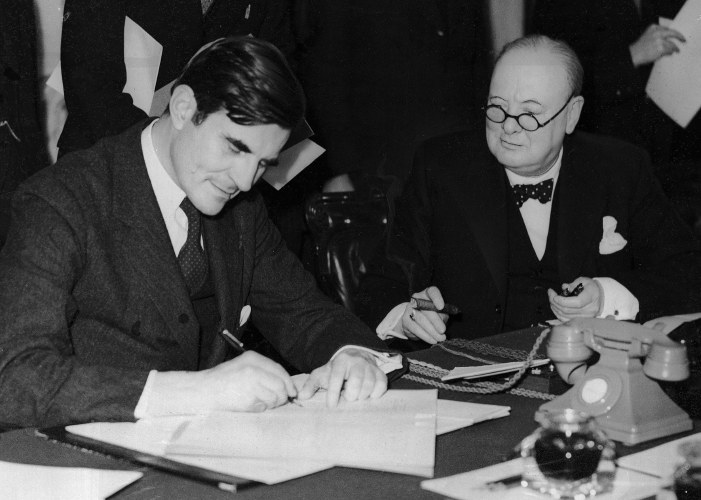
A few months ago I learned about the dedication of a statue of John Gilbert Winant from Concord resident and college professor Stephen Ambra.
“Who the heck is John Gilbert Winant?” I asked.
“He’s one of this country’s great unsung heroes of World War II,” Ambra said.
Ernest Bevin, a leading figure in Winston Churchill’s government, said “There is one man who was with us, who never believed we would surrender, and that was John Gilbert Winant.”
“Winant was a lifelong Republican,” Harvard Magazine wrote in 2000, “whose humanitarian principles transcended party lines. Influenced by the writings of Charles Dickens and John Ruskin and inspired by the examples of Lincoln and Theodore Roosevelt, he was as governor a forceful advocate of progressive reform initiatives, including a 48-hour work week for women and children, a minimum wage, and the abolition of capital punishment. In 1935, Franklin D. Roosevelt appointed him the first chairman of the Social Security Board.”
However, despite his successful service as New Hampshire’s first two-term governor, Winant remains largely unknown to most Americans. Not so in Britain, where, as America’s ambassador, along with Averell Harriman and CBS news correspondent Edward R. Murrow, he motivated Franklin Roosevelt to help Britain through the lend-lease program and eventually enter the war.
So trusted were Winant and Harriman that they became part of Winston Churchill’s inner circle.
In her extraordinary book, Citizens of London, historian Lynne Olson describes how Winant not only personally helped British citizens in the streets of London during the Blitz, but gave speeches that would rally them to action.
One notable example took place in 1942 when Britain was facing a coal strike. Winant received a call from Labor Party Leader Clement Attlee requesting the American ambassador’s help to resolve the crisis.
“Winant didn’t need Attlee to tell him how perilous a prolonged coal strike would be for Britain,” Olson writes. “Coal was the life’s blood of British industry, and its production, in the words of one historian, ‘was every bit as essential to Britain’s victory as going on the battlefield.’ …
“For decades, Winant’s main focus had been on social justice and the creation of a better life for workingmen and women throughout the world. ‘When the war has been won by democracy, we must be prepared to conquer the peace,’ he said on the day he was named ambassador to Britain.”
On June 6, 1942, the American ambassador’s speech rallied the miners with meaning that extended beyond the immediate crisis of war.
“You who suffered so deeply in the long Depression years,” Winant told the miners, “know we must move on a great social offensive if we are to win the war completely. It is not a short-term military job. We must solemnly resolve that in our future order we will not tolerate the economic evils which breed poverty and war. This is not something that we shelve for the duration. It is part of the war.
“What we want is not complicated,” Winant said. “We have enough technical knowledge and organizing ability… We have enough courage. We must put it to use. When war is done, the drive for tanks must become a drive for houses. The drive for food to prevent the enemy from starving us must become a drive for food to satisfy the needs of all people in all countries. The drive for manpower in war must become a drive for employment to make freedom from want a living reality… Just as the peoples of democracy are united in a common objective today, so we are committed to a common objective tomorrow. We are committed to the establishment of the people’s democracy.
“We must always remember,” Winant concluded, “that it is the things of the spirit that in the end prevail. That caring counts. That where there is no vision, people perish. That hope and faith count, and that without charity there can be nothing good. That by daring to live dangerously, we are learning to live generously. And that by believing in the inherent goodness of man, we may meet the call of your great Prime Minister and ‘stride forward into the unknown with growing confidence.’ ”
Upon finishing, the U.S. ambassador was immediately overwhelmed by shouts of “Hear, hear!”
The following day, Britain’s Daily Express carried the headline: “WINANT TALKS, STRIKE ENDS.”
And that was just one of many personal achievements by the man called upon by President Roosevelt to represent America during Britain’s darkest days.
The event, dedicating the statue of John Gilbert Winant, is scheduled in the state’s capitol of Concord on June 30.
Comments
Recent Commentaries
It Was Important Then. It is Important Today
August 3, 2026
When Political Identity Replaces Ethical Judgment
July 31, 2026
Principles Matter.
July 28, 2026
All the President’s Men 2.0
July 23, 2026
The Threat to November Is Already Here
July 20, 2026
Jon Ossoff and the Conscience of Atticus Finch
July 17, 2026
Hearts and Minds
July 16, 2026

The Ethics of Belonging
July 14, 2026
The Best of Us
July 9, 2026
The Standard Washington Set
July 6, 2026
Read More Articles
The Latest... And Sometimes Greatest
Who We Were. Who We Are…
Today, America is 250 years old. This Fourth of July, amid deep national division, it seems worth asking a simple question: Which of our country’s...
July 4, 2026
Are We Still Worthy of What They Declared?
Conclusion: The Words That Made Us and Still Must. In December of 1776, the Revolution was not moving toward triumph. It was close to collapse....
July 3, 2026
Are We Still Worthy of What They Declared?
Part 2: Common Sense Are we still capable of that kind of clarity when it matters most? There was a moment in the birth of...
July 1, 2026
Are We Still Worthy of What They Declared?
For the most part, my high school history classes consisted of names, dates, documents, and battles. What I’ve learned since then — through historians like...
June 29, 2026
A Cautionary Tale: France Then, Washington Now
Lately, I’ve been reading more history, mostly to educate myself. But the other night, I opened Lord Acton’s Lectures on the French Revolution and didn’t...
June 25, 2026
Different Issues. Same Fear.
As our nation nears its 250th anniversary, an uneasy emotional connection to the past has returned—one rooted in fear, and the question of who gets...
June 22, 2026