Published: January 2, 2009
By Jim Lichtman
The events surrounding Illinois Governor Rod Blagojevich’s decision to appoint a replacement to the United States Senate seat previously held by President-elect Barack Obama grows denser and unnecessarily more controversial.
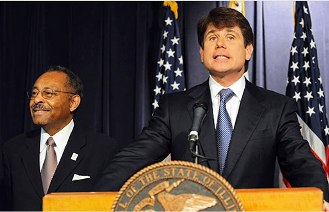
The New York Times reported (Jan. 1) that Gov. Blagojevich “…had an emissary make a call on the Dec. 24 to Danny K. Davis, a Democratic representative and longtime African-American leader,” to ask if he would be interested in taking the seat. “Representative Davis met with Sam Adam Sr., a well-known criminal defense lawyer… Mr. Adam said the governor wanted to give him the Senate job.”
Davis said he wanted some time to think about it.
“The decision, Mr. Davis said, did not take long and required a conversation with his wife, the only one he consulted.”
And what was Davis’s thinking on the matter? “I felt that if I was to take the appointment I would spend so much of my time deflecting and defending the position that it would take away from my real reason for being involved in politics and political life: to try and find solutions to problems.”
Mr. Davis recommended Roland Burris, a man with “impeccable credentials,” to fill the seat.
What was Burris’s thinking? He “…spent Friday and Saturday calling nearly 200 people,” the Times wrote. “…friends, judges, fellow lawyers. ‘It was all positive,’ Burris said. “He also studied the law… to satisfy himself that Mr. Blagojevich was within his authority in making the appointment.
“On Sunday afternoon, Mr. Blagojevich… called Mr. Burris… [and] sealed the appointment.”
And what’s the difference?
The difference is, while Burris and Blagojevich focused solely on the legal aspects of the appointment, Mr. Davis, whether he realized it or not, considered it from a very practical and ethical point of view of the people he wishes to serve.
However, several “…black Democrats in the House said Mr. Burris should be allowed to join the Senate despite opposition: Representatives Maxine Waters of California, Donald Payne of New Jersey, and Donna Christensen of the Virgin Islands.
Adding further controversy, when Blagojevich announced Burris as the replacement, Illinois Representative Bobby Rush put forth his own impromptu opinion at the press briefing and asked the public not to “hang or lynch the appointee…” an unambiguous message that says that if anyone disqualifies Burris, they are racist.
I’m shocked and disappointed that a U.S. Representative would publicly make such a statement. It’s an insult to any reasonable person, much less black Americans.
But the underlying ethics of the matter are far simpler.
This is not about a Senate replacement with “impeccable credentials.” This is about one man’s Nixon-like hold on power and how, in his own words said, “I will fight, I will fight, I will fight until my last breath,” not only for his own innocence but to hold onto the powers of his office no matter the cost to the people whose interests he took an oath to uphold.
Despite all the lawyers, judges, friends, and political advocates, it still comes down to one point that is consistently (sometimes, conveniently) overlooked: Legal does not always mean ethical.
When you have a sitting governor like Blagojevich with corruption charges hanging over his head, every decision that he makes, ANY decision that he makes carries the stain of that corruption in the form of doubt.
To read it any other way is simply to ignore the obvious.
I would respectfully ask Representatives Rush, Waters, Payne and Christensen to re-read the opening statement from their own House Ethics Manual:
“Members, officers, and employees of the House should: Conduct themselves at all times in a manner that reflects creditably on the House…” (Page 1, House Ethics Manual, 2008)
The key word here is “creditably” as in commendably, honorably, admirably.”
Does this appointment rise to the standard of honorable?
The House Manual further says, “Government is a trust, and the officers of the government are trustees; and both the trust and the trustees are created for the benefit of the people.” (Page 2)
Does this appointment rise to the highest standard of trust?
Ethics is not about technical compliance of the law. It’s about making the right decision even when that decision costs more than you really want to pay. And that is why as long as a charge of corruption remains against the Illinois governor, ANYchoice he makes is the WRONG choice.
Comments


Recent Commentaries

November 4, 2026
October 20, 2026

Has America Lost Its Way?
October 16, 2026
All The President’s Targets
October 13, 2026

Integrity Doesn’t Require a Megaphone
October 12, 2026

WHOSE PURPOSE DOES THIS SERVE?
October 9, 2026

Choreographer of Disaster
October 5, 2026
I Am Not a Politician, and I Have No Partisan Loyalties
October 2, 2026
A Man of Incorruptible Integrity
September 29, 2026

HUMAN VALUES: NOT SPECIFIED
September 23, 2026

You Can’t Do That.
September 21, 2026
Read More Articles
The Latest... And Sometimes Greatest
I AM SICKENED
Tonight, protesters are surrounding the Kennedy Center, the living memorial to John F. Kennedy and the heartbeat of Washington’s cultural life. They are there because...
September 18, 2026
The Courage to Defend a Principle
In 1998, at the height of the Clinton-Lewinsky scandal, Secret Service Director Lewis Merletti was driving to work when a radio report stopped him cold....
September 17, 2026
The Better Angels Among Us
By all appearances, we are becoming less the land of the brave than the land of resentment. Every day is Groundhog Day: same arguments, same...
September 14, 2026
We Remember
On September 11, 2001, nearly 3,000 people were killed in terrorist attacks in New York, at the Pentagon, and aboard Flight 93 in Pennsylvania. More...
September 11, 2026
Mister Roberts!
One of my favorite movies is Mister Roberts, the 1955 comedy-drama set aboard the USS Reluctant in the Pacific during World War II. Henry Fonda...
September 8, 2026
Where’s the Character
In 1984, Wendy’s ran a television commercial featuring the redoubtable Clara Peller, staring at an enormous hamburger bun. Inside was a burger patty smaller than...
August 7, 2026