Published: November 27, 2017
By Jim Lichtman
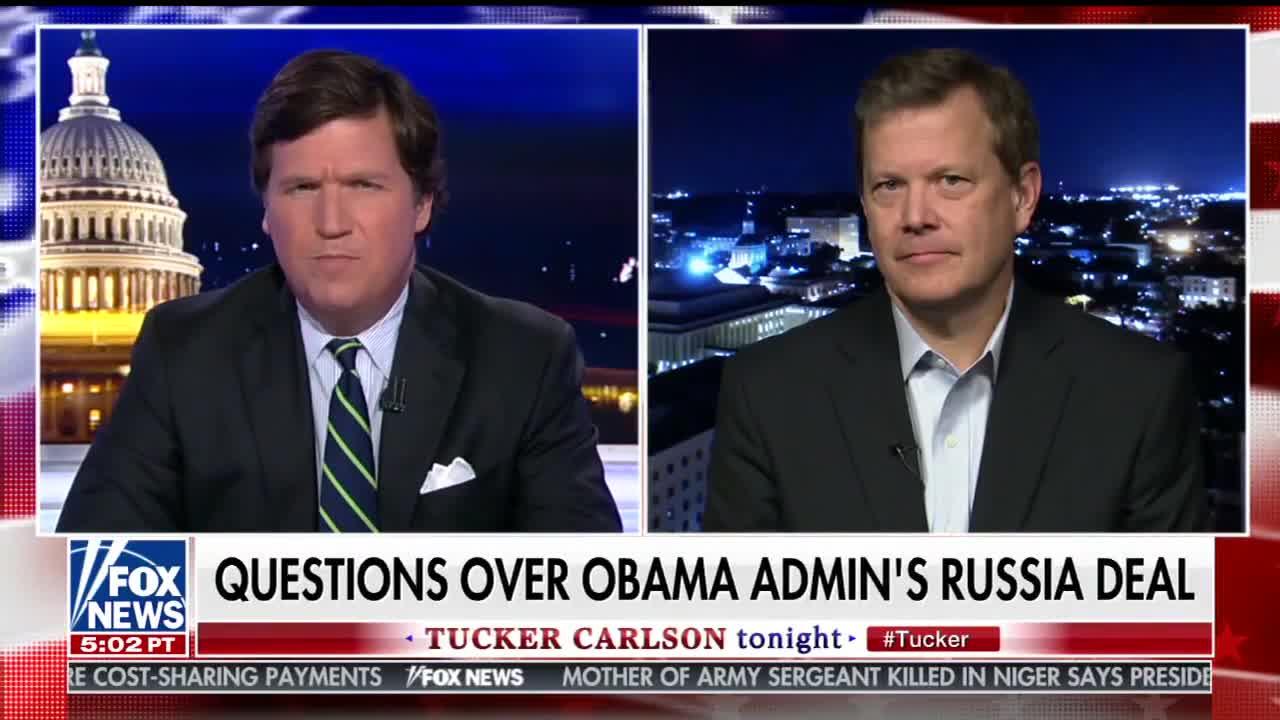
“Knowing what you know about Russia, was it really a good idea for the Obama administration and the Secretary of State Hillary Clinton to approve a deal giving the Russians control of 20 percent of our uranium supply? . . . Why did Hillary’s office and the Obama administration sign off on giving the Russians a fifth of our uranium? . . . What was she doing?” — Tucker Carlson, on Fox’s Tucker Carlson Tonight, Oct. 23
Last month, I talked about The Russian Uranium Deal that continues to be of great significance to conservative media. In my commentary, I mentioned that two House committees, Intelligence and Oversight, have begun a joint investigation examining the details of a deal that purportedly gave 20 percent of our uranium supply to a Russian company.
After researching several fact-checking sites, I offered the rather lengthy explanation by Politifact because the story was a complicated one. At the end, I added, I would offer any updates that are reported.
On November 3, I received the following update from The Washington Post Fact Checker:
“The claim that Russia obtained 20 percent of American uranium is still not true.
“More than a year ago, Donald Trump, then a presidential candidate, made a slew of claims about Hillary Clinton’s alleged role in the approval of the sale of a Canadian company, Uranium One, with mining rights in the United States to Rosatom, Russia’s nuclear energy agency. The Fact Checker labelled it false at the time.
“But this claim seems to resurface whenever news about the Russia investigation heats up. After Rep. Devin Nunes (R-Calif.), head of the House Intelligence Committee, announced Congress would lead a probe into the deal, the Fact Checker delved into the tale again.
“In an interview with Fox News, Nunes said, ‘How is it that our government could approve a sale of 20 percent of our uranium at the same time that there was an open FBI investigation?’
“The 20 percent figure has long been in wide circulation. It comes from the Nuclear Regulatory Commission, one of the agencies that approved the deal in 2010. It stated that as of 2010, the licenses ‘represent approximately 20 percent of the currently licensed uranium in-situ recovery production capacity’ in the United States. But that did not mean 20 percent of U.S. uranium reserves. In-situ recovery is one of two ways uranium is mined and is generally used for low-grade ore that would otherwise be too expensive to mine.
“Plus, the 20 percent number was an estimate. Today, the Uranium One represents only 2.3 percent of all U.S. production. And uranium produced in the U.S. represents a very small section of the world’s total. In 2016, it accounted for 1,126 tons of the world’s total 62,266.
“So, the overwrought claims that Clinton ‘gave away’ 20 percent of the U.S. nuclear supply or that Russia controls that much U.S. uranium are simply absurd. Clearly, the number is woefully out of date. We award Four Pinocchios.”
Further, as Politifact and other news sources have mentioned, the State Department is one of nine agencies that must approve such a sale. All NINE entities must approve the deal before the sale can be finalized.
Comments

Recent Commentaries
All The President’s Targets
October 13, 2026

Integrity Doesn’t Require a Megaphone
October 12, 2026
WHOSE PURPOSE DOES THIS SERVE?
October 9, 2026

Choreographer of Disaster
October 5, 2026
I Am Not a Politician, and I Have No Partisan Loyalties
October 2, 2026
A Man of Incorruptible Integrity
September 29, 2026

HUMAN VALUES: NOT SPECIFIED
September 23, 2026
You Can’t Do That.
September 21, 2026
I AM SICKENED
September 18, 2026
The Courage to Defend a Principle
September 17, 2026
Read More Articles
The Latest... And Sometimes Greatest
The Better Angels Among Us
By all appearances, we are becoming less the land of the brave than the land of resentment. Every day is Groundhog Day: same arguments, same...
September 14, 2026
We Remember
On September 11, 2001, nearly 3,000 people were killed in terrorist attacks in New York, at the Pentagon, and aboard Flight 93 in Pennsylvania. More...
September 11, 2026
Mister Roberts!
One of my favorite movies is Mister Roberts, the 1955 comedy-drama set aboard the USS Reluctant in the Pacific during World War II. Henry Fonda...
September 8, 2026
Where’s the Character
In 1984, Wendy’s ran a television commercial featuring the redoubtable Clara Peller, staring at an enormous hamburger bun. Inside was a burger patty smaller than...
August 7, 2026
It Was Important Then. It is Important Today
Freedom of speech in America is under attack, not only when people are denied the right to speak, but when lies, intimidation and the deliberate...
August 3, 2026
When Political Identity Replaces Ethical Judgment
The political and cultural landscape has become a minefield of conflicting beliefs, many now rooted less in public policy than in personal identity. One of...
July 31, 2026