Published: May 7, 2024
By Jim Lichtman
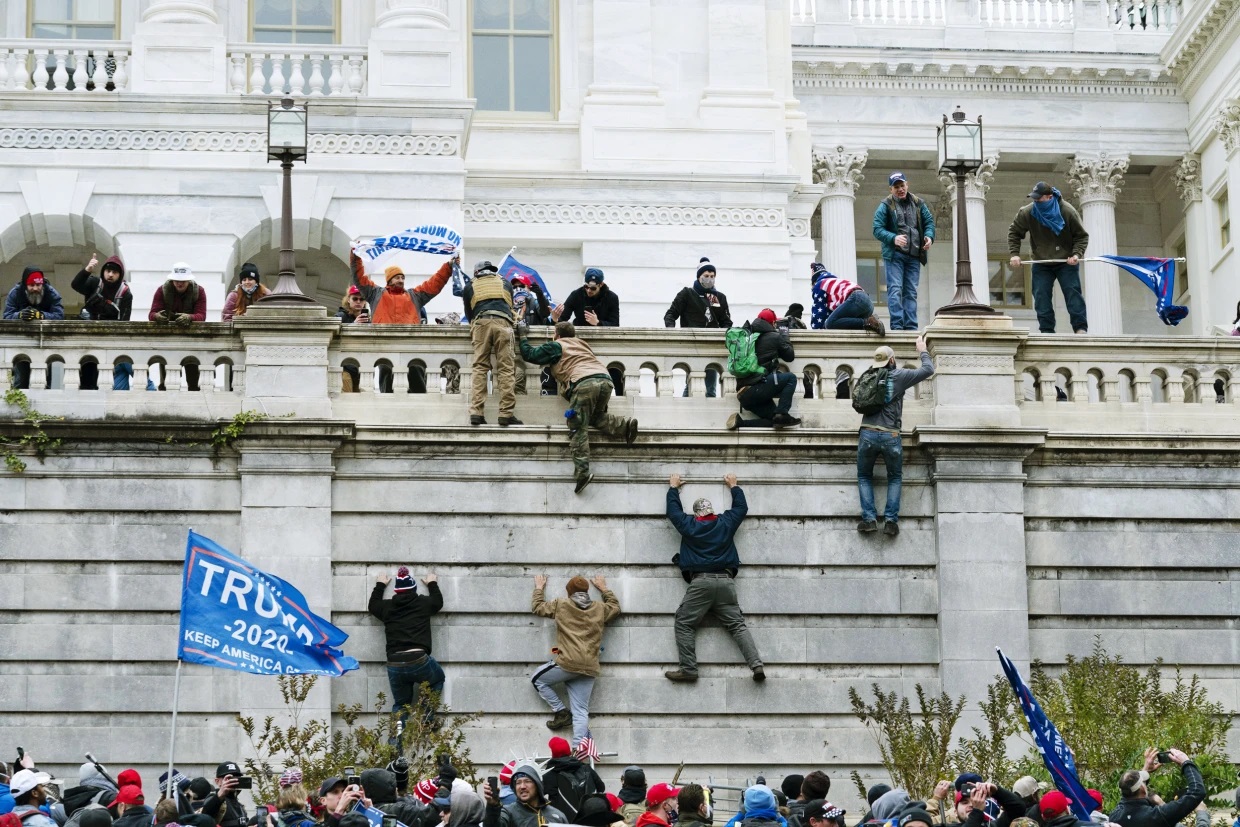
Photo: Jose Luis Magana/AP
While the Gettysburg Address is one of the most remembered and well-regarded, it was not Lincoln’s greatest speech. His second inaugural address was far superior and can be viewed as a prophecy for today’s divided nation:
“On the occasion corresponding to this four years ago all thoughts were anxiously directed to an impending civil war. All dreaded it, all sought to avert it. While the inaugural address was being delivered from this place, devoted altogether to saving the Union without war, insurgent agents were in the city seeking to destroy it without war—seeking to dissolve the Union and divide effects by negotiation. Both parties deprecated war, but one of them would make war rather than let the nation survive, and the other would accept war rather than let it perish. And the war came.”
With a country deeply divided, we saw, for the first time in US history, a president not only denying that he lost an election but pushing his faithful supporters to the edge of unreason: “We fight like hell, and if you don’t fight like hell, you’re not going to have a country anymore.”
And the war came.
The January 6 insurrection was a war against democracy as more than 2,000 insurgents were outside the Capitol building—the symbol of American democracy—seeking to destroy it by stopping the certification of the state’s electoral votes by the vice president.
“Both read the same Bible and pray to the same God and each invokes His aid against the other.”
According to Pew Research, “Most white Americans who regularly attend worship services voted for Trump in 2020. . . [while] Nine-in-ten Black Americans who attend religious services monthly or more voted for Biden.”
“The prayers of both could not be answered ~ that of neither has been answered fully. The Almighty has His own purposes. ‘Woe unto the world because of offences (sic) for it must needs be that offenses come but woe to that man by whom the offence cometh.’”
Slavery was the offense Lincoln was speaking of.
On January 6, near the front of the White House, the former president urged his supporters to “fight like hell” under the guise of saving the country, resulting in a violent attack against the seat of government. His actions were an offense to the “peaceful transfer of power” and the rule of law.
“Fondly do we hope ~ fervently do we pray ~ that this mighty scourge of war may speedily pass away.”
Throughout his speech, Lincoln uses the words “us,” “both,” “we,” and “all” to demonstrate that we are all part of the problem and all responsible for the solution.
“Yet, if God wills that it continue until all the wealth piled by the bondsman’s two hundred and fifty years of unrequited toil shall be sunk and until every drop of blood drawn with the lash shall be paid by another drawn with the sword. . .”
Lincoln warns that continuing the conflict will only result in more death and division.
In our current context, Lincoln’s last line might be interpreted that if the “lash” of violence continues, it will be met with the “sword” of justice. The Justice Department continues to prosecute those who stormed the Capitol; some are already serving prison terms.
“With malice toward none with charity for all with firmness in the right as God gives us to see the right, let us strive on to finish the work we are in to bind up the nation’s wounds.”
While Lincoln is aware of the remaining bitterness, he appeals to “charity for all…”
“…with firmness in the right as God gives us to see the right.”
Both the North and the South believed they were right. Lincoln is asking both sides to look within themselves to see the light of reason that will lead them to what is right.
With the wisdom of our past, let us pray that we may find that light.
Comments
Recent Commentaries

Who Writes This Stuff: Jim or A.I.?
March 23, 2026
Loyalty vs. Conscience
March 19, 2026
When Will This Madness End!?
March 18, 2026

When Government Threatens the Truth
March 16, 2026
Separating Fact from Rhetoric
March 12, 2026

Lindsay Vonn’s Gold Medal Moment
March 12, 2026

Teaching an Algorithm Right from Wrong
March 9, 2026
Now, More Than Ever
March 6, 2026
Peace Is Not an Elective
March 2, 2026
Revelations
February 26, 2026
Read More Articles
The Latest... And Sometimes Greatest
The Story of Chips, and The Cost of Looking Away
It’s just a photograph: a wartime dog sitting alert, ears up, wearing a military harness. But the story about a World War II sentry dog...
February 23, 2026
It’s Time to Talk About Respect
A cancer has been growing in our national life, so embedded in our culture that we’ve stopped acknowledging it. In the 1940s and the decades...
February 18, 2026
Adversity and Perseverance
“How you climb a mountain is more important than reaching the top.”— Yvon Chouinard “Every new adjustment is a crisis in self-esteem”—Eric Hoffer “Retreat, Hell!...
February 16, 2026
Who Decides What’s Seen?
There are moments when a single arrest tells us more about the state of the country than a thousand speeches. The recent detention of Don...
February 12, 2026
The Death of Shame
Over the past several months, I’ve written commentaries revisiting moments in our history when individuals confronted serious challenges and rose to meet them — to...
February 9, 2026
Because We Need It
From the man who invented The Tonight Show. What Steve Allen understood—long before humor became sharper and more performative—is that laughter can be light and...
February 5, 2026