Published: May 25, 2020
By Jim Lichtman
Note: I will return Friday.
On May 30, 1868 Ohio Senator James A. Garfield gave the first address to a crowd of more than 5,000 at Arlington National Cemetery. The event, known then as Decoration Day, was organized to honor those who died during the Civil War.
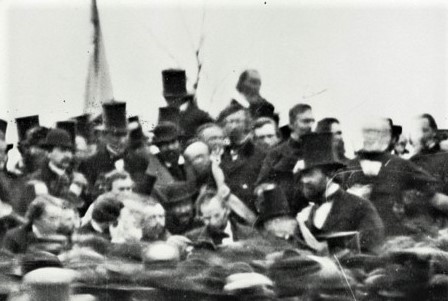
Lincoln (lower, center) at Gettysburg
However, five years before Garfield’s address another political figure stood to deliver a speech honoring more than 7,000 Union and Confederate soldiers who died in the bloodiest battle of the Civil War in Gettysburg, Pennsylvania.
In just 270 words, Lincoln summarized what the country stands for — freedom and equality, and the courage and sacrifice it takes to preserve them.
“Four score and seven years ago,” Lincoln began, “our fathers brought forth on this continent a new nation, conceived in Liberty, and dedicated to the proposition that all men are created equal.
“Now we are engaged in a great civil war, testing whether that nation, or any nation, so conceived and so dedicated, can long endure. We are met on a great battlefield of that war. We have come to dedicate a portion of that field, as a final resting place for those who here gave their lives that that nation might live. It is altogether fitting and proper that we should do this.
“But, in a larger sense, we cannot dedicate — we cannot consecrate — we cannot hallow — this ground. The brave men, living and dead, who struggled here, have consecrated it, far above our poor power to add or detract.
“The world will little note, nor long remember what we say here, but it can never forget what they did here. It is for us the living, rather, to be dedicated here to the unfinished work which they who fought here have thus far so nobly advanced. It is rather for us to be here dedicated to the great task remaining before us — that from these honored dead we take increased devotion to that cause for which they gave the last full measure of devotion — that we here highly resolve that these dead shall not have died in vain — that this nation, under God, shall have a new birth of freedom — and that government of the people, by the people, for the people, shall not perish from the earth.”
With the war continuing, Lincoln’s speech revitalized the Union to fight to end the conflict of a deeply divided nation.
Perhaps we should remember Lincoln’s wisdom today.
Comments

Recent Commentaries
Same Price. Same War. Different Truth
March 25, 2026

Who Writes This Stuff: Jim or A.I.?
March 23, 2026
Loyalty vs. Conscience
March 19, 2026
When Will This Madness End!?
March 18, 2026

When Government Threatens the Truth
March 16, 2026
Separating Fact from Rhetoric
March 12, 2026

Lindsay Vonn’s Gold Medal Moment
March 12, 2026

Teaching an Algorithm Right from Wrong
March 9, 2026
Now, More Than Ever
March 6, 2026
Peace Is Not an Elective
March 2, 2026
Read More Articles
The Latest... And Sometimes Greatest
Revelations
In 1927, Sinclair Lewis gave America a character it did not want to recognize in the mirror: Elmer Gantry. Gantry is loud, magnetic, insatiable —...
February 26, 2026
The Story of Chips, and The Cost of Looking Away
It’s just a photograph: a wartime dog sitting alert, ears up, wearing a military harness. But the story about a World War II sentry dog...
February 23, 2026
It’s Time to Talk About Respect
A cancer has been growing in our national life, so embedded in our culture that we’ve stopped acknowledging it. In the 1940s and the decades...
February 18, 2026
Adversity and Perseverance
“How you climb a mountain is more important than reaching the top.”— Yvon Chouinard “Every new adjustment is a crisis in self-esteem”—Eric Hoffer “Retreat, Hell!...
February 16, 2026
Who Decides What’s Seen?
There are moments when a single arrest tells us more about the state of the country than a thousand speeches. The recent detention of Don...
February 12, 2026
The Death of Shame
Over the past several months, I’ve written commentaries revisiting moments in our history when individuals confronted serious challenges and rose to meet them — to...
February 9, 2026