Published: March 20, 2008
By Jim Lichtman
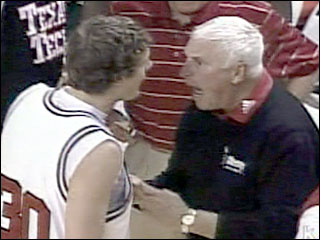
Okay class, let’s all bow our heads in a moment of silence for the retirement of Robert Montgomery “Bobby” Knight, “the winningest coach in Division I men’s college basketball.”
Moment over.
I’m now going to say something that will more than likely be anathema to most college basketball fans on the planet: I’m glad. Thank God! FINALLY!!
After years of enduring this big-mouth, foul-mouthed, throat-grabbing, chair-tossing, insult-spewing, lout of a coach, he’s finally leaving the game. Remember the adage, “Nice guys finish last”? Well, if Knight didn’t invent it, he certainly perfected the idiom every time he walked onto a basketball court. Yes, he ran “clean” programs with high graduation rates for his student players, but at what cost?
In a May 2000 Op-ed I wrote for the New York Times after Knight’s infamous throat-grabbing of one of his own Indiana players, University President Myles Brand said, “I had never seen him before contrite and apologetic… I think the ethical approach is to give him one last chance.”
That “last chance” lasted all of four months. In September of that year, Knight was fired as head coach at Indiana University for once again, crossing the line with his contemptible actions.
And this bastion of coaching “excellence” was quickly snapped up by Texas Tech where he has since played his part as “The General” (Generalissimo Franco?) since that time.
Sadly, some people think that the only way you can teach college athletes and build a winning basketball season is to intimidate, bully and demean. It’s a good thing John Wooden and his students never paid much attention to that kind of “conventional” wisdom.
Always there to support, encourage, and congratulate, Coach Wooden, the “Wizard of Westwood,” directed his UCLA basketball teams to 10 NCAA titles – including 7 in a row – and achieved an amazing lifetime wining percentage of 81.5%. In the heat of battle, the harshest words Wooden ever used on a basketball court were, “Goodness Gracious, sakes alive!”
In 1934 Coach Wooden coined his own definition for success:“Peace of mind which is a direct result of self-satisfaction in knowing you did your best to become the best of which you are capable of becoming.”
Through word and deed, John Wooden taught his student players how to be successful in life.
That, Mr. Knight, is what coaching excellence is all about.
“When [Knight] broke the record for game wins,” TIME magazine wrote of his retirement, “the song he chose to play over the loudspeaker was ‘My Way.’ “When I think back on it, [Knight] said, “I don’t think my way was all that bad.”
Say goodnight, Bobby!
Comments

Recent Commentaries

When the Story Becomes the Scandal
January 5, 2026

A Light from Christmas Past – Conclusion
December 24, 2025

A Light From Christmas Past – Part II
December 23, 2025

A Light from Christmas Past
December 22, 2025

Nothing Beside Remains
December 16, 2025

Finding Common Ground, and Why It Matters
December 15, 2025
What Dickens Meant Us to Remember
December 11, 2025
Looking for America’s Soul
December 8, 2025
Here We Are Again
December 5, 2025
The Steady Endurance of Leadership
December 1, 2025
Read More Articles
The Latest... And Sometimes Greatest
Under the Wild Sky, We Gather
Wisconsin’s night sky opened to a rare sight, one usually reserved for places far colder and farther north—the Northern Lights. The colors pulled against each...
November 27, 2025
London, 1943.
In a war that hammered away and left families lying awake at night counting the seconds between sirens, John Gilbert Winant, America’s ambassador to Britain,...
November 25, 2025
Faith in The Goodness of Ordinary People, Even in The Darkest Hours
During his years in wartime London, U.S. Ambassador John Gilbert Winant absorbed the suffering around him. He was known for walking the streets during the...
November 24, 2025
The Forgotten Statesman and the Freedom He Helped Preserve
John Gilbert Winant was one of the rarest of figures in public life: a three-term Republican governor from New Hampshire whose leadership wasn’t calculated but...
November 20, 2025
“What Is Essential Is Invisible to The Eye.”
That line from The Little Prince by French aviator and author, Antoine de Saint-Exupéry is the essence of the story and the essence of what...
November 17, 2025
The Move That Mattered Most
I’ve played chess about two dozen times, and every match feels less like a game and more like mental boot camp. It’s not difficult; it’s...
November 13, 2025