Published: May 13, 2025
By Jim Lichtman
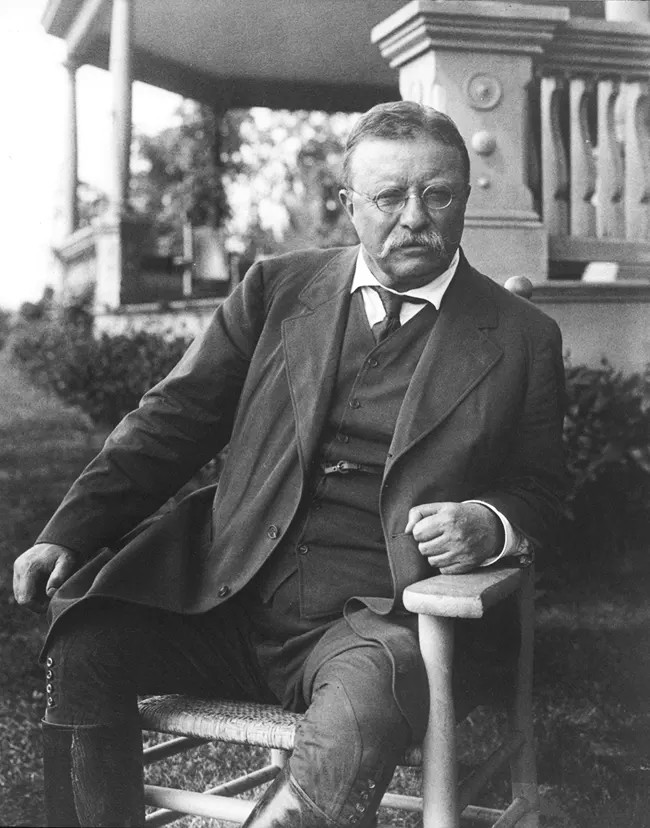
Theodore Roosevelt didn’t plan to become president. In 1901, after President William McKinley was assassinated, the 42-year-old vice president was sworn in—becoming the youngest person ever to occupy the White House. Many in the Republican Party had hoped to sideline Roosevelt’s reformist energy by placing him in a quiet, symbolic role. But Roosevelt had other ideas. He brought his convictions with him—and used the presidency as what he called a “bully pulpit” to speak out for the public good.
Roosevelt’s view of power was rooted not in entitlement but in duty. “The President is merely the most important among a large number of public servants,” he said. “He should be supported or opposed exactly to the degree which is warranted by his good conduct or bad conduct.” To him, leadership meant honest service—not loyalty to party or self.
He turned that belief into action. At a time when big business wielded enormous influence, Roosevelt took on the trusts—powerful monopolies that operated above the law. He believed in capitalism, but more deeply, he believed in fairness. That belief became the bedrock of his “Square Deal,” aimed at ensuring justice for workers, consumers, and small businesses.
His Justice Department filed nearly four dozen antitrust suits, including a landmark case against the Northern Securities Company, backed by J.P. Morgan. “No man is above the law, and no man is below it,” Roosevelt declared. “Nor do we ask any man’s permission when we ask him to obey it.”
Roosevelt was just as willing to confront entrenched interests in his own party. His progressive policies—regulating food and drug industries, protecting laborers, overseeing railroads—angered Republican elites aligned with industrial chiefs. Yet he remained popular with the public because he stood where they stood: on principle.
When his presidency ended in 1909, he grew disillusioned with his successor, William Howard Taft. Roosevelt returned to politics, challenging Taft in 1912. When he lost the Republican nomination, he ran as a Progressive, championing campaign finance reform, women’s suffrage, and workers’ rights. He didn’t win, but he reshaped the political conversation.
He was also a pioneering conservationist. Roosevelt preserved over 230 million acres of public lands and established five national parks. “The nation behaves well,” he wrote, “if it treats the natural resources as assets which it must turn over to the next generation increased, and not impaired, in value.”
Roosevelt’s views on assimilation and American identity were shaped by his time and are debated today. But his core ethic—public service over personal gain, fairness over favoritism, action over apathy—remains a benchmark of integrity in public life.
Perhaps his clearest expression of principle came in a warning to citizens:
“To announce that there must be no criticism of the president… is morally treasonable to the American public.”
In an era when criticism is often deflected or weaponized, Roosevelt’s words still resonate.
He demonstrated that true leadership entails confronting the powerful, defending the voiceless, and being willing to sacrifice for the right reasons. Roosevelt didn’t just hold office—he lived his convictions. And that conviction was integrity in action.
Comments
Recent Commentaries
November 4, 2026
October 20, 2026

Has America Lost Its Way?
October 16, 2026
All The President’s Targets
October 13, 2026
Integrity Doesn’t Require a Megaphone
October 12, 2026
WHOSE PURPOSE DOES THIS SERVE?
October 9, 2026

Choreographer of Disaster
October 5, 2026
I Am Not a Politician, and I Have No Partisan Loyalties
October 2, 2026
A Man of Incorruptible Integrity
September 29, 2026

HUMAN VALUES: NOT SPECIFIED
September 23, 2026
You Can’t Do That.
September 21, 2026
Read More Articles
The Latest... And Sometimes Greatest
I AM SICKENED
Tonight, protesters are surrounding the Kennedy Center, the living memorial to John F. Kennedy and the heartbeat of Washington’s cultural life. They are there because...
September 18, 2026
The Courage to Defend a Principle
In 1998, at the height of the Clinton-Lewinsky scandal, Secret Service Director Lewis Merletti was driving to work when a radio report stopped him cold....
September 17, 2026
The Better Angels Among Us
By all appearances, we are becoming less the land of the brave than the land of resentment. Every day is Groundhog Day: same arguments, same...
September 14, 2026
We Remember
On September 11, 2001, nearly 3,000 people were killed in terrorist attacks in New York, at the Pentagon, and aboard Flight 93 in Pennsylvania. More...
September 11, 2026
Mister Roberts!
One of my favorite movies is Mister Roberts, the 1955 comedy-drama set aboard the USS Reluctant in the Pacific during World War II. Henry Fonda...
September 8, 2026
Where’s the Character
In 1984, Wendy’s ran a television commercial featuring the redoubtable Clara Peller, staring at an enormous hamburger bun. Inside was a burger patty smaller than...
August 7, 2026