Published: November 30, 2010
By Jim Lichtman
In light of my excess last week regarding political pundit Keith OIbermann, I’ve been spending a little more time reading up on civility.
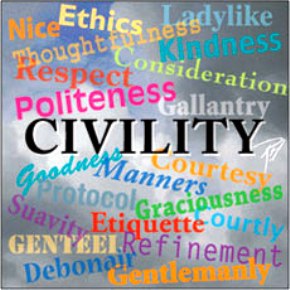
According to an excellent little volume, Choosing Civility, by P.M. Forni, “Civility’s defining characteristic is its ties to city and society.
“The word derives from the Latin civitas, which means ‘city,’ especially in the sense of civic community. Civitas is the same word from which civilization comes. The age-old assumption behind civility is that life in the city has a civilizing effect. The city is where we enlighten our intellect and refine our social skills. And as we are shaped by the city, we learn to give of ourselves for the sake of the city. Although we can describe the civil as courteous, polite and well mannered, etymology reminds us that they are also supposed to be good citizens and good neighbors.”
In Michael Josephson’s Six Pillars of Character, civility falls under the ethical value of respect.
“People are not things,” writes Josephson, “and everyone has a right to be treated with dignity. We certainly have no ethical duty to hold all people in high esteem, but we should treat everyone with respect, regardless of who they are and what they have done. We have a responsibility to be the best we can be in all situations, even when dealing with unpleasant people.”
Are you listening, Jim?
“A respectful person is an attentive listener…”
Well, okay, but what about…
“…although his patience with the boorish need not be endless (respect works both ways).”
It sure does. But when I hear things that violate respect for society, I feel…
“Nevertheless, the respectful person treats others with consideration, and doesn’t resort to intimidation, coercion or violence except in extraordinary and limited situations to defend others, teach discipline, maintain order or achieve social justice. Punishment is used in moderation and only to advance important social goals and purposes.”
Clearly the lesson for me is self-restraint. Speak out, when necessary, but in a way that demonstrates respect for the individual as well as society, as a whole.
In a 1792 letter to George Hammond, Thomas Jefferson writes, “A nation, as a society, forms a moral person, and every member of it is personally responsible for his society.”
Comments


Recent Commentaries
Mister Roberts!
September 8, 2026

Where’s the Character
August 7, 2026
It Was Important Then. It is Important Today
August 3, 2026
When Political Identity Replaces Ethical Judgment
July 31, 2026

Principles Matter.
July 28, 2026

All the President’s Men 2.0
July 23, 2026

The Threat to November Is Already Here
July 20, 2026

Jon Ossoff and the Conscience of Atticus Finch
July 17, 2026
Hearts and Minds
July 16, 2026

The Ethics of Belonging
July 14, 2026
Read More Articles
The Latest... And Sometimes Greatest
The Best of Us
“We choose to go to the Moon in this decade and do the other things—not because they are easy, but because they are hard.” When...
July 9, 2026
The Standard Washington Set
Much has been written about George Washington, our first American president: his command of the Continental Army, his leadership in the fragile birth of a...
July 6, 2026
Who We Were. Who We Are…
Today, America is 250 years old. This Fourth of July, amid deep national division, it seems worth asking a simple question: Which of our country’s...
July 4, 2026
Are We Still Worthy of What They Declared?
Conclusion: The Words That Made Us and Still Must. In December of 1776, the Revolution was not moving toward triumph. It was close to collapse....
July 3, 2026
Are We Still Worthy of What They Declared?
Part 2: Common Sense Are we still capable of that kind of clarity when it matters most? There was a moment in the birth of...
July 1, 2026
Are We Still Worthy of What They Declared?
For the most part, my high school history classes consisted of names, dates, documents, and battles. What I’ve learned since then — through historians like...
June 29, 2026