Published: November 6, 2025
By Jim Lichtman
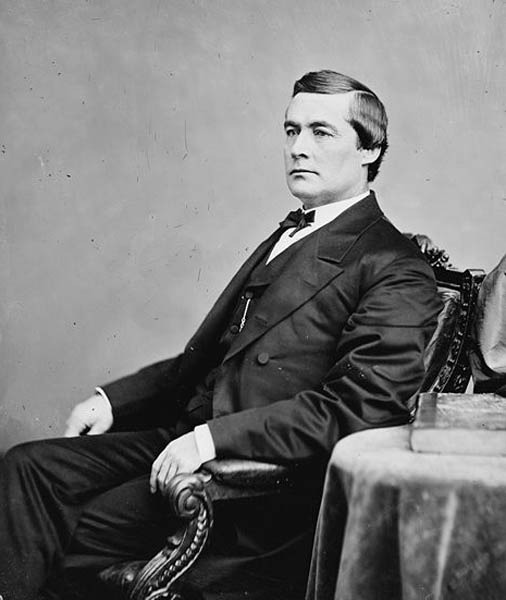
Republican Edmund G. Ross – LegendsOfKansas.com
Moments of character often define a person—sometimes even a nation.
I first came across Senator Ross’s story when reading President Kennedy’s Profiles in Courage. What I discovered was that political courage was as difficult then as it is today.
Throughout our history, politicians have faced those defining moments when principle collides with pressure, when conscience demands both courage and character. Few rise to the occasion. Fewer still do so knowing the cost.
In 1868, as the Senate prepared to decide the fate of President Andrew Johnson, Republican Senator Edmund G. Ross of Kansas stood at such a crossroads.
Three years after the Civil War, the country was still torn by divisions. Abraham Lincoln was gone, cut down by an assassin. His successor, Andrew Johnson, a Southern Democrat who had stayed loyal to the Union, found himself at odds with Congress. Radical Republicans, determined to punish the South, saw Johnson’s leniency as nothing but betrayal.
When Johnson tried to remove his Secretary of War, Edwin Stanton, Congress seized its chance. Articles of impeachment were drafted—not out of clear evidence of “high crimes and misdemeanors,”–but out of political vengeance.
The Senate trial was political theater at its best. Party leaders promised punishment for any Republican who wavered (Sound familiar). The final count stood but one vote short of the two-thirds majority required to remove the president from office. That one vote belonged to Edmund G. Ross of Kansas.
“I looked down into my open grave,” Ross later wrote, understanding that his political career would not survive a vote of conscience. Yet, believing that the charges were based more on politics than principle, Ross voted “not guilty.”
The backlash was immediate and merciless. He was vilified by his own party, ostracized in his home state, and denied renomination for the Senate (Think Liz Cheney). His reputation was shredded in the press.
Historians now agree that Ross’s vote preserved the constitutional balance between the executive and legislative branches. He defended not Andrew Johnson, but the office of the presidency itself from being subjugated to the whims of a partisan Congress. His stand became one of the earliest and clearest examples of principle over party.
Integrity is rarely convenient. It often demands sacrifice: sometimes reputation, sometimes livelihood. But as Ross’s story reminds us, it is the willingness to stand alone for what is right that defines character.
In times when party loyalty too often eclipses truth and conscience, we would do well to remember Edmund Ross, a man who, when the nation demanded a partisan verdict, chose instead to defend its principles.
Comments

Recent Commentaries
All The President’s Targets
October 13, 2026
Integrity Doesn’t Require a Megaphone
October 12, 2026

WHOSE PURPOSE DOES THIS SERVE?
October 9, 2026

Choreographer of Disaster
October 5, 2026
I Am Not a Politician, and I Have No Partisan Loyalties
October 2, 2026
A Man of Incorruptible Integrity
September 29, 2026

HUMAN VALUES: NOT SPECIFIED
September 23, 2026
You Can’t Do That.
September 21, 2026
I AM SICKENED
September 18, 2026
The Courage to Defend a Principle
September 17, 2026
Read More Articles
The Latest... And Sometimes Greatest
The Better Angels Among Us
By all appearances, we are becoming less the land of the brave than the land of resentment. Every day is Groundhog Day: same arguments, same...
September 14, 2026
We Remember
On September 11, 2001, nearly 3,000 people were killed in terrorist attacks in New York, at the Pentagon, and aboard Flight 93 in Pennsylvania. More...
September 11, 2026
Mister Roberts!
One of my favorite movies is Mister Roberts, the 1955 comedy-drama set aboard the USS Reluctant in the Pacific during World War II. Henry Fonda...
September 8, 2026
Where’s the Character
In 1984, Wendy’s ran a television commercial featuring the redoubtable Clara Peller, staring at an enormous hamburger bun. Inside was a burger patty smaller than...
August 7, 2026
It Was Important Then. It is Important Today
Freedom of speech in America is under attack, not only when people are denied the right to speak, but when lies, intimidation and the deliberate...
August 3, 2026
When Political Identity Replaces Ethical Judgment
The political and cultural landscape has become a minefield of conflicting beliefs, many now rooted less in public policy than in personal identity. One of...
July 31, 2026