Published: January 20, 2017
By Jim Lichtman
ci·vil·i·ty
- formal politeness and courtesy in behavior and speech.
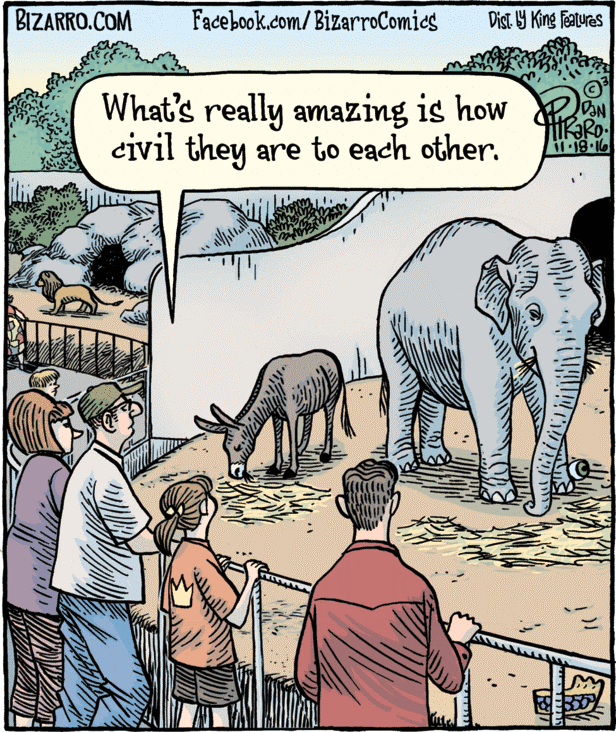
courtesy Dan Piraro, Bizarro.com
Last year, civility took a beating – from rallies to street protestors; from road rage to political rage. Civility was pushed to the back of the bus, and shouted down every time it requested just a little self-restraint and decorum.
According to the Zogby Survey on Civility in U.S. Politics conducted by Zogby Analytics for Allegheny College, “The September 2016 survey of 1,286 adults, which revisits the same questions asked in Allegheny’s 2010 benchmark civility survey, shows that this year’s presidential campaign appears to be the most uncivil in recent American politics. And the uncivil behavior appears to be numbing the electorate.
“For example, in 2010, 89% of respondents said commenting on another’s race or ethnicity in a political engagement was not okay. Today that number has dropped to 69%, a full 20 points. Similarly, 81% said commenting on someone’s sexual orientation was not acceptable. Today that number is 65%.
“And the percentage of voters who believe elected officials should pursue personal friendships with members of other parties plummeted even more precipitously, from 85 percent to 56 percent.
“From where did we first get ‘civility’?,” Johns Hopkins University Professor P.M. Forni asks.
“Civitas is a juridical and political construct that Greco-Roman antiquity bequeathed to Western civilization. In Latin, it meant ‘city,’ in the sense of city-state, the body politic, the commonwealth. Consequently, ‘civilitas’ – which became ‘civility’ in English – was the conduct becoming citizens in good standing, willing to give of themselves for the good of the city.
“Building on the notion of ‘civilitas,’ ” Froni continues, “here is a possible definition of civility for our times: The civil person is someone who cares for his or her community and who looks at others with a benevolent disposition rooted in the belief that their claim to well being and happiness is as valid as his or her own.”
The Institute for Civility reminds us of the underlying aspect of respect.
“Civility is about more than just politeness… It is about disagreeing without disrespect, seeking common ground as a starting point for dialogue about differences, listening past one’s preconceptions, and teaching others to do the same.
“Civility,” the Institute points out, “is the hard work of staying present even with those with whom we have deep-rooted and fierce disagreements. It is political in the sense that it is a necessary prerequisite for civic action. But it is political, too, in the sense that it is about negotiating interpersonal power such that everyone’s voice is heard, and nobody’s is ignored.
“And civility begins with us.”
After a bruising and bitter presidential campaign, Thomas Jefferson stood in the Senate chamber of the Capitol on March 4, 1801 to deliver his inaugural address to a divided States of America. Jefferson understood the importance of compromise in order to effectively govern and he made it clear in his first speech.
“Every difference of opinion is not a difference of principle. We have called by different names brethren of the same principle. We are all republicans: we are all federalists.”
Writing for the Irish Times (May 11, 2016), Laura Kennedy describes how Thomas Jefferson would argue with civility.
“Stop waiting for your turn to speak during a disagreement. Listen to the other person. We should enter into these sorts of conversations in a generous spirit; what is there in the other person’s perspective that you can concede? What is there that you can agree with? If you can find it, perhaps you can answer the question together instead of shouting at one another.
“A difference of opinion isn’t always a difference of principle. That one is important. Stop attaching moral value to opinions or ascribing intent to others’ ideas.
“Most importantly of all, adopt artificial good humor (if that’s the best you can muster).”
Comments

Recent Commentaries

Adversity and Perseverance
February 16, 2026
Who Decides What’s Seen?
February 12, 2026
The Death of Shame
February 9, 2026
Because We Need It
February 5, 2026
Why George Marshall Still Matters
February 2, 2026
The Most Sacred Thing
January 29, 2026
THIS Cannot Be Ignored
January 25, 2026
Year One
January 20, 2026
Removed
January 18, 2026
Clarence Darrow’s Warning to a Tired Democracy
January 15, 2026
Read More Articles
The Latest... And Sometimes Greatest
Accountability, Optional
On October 7, 2025, Pam Bondi, the nation’s chief law enforcement officer, appeared before a Senate oversight committee and refused to answer question after question,...
January 12, 2026
My Dinner with Jefferson, Hamilton and Madison
In June 1790, I attended an extraordinary dinner. Through a tear in the fabric of time, I found myself seated at a small table with...
January 8, 2026
When the Story Becomes the Scandal
For nearly sixty years, the CBS News program 60 Minutes has stood as one of the few remaining institutions in American journalism recognized as serious,...
January 5, 2026
A Light from Christmas Past – Conclusion
I’ll be back on January 5th. Later that night, Emily returned home, warmed her hands around a cup of tea, and set the original lantern...
December 24, 2025
A Light From Christmas Past – Part II
Emily returned to the attic the next evening. The attic felt different, not mysterious, purposeful. She unlocked the small door again and stood for a...
December 23, 2025
A Light from Christmas Past
In the winter of his century, Charles Dickens walked a London powered by industry but running short on warmth. People moved past one another as...
December 22, 2025