Published: May 2, 2008
By Jim Lichtman
Air Force Colonel Morris Davis chief prosecutor at the detention facility at Guantanamo Bay, Cuba resigned last October due to political interference.
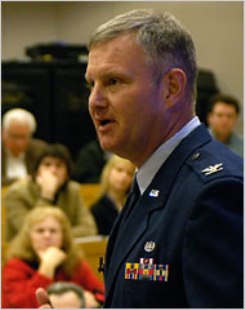
“…we’ve really taken ‘military’ out of military commissions and inserted politics in its place,” Morris said in a December, 2007 interview on National Public Radio.
“I took the job… with the agreement that I’d stay… as long as I thought we were committed to providing full, fair, and open trials. In October of this year [2007], I concluded that I couldn’t live up to that commitment.
This past Monday (April 28) the Washington Post reported that Col. Davis appeared at Guantanamo“…to argue on behalf of a terrorism suspect that the military justice system has been corrupted by politics and inappropriate influence from senior Pentagon officials.”
“…the one that really broke the camel’s back for me was on October 3rd, Deputy Secretary of Defense Gordon England signed memorandums that placed Department of Defense general council Jim Haynes in a command position over me with the authority to issue orders to me as the chief prosecutor. Prior to that, the prosecution had pretty much independence, and as a matter of public record, I instructed my staff, back in 2005, that we’d use no evidence derived from waterboarding.
“My opinion is, if you induce someone to believe he’s going to die if they don’t talk, that has no place in a courtroom. So, I thought it was time to leave.
“Congress gave us a very good piece of legislation with the Military Commissions Act,” Colonel Davis said. “The problem, I see, is not in the statutory framework, it’s in the execution and implementation of that by a political appointee who seems intent on trying to control the process in order to insure outcomes. And that’s not the way you do justice in an American system of justice.”
In both politics and the military, we have seen too many examples of loyalty trumping duty – not always for self-interest, but sometimes for a perceived noble cause.
In the case of the Guantanamo detainees, most Americans probably feel that most or all of the individuals held there had some part in planning or executing terrorist attacks on America. We have also witnessed examples where the guilty go free due to some legal technicality. Therefore, the argument goes, we don’t want any of the possible guilty to wriggle free.
Politics adds another layer to all of this.
The current administration would very much like to have the guilty receive the full force of the law for their alleged crimes. Due to the upcoming elections, they want to speed the process along, not for the right reasons, but for partisan, political reasons.
No matter the reasons, the ethical reality is the “noble cause” excuse is another variation of the end-justifies-the-means rationale. We all want to see those responsible for terrorist acts punished. We want to see justice done, but not at the cost of integrity to the process, itself.
Colonel Davis’ stand in speaking out about the undue influence in the case of the detainees is not unlike tobacco insider Jeff Wigand speaking out about the decades of lies told by the tobacco companies. In spite of his ethical stand, Colonel Davis is likely to face the same kinds of consequences Jeff Wigand faced: the loss of credibility, isolation from friends and colleagues, perhaps even the loss of a valued career.
Loyalty is an important and fundamental ethical value. But when you have a choice between honestly speaking out for what you know is the truth – in this case the corruption of a judicial process for the sake of political expediency – that trumps loyalty to any individual, group or organization.
Author and Nobel Peace Prize winner Elie Wisel reminds us,“There may be times when we are powerless to prevent injustice, but there must never be a time when we fail to protest.”
Comments
Recent Commentaries

Lindsay Vonn’s Gold Medal Moment
March 12, 2026

Teaching an Algorithm Right from Wrong
March 9, 2026
Now, More Than Ever
March 6, 2026
Peace Is Not an Elective
March 2, 2026
Revelations
February 26, 2026
The Story of Chips, and The Cost of Looking Away
February 23, 2026

It’s Time to Talk About Respect
February 18, 2026

Adversity and Perseverance
February 16, 2026
Who Decides What’s Seen?
February 12, 2026
The Death of Shame
February 9, 2026
Read More Articles
The Latest... And Sometimes Greatest
Because We Need It
From the man who invented The Tonight Show. What Steve Allen understood—long before humor became sharper and more performative—is that laughter can be light and...
February 5, 2026
Why George Marshall Still Matters
There are moments in history when power reveals its true character. During World War II, no American general was more central to victory than George...
February 2, 2026
The Most Sacred Thing
We toss the word “sacred” around as if it were a mood, something reserved for private faith. But in public life, “sacred” has a harder...
January 29, 2026
THIS Cannot Be Ignored
New information has now confirmed what many feared from the start: Alex Pretti was disarmed before he was shot—multiple times—by federal agents in Minneapolis. Whatever...
January 25, 2026
Year One
Not long ago, I stopped watching the national news. I told myself I was stepping away from the noise and the churn for some peace...
January 20, 2026
Removed
First an update: Not long ago, 60 Minutes, the CBS news program, pulled a segment a few hours before it was set to air. The...
January 18, 2026