Published: January 8, 2026
By Jim Lichtman
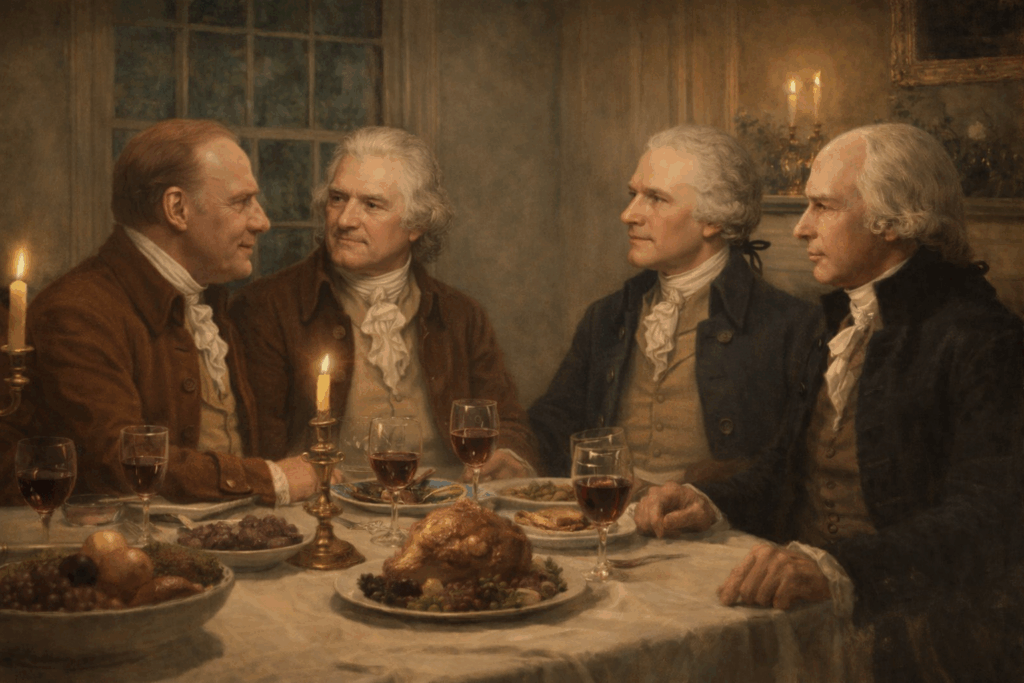
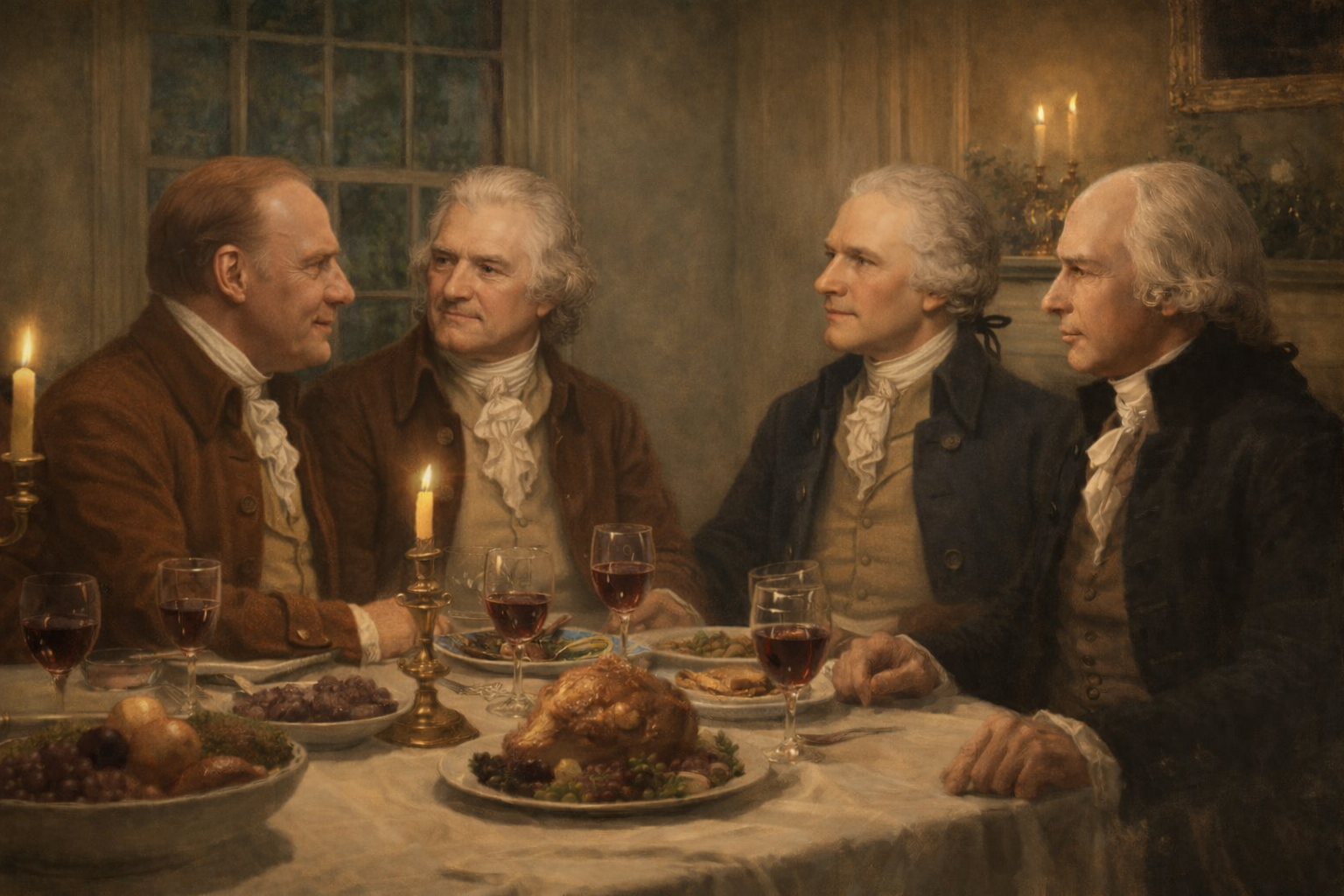
In June 1790, I attended an extraordinary dinner.
Through a tear in the fabric of time, I found myself seated at a small table with three revolutionary figures: Thomas Jefferson, Alexander Hamilton, and James Madison.
While the dinner itself was real, it was reconstructed by author Charles A. Cerami in Dinner at Mr. Jefferson’s. Even if the precise words spoken that evening have been lost to history. What survives, however, are the arguments. What unfolded at the table was a serious conversation about power, liberty, and human nature, revealing how democracy survives. I found myself living a moment of history, and dressed for the occasion.
Mr. Jefferson’s dinner was replete with the finest cuisine he had come to love in France. He served French Bordeaux and Madeira not for indulgence, but for what they invited: patience, reflection, and a slower exchange of ideas.
Mr. Hamilton was convinced that a young republic could not endure on ideals alone. “Power is not a vice but a necessity, an instrument that had to be strong enough to hold the nation together in a dangerous and uncertain world.”
“I take your point, Mr. Hamilton,” I said, “However, power carries its own danger. As Lord Acton would later warn, power tends to corrupt, and absolute power corrupts absolutely.”
“Then the task,” he replied, “is not to fear power, but to discipline it, to give it energy without surrendering it to impulse. A weak government invites corruption no less surely than an unchecked one.”
Clearly, Alex has been gone long enough to be unaware of the current threats to the democracy he helped create. I turned to Mr. Jefferson, who carried the memory of tyranny and the quiet fear that power, once obtained, rarely releases its grip. He needed no reminder of King George III and was clearly in my camp.
“The danger,” Mr. Jefferson said, “is not whether government can act, but how easily it may overreach. Liberty is never self-sustaining. It is most often surrendered gradually, with the willing consent of those who mistake efficiency or security for freedom, forgetting that vigilance is required not only in our laws, but in ourselves.”
“I couldn’t agree with you more, sir.” I smiled as I poured a nice Pinot Noir I had brought for the occasion. Mr. Jefferson sipped it. It pleased him.
Not so Mr. Hamilton, whose expression turned prunish.
“Good wine, like good government,” Mr. Jefferson said, “is best appreciated when it invites us to slow down and listen carefully, remembering that the health of the republic depends less on our preferences than on our patience, especially when convictions run deep.”
Mr. Madison, had been listening closely. “The problem is not power or liberty alone, but human nature. People are ambitious, fearful, self-interested, and inconsistent. The Constitution does not presume virtue; it protects the republic from the consequences when virtue fails.”
“I couldn’t agree with you more, either, sir.”
(I chose not to interrupt the moment with examples of failures from our own time.)
The lesson of the dinner was clear: no single argument was agreed upon. Each left with misgivings. And yet the republic endured. Compromise, in this setting, was not weakness but responsibility.
History reminds us that moral certainty without restraint can be as damaging as corruption. The Founders understood that refusing to bend may feel principled, but it is often reckless. Thus, compromise became a watchword.
Perhaps the most important lesson of the dinner was the simplest. Rivals remained seated. They argued fiercely and listened reluctantly. Civility here was not politeness; it was a democratic tool. When conversation collapses, force fills the void.
Democracy survives when it keeps faith with something larger than itself: the public trust, the common good, the republic itself.
Comments
Recent Commentaries
THIS Cannot Be Ignored
January 25, 2026
What the Framers Understood About Power and What the Supreme Court Gets Wrong
January 22, 2026
Year One
January 20, 2026

Removed
January 18, 2026
Clarence Darrow’s Warning to a Tired Democracy
January 15, 2026
Accountability, Optional
January 12, 2026
My Dinner with Jefferson, Hamilton and Madison
January 8, 2026

When the Story Becomes the Scandal
January 5, 2026
A Light from Christmas Past – Conclusion
December 24, 2025
A Light From Christmas Past – Part II
December 23, 2025
Read More Articles
The Latest... And Sometimes Greatest
A Light from Christmas Past
In the winter of his century, Charles Dickens walked a London powered by industry but running short on warmth. People moved past one another as...
December 22, 2025
Nothing Beside Remains
I have stopped watching national news about Donald Trump because the coverage now mirrors the damage itself. What once informed now exhausts; what once clarified...
December 16, 2025
Finding Common Ground, and Why It Matters
A national media organization has recognized the seriousness of our political division and offered something we’ve been missing… A REAL beginning toward ending the death...
December 15, 2025
What Dickens Meant Us to Remember
Every December, I look forward to reading and watching Dickens’ A Christmas Carol. While there are countless versions of the classic, I always return to...
December 11, 2025
Looking for America’s Soul
“At what point then is the approach of danger to be expected? I answer, if it ever reach us, it must spring up amongst us;...
December 8, 2025
Here We Are Again
CONTEMPT—Raw, in-your-face, unapologetic, and morally bankrupt. Every so often, the country reaches a point where character is not an abstraction but a requirement. We’re in...
December 5, 2025