Published: August 1, 2025
By Jim Lichtman
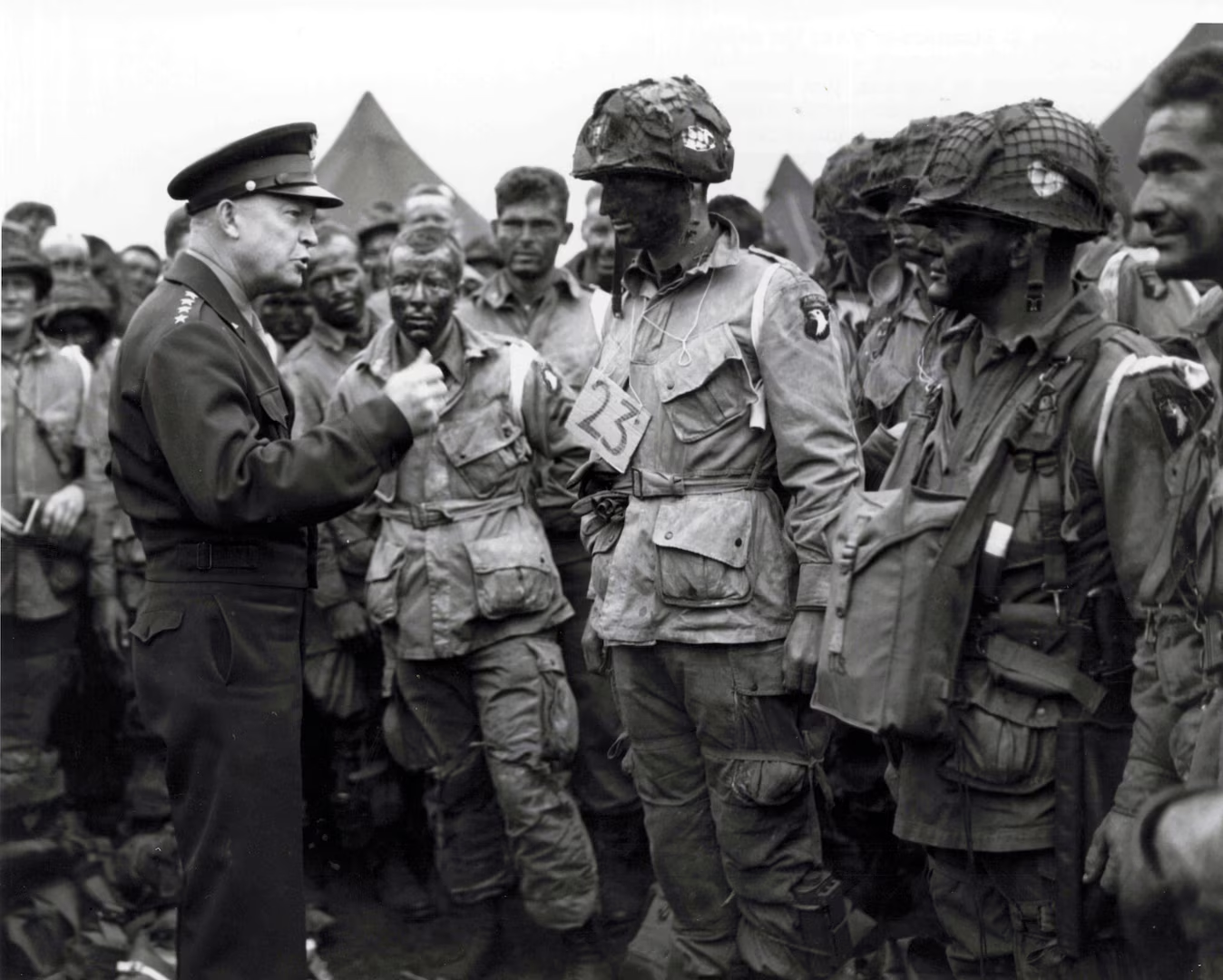
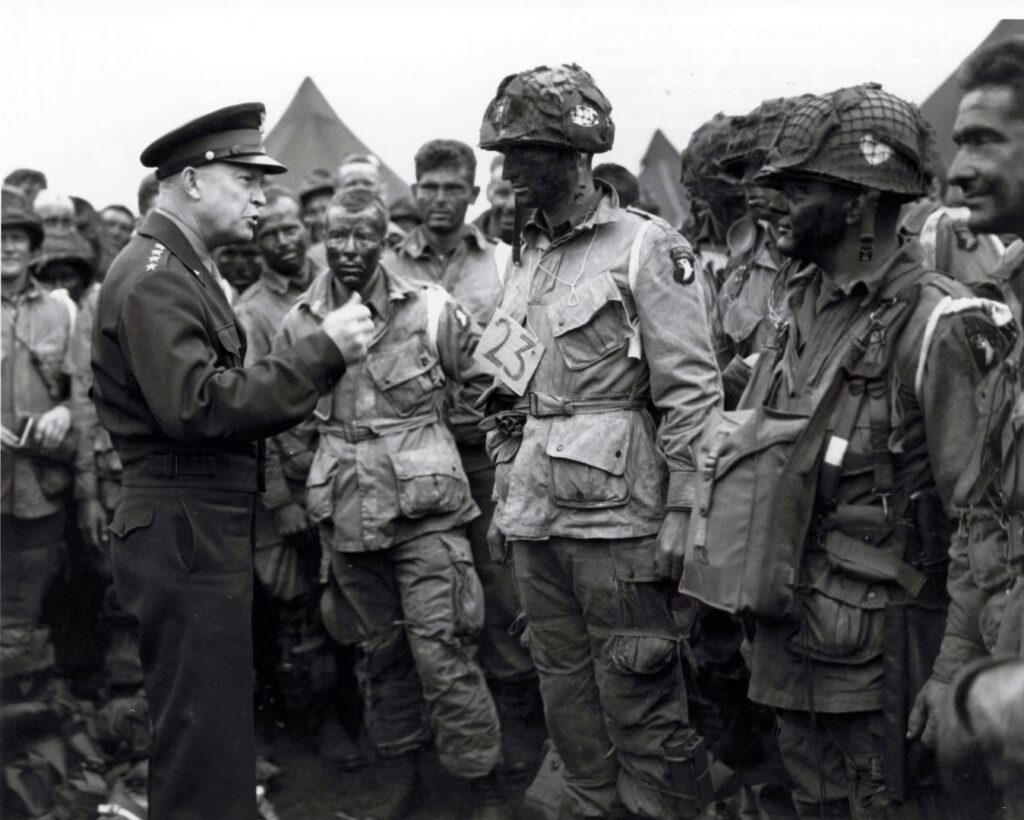
June 5, 1944 – General Eisenhower speaks with paratroopers of the 101st Airborne Division just before they board their planes to participate in the first assault of the Normandy invasion.
I’ve been looking back at history for moments when leadership wasn’t just a word, it was a responsibility carried with humility and moral strength.
It’s easy to talk about leadership when the outcome is victory. The harder truth—the one that defines real character—is how a leader responds when the stakes are high, and the outcome is uncertain.
Dwight D. Eisenhower wasn’t a man of theatrics. He carried his authority the way a soldier carries a field pack…without complaint. He didn’t bark commands or chase cameras. He listened more than he spoke. And when he did speak, it was with clarity, not showmanship. He embodied a kind of leadership that was quiet, resolute, and deeply grounded in duty. The kind that didn’t need to shout to be heard.
On the eve of D-Day, June 5, 1944, Eisenhower prepared a short, handwritten message. It wasn’t meant to inspire. It wasn’t even meant to be seen—unless the invasion failed. In just four sentences, Eisenhower took full responsibility for what could have been one of the greatest military disasters in history:
“Our landings in the Cherbourg-Havre area have failed to gain a satisfactory foothold, and I have withdrawn the troops. My decision to attack at this time and place was based upon the best information available. The troops, the air, and the Navy did all that bravery and devotion to duty could do. If any blame or fault attaches to the attempt, it is mine alone.”
There were no caveats. No shifting of blame to weather reports, bad intelligence, or battlefield conditions. Just a clear statement: “It is mine alone.”
This is what integrity looks like. Not a performance, not a calculation—but the quiet, private commitment to truth and responsibility, even when no one is watching. Eisenhower didn’t need to release the note. D-Day succeeded. But the fact that he wrote it—before he knew what would happen—reveals the kind of character that doesn’t need applause to do the right thing.
Today, we’re surrounded by leaders who do the opposite. When plans fail or promises collapse, we hear excuses. We see fingers pointed in every direction but inward. Deflection has become strategy. Spin has become policy. And truth is treated not as a duty, but as something optional.
Contrast that with President Barack Obama’s response to the failed launch of Healthcare.gov in 2013. While critics circled and headlines mounted, Obama didn’t duck the issue. He didn’t blame his staff. He didn’t scapegoat contractors. He owned the failure. He faced the press and the public and said, “That’s on me.”
It wasn’t a grand moment. It didn’t change headlines overnight. But it mattered—because accountability still matters. Not because it’s politically convenient, but because it is the foundation of trust. And trust, once lost, is not easily rebuilt. It is earned, brick by brick, in moments just like these—when leaders have the chance to hide and instead choose to stand up. That choice defines not only their character, but ours, if we’re willing to expect more.
What Eisenhower understood—and what too many today ignore—is that real leadership begins with conscience. Not branding. Not blame. Conscience. The quiet voice that says, “Do the right thing, even when no one’s looking—and especially when everything’s on the line.”
In the end, integrity doesn’t shout. It doesn’t tweet. It doesn’t need a poll to know what’s right. It steps forward, quietly, when no one else will. And when it does, it reminds the rest of us that the truth still matters—and character still counts.
Comments

Recent Commentaries

November 4, 2026
October 20, 2026

Has America Lost Its Way?
October 16, 2026
All The President’s Targets
October 13, 2026
Integrity Doesn’t Require a Megaphone
October 12, 2026
WHOSE PURPOSE DOES THIS SERVE?
October 9, 2026

Choreographer of Disaster
October 5, 2026
I Am Not a Politician, and I Have No Partisan Loyalties
October 2, 2026
A Man of Incorruptible Integrity
September 29, 2026

HUMAN VALUES: NOT SPECIFIED
September 23, 2026
You Can’t Do That.
September 21, 2026
Read More Articles
The Latest... And Sometimes Greatest
I AM SICKENED
Tonight, protesters are surrounding the Kennedy Center, the living memorial to John F. Kennedy and the heartbeat of Washington’s cultural life. They are there because...
September 18, 2026
The Courage to Defend a Principle
In 1998, at the height of the Clinton-Lewinsky scandal, Secret Service Director Lewis Merletti was driving to work when a radio report stopped him cold....
September 17, 2026
The Better Angels Among Us
By all appearances, we are becoming less the land of the brave than the land of resentment. Every day is Groundhog Day: same arguments, same...
September 14, 2026
We Remember
On September 11, 2001, nearly 3,000 people were killed in terrorist attacks in New York, at the Pentagon, and aboard Flight 93 in Pennsylvania. More...
September 11, 2026
Mister Roberts!
One of my favorite movies is Mister Roberts, the 1955 comedy-drama set aboard the USS Reluctant in the Pacific during World War II. Henry Fonda...
September 8, 2026
Where’s the Character
In 1984, Wendy’s ran a television commercial featuring the redoubtable Clara Peller, staring at an enormous hamburger bun. Inside was a burger patty smaller than...
August 7, 2026