Published: January 11, 2021
By Jim Lichtman
“This building is dedicated by his colleagues to the memory of Philip A. Hart with affection, respect, and esteem. A man of incorruptible integrity and personal courage strengthened by inner grace and outer gentleness, he elevated politics to a level of purity that will forever be an example to every elected official. He advanced the cause of human justice, promoted the welfare of the common man, and improved the quality of life. His humility and ethics earned him his place as the conscience of the Senate.”
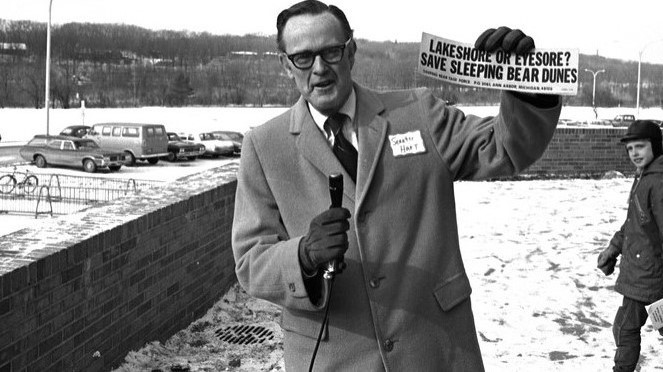
Those words are inscribed in marble on the front of the Hart Senate Office Building in Washington, DC. In his 1998 book, The Buying of the Congress, journalist Charles Lewis offers this Senator’s story of integrity.
“Hart earned a bachelor’s degree at Georgetown University and a law degree at the University of Michigan. Before entering politics, he worked in a Detroit law firm. As a novice political candidate in 1950, Hart lost his first election for Secretary of State, and following a stint as a U.S. Attorney, he was elected to statewide office as Michigan’s lieutenant governor in 1954 and was reelected in 1956. He was elected to the Senate in 1958 and served there until his death from cancer in 1976.
“Hart was known as an author and sponsor of important legislation in the areas of civil rights (he was a leader in the fight for the 1956 Voting Rights Act), antitrust enforcement, and consumer and environmental protection. But most unusual, then and today, Hart frequently took difficult, courageous stands on issues directly against his own political self-interest. In late 1968, for example, a staff aide on the Senate Antitrust and Monopoly Subcommittee, which Hart chaired, proposed that the subcommittee investigate the automobile industry. Hart met the aide, Donald Randall, in the hallway:
“‘Don, I understand you’re recommending we go into investigation of the automobile business,’ Hart observed.
“‘Yes, sir,’ said Randall.
“‘Do you know that I’m running for re-election next year?’
“‘Yes, sir.’
“‘Do you know I’m from Michigan?’
“‘Yes, sir.’
“‘You know that the biggest business in my state is the auto industry, don’t you?’
“‘Yes, sir.’
“‘And do you know that if I lose, you lose?’
“‘Yes, sir.’
“‘Do you still want to do it?’ Hart asked.
“‘Yes, sir,’ Randall replied.
“‘Well,’ Hart said, ‘go do it.’
“For more than a year, Hart’s subcommittee held hearings on abuses in the automobile-repair business. Hundreds of angry car owners, frustrated mechanics, and auto-industry experts testified about the rampant incompetence and exploding costs in the multibillion-dollar business. The owner of an automobile-diagnostic center in Denver testified that tests on 5,000 cars in his shop revealed that only one of every 100 cars was being repaired properly.
“One of the outcomes of Hart’s hearings was the 1970 Motor Vehicle Information and Cost Savings Act, which mandated fragility standards for assembling automobiles. Motor Trend magazine said, ‘Senator Hart is a man of courage. To attack a problem as large and politically explosive as automobile repair, especially for a Senator from Michigan, the home of the auto industry, is no small undertaking.’
“Hart was also upset by monopolistic practices in the communications and newspaper industry, and he held hearings on the subject. He was one of the few dissenting voices against the Newspaper Preservation Act in 1970, which gave a special exemption to competing newspapers that merged their business operations and fixed their advertising rates. ‘Swift congressional rescue of the publishers,’ Hart observed, ‘must make fascinating reading for the blacks who, until the 1964 Civil Rights Act, had waited decades for relief from court convictions for eating in certain restaurants and hotels.’
With the chaos and bitterness taking place in Washington, every Senator and Representative, should stand in front of that inscription and read the words that describe the character of a man who acted in the best interests of the people rather than those of his party or himself.
Who will live up to Hart’s standard, today?
Comments

Recent Commentaries
I AM SICKENED
September 18, 2026
The Courage to Defend a Principle
September 17, 2026

The Better Angels Among Us
September 14, 2026

We Remember
September 11, 2026
Mister Roberts!
September 8, 2026

Where’s the Character
August 7, 2026
It Was Important Then. It is Important Today
August 3, 2026
When Political Identity Replaces Ethical Judgment
July 31, 2026

Principles Matter.
July 28, 2026

All the President’s Men 2.0
July 23, 2026
Read More Articles
The Latest... And Sometimes Greatest
The Threat to November Is Already Here
“Cunning, ambitious, and unprincipled men will be enabled to subvert the power of the people and to usurp for themselves the reins of government.”—George Washington’s...
July 20, 2026
Jon Ossoff and the Conscience of Atticus Finch
I’ve written about Georgia Senator Jon Ossoff before, but after watching his questioning of Jay Clayton, President Trump’s nominee for director of national intelligence (DNI),...
July 17, 2026
Hearts and Minds
There’s a moment in Cool Hand Luke when Luke, played by Paul Newman, is returned to a prison camp after escaping. Determined to break his...
July 16, 2026
The Ethics of Belonging
I recently read a book by a man who has learned some of life’s hardest lessons and, by his own account, is still learning them...
July 14, 2026
The Best of Us
“We choose to go to the Moon in this decade and do the other things—not because they are easy, but because they are hard.” When...
July 9, 2026
The Standard Washington Set
Much has been written about George Washington, our first American president: his command of the Continental Army, his leadership in the fragile birth of a...
July 6, 2026