Published: March 12, 2013
By Jim Lichtman
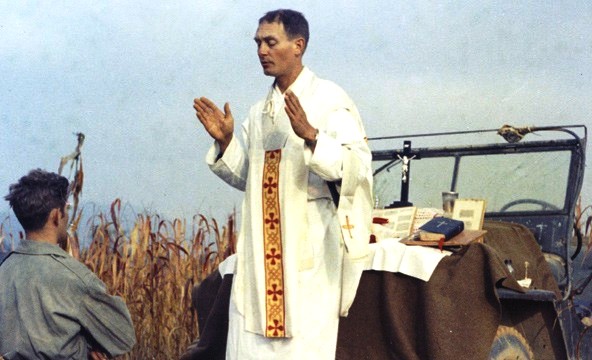 This is an amazing story not only of duty and courage, but of faith.
Last week, President Obama stood in the East Room of the White House to tell an amazing story of courage and duty by an Army Chaplain in the Korean War.
The President was there to bestow the nation’s highest military award, The Medal of Honor posthumously to Father Kapaun. Included in the audience were relatives, as well as a number of the American heroes who served alongside him—veterans and former POWs from the Korean War.
“After the Communist invasion of South Korea, [Father Kapaun] was among the first American troops that hit the beaches and pushed their way north through hard mountains and bitter cold. In his understated Midwestern way, he wrote home, saying, ‘this outdoor life is quite the thing’ and ‘I prefer to live in a house once in a while.’ But he had hope, saying, ‘It looks like the war will end soon.’
“That’s when Chinese forces entered the war with a massive surprise attack — perhaps 20,000 soldiers pouring down on a few thousand Americans. In the chaos, dodging bullets and explosions, Father Kapaun raced between foxholes, out past the front lines and into no-man’s land — dragging the wounded to safety.
“When his commanders ordered an evacuation, he chose to stay — gathering the injured, tending to their wounds. When the enemy broke through and the combat was hand-to-hand, he carried on — comforting the injured and the dying, offering some measure of peace as they left this Earth.
“When enemy forces bore down, it seemed like the end — that these wounded Americans, more than a dozen of them, would be gunned down. But Father Kapaun spotted a wounded Chinese officer. He pleaded with this Chinese officer and convinced him to call out to his fellow Chinese. The shooting stopped and they negotiated a safe surrender, saving those American lives.
“Then, as Father Kapaun was being led away, he saw another American — wounded, unable to walk, laying in a ditch, defenseless. An enemy soldier was standing over him, rifle aimed at his head, ready to shoot. And Father Kapaun marched over and pushed the enemy soldier aside. And then as the soldier watched, stunned, Father Kapaun carried that wounded American away.
“This is the valor we honor today — an American soldier who didn’t fire a gun, but who wielded the mightiest weapon of all, a love for his brothers so pure that he was willing to die so that they might live. And yet, the incredible story of Father Kapaun does not end there.
“He carried that injured American, for miles, as their captors forced them on a death march. When Father Kapaun grew tired, he’d help the wounded soldier hop on one leg. When other prisoners stumbled, he picked them up. When they wanted to quit — knowing that stragglers would be shot — he begged them to keep walking.
“In the camps that winter, deep in a valley, men could freeze to death in their sleep. Father Kapaun offered them his own clothes. They starved on tiny rations of millet and corn and birdseed. He somehow snuck past the guards, foraged in nearby fields, and returned with rice and potatoes. In desperation, some men hoarded food. He convinced them to share. Their bodies were ravaged by dysentery. He grabbed some rocks, pounded metal into pots and boiled clean water. They lived in filth. He washed their clothes and he cleansed their wounds.
“The guards ridiculed his devotion to his Savior and the Almighty. They took his clothes and made him stand in the freezing cold for hours. Yet, he never lost his faith. If anything, it only grew stronger. At night, he slipped into huts to lead prisoners in prayer, saying the Rosary, administering the sacraments, offering three simple words: ‘God bless you. One of them later said that with his very presence he could just for a moment turn a mud hut into a cathedral.
“That spring, he went further — he held an Easter service. As the sun rose that Easter Sunday, he put on [his] purple stole and led dozens of prisoners to the ruins of an old church in the camp. And he read from a prayer missal that they had kept hidden. He held up a small crucifix that he had made from sticks. And as the guards watched, Father Kapaun and all those prisoners — men of different faith, perhaps some men of no faith — sang the Lord’s Prayer and ‘America the Beautiful.’ They sang so loud that other prisoners across the camp not only heard them, they joined in, too — filling that valley with song and with prayer.
“That faith — that they might be delivered from evil, that they could make it home — was perhaps the greatest gift to those men; that even amidst such hardship and despair, there could be hope; amid their misery in the temporal they could see those truths that are eternal; that even in such hell, there could be a touch of the divine. Looking back, one of them said that that is what ‘kept a lot of us alive.’
“Yet, for Father Kapaun, the horrific conditions took their toll. Thin, frail, he began to limp, with a blood clot in his leg. And then came dysentery, then pneumonia. That’s when the guards saw their chance to finally rid themselves of this priest and the hope he inspired. They came for him. And over the protests and tears of the men who loved him, the guards sent him to a death house — a hellhole with no food or water — to be left to die.
“And yet, even then, his faith held firm. ‘I’m going to where I’ve always wanted to go,’ he told his brothers. ‘And when I get up there, I’ll say a prayer for all of you.’ And then, as he was taken away, he did something remarkable — he blessed the guards. ‘Forgive them,’ he said, ‘for they know not what they do. Two days later, in that house of death, Father Kapaun breathed his last breath. His body was taken away, his grave unmarked, his remains unrecovered to this day.”
Truly a remarkable reminder of the power of faith.
When one of Father Kapaun’s comrades heard that the priest was to receive the nation’s highest honor, he said, “it’s about time.”
Comments
Recent Commentaries
I AM SICKENED
September 18, 2026
The Courage to Defend a Principle
September 17, 2026
The Better Angels Among Us
September 14, 2026
We Remember
September 11, 2026
Mister Roberts!
September 8, 2026
Where’s the Character
August 7, 2026
It Was Important Then. It is Important Today
August 3, 2026
When Political Identity Replaces Ethical Judgment
July 31, 2026
Principles Matter.
July 28, 2026
All the President’s Men 2.0
July 23, 2026
Read More Articles
The Latest... And Sometimes Greatest
The Threat to November Is Already Here
“Cunning, ambitious, and unprincipled men will be enabled to subvert the power of the people and to usurp for themselves the reins of government.”—George Washington’s...
July 20, 2026
Jon Ossoff and the Conscience of Atticus Finch
I’ve written about Georgia Senator Jon Ossoff before, but after watching his questioning of Jay Clayton, President Trump’s nominee for director of national intelligence (DNI),...
July 17, 2026
Hearts and Minds
There’s a moment in Cool Hand Luke when Luke, played by Paul Newman, is returned to a prison camp after escaping. Determined to break his...
July 16, 2026
The Ethics of Belonging
I recently read a book by a man who has learned some of life’s hardest lessons and, by his own account, is still learning them...
July 14, 2026
The Best of Us
“We choose to go to the Moon in this decade and do the other things—not because they are easy, but because they are hard.” When...
July 9, 2026
The Standard Washington Set
Much has been written about George Washington, our first American president: his command of the Continental Army, his leadership in the fragile birth of a...
July 6, 2026