Published: May 15, 2025
By Jim Lichtman
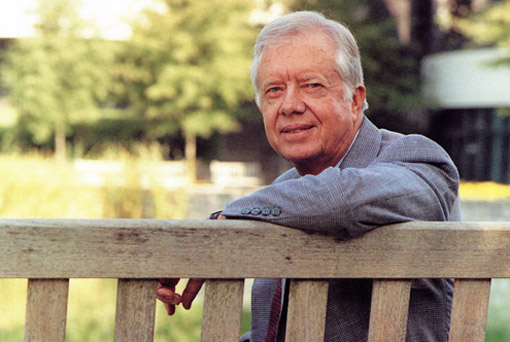
Photo: Rick Diamond
Jimmy Carter didn’t just talk about values—he lived them. Long before entering the White House in 1977, and long after he left, Carter viewed leadership as a form of service. That idea of service shaped every part of his presidency. While it cost him politically, it never shook his commitment to doing what was right.
He believed the office should be about responsibility, not self-interest. “We must adjust to changing times and still hold to unchanging principles,” he said. That was Carter’s approach from the beginning. He didn’t govern to please pundits. He made decisions he believed served the long-term good, not short-term approval.
One of the clearest examples came in foreign policy. Carter put human rights at the center of U.S. engagement with the world. That meant breaking with regimes that had long enjoyed U.S. support—governments in Latin America and Asia with poor records on freedom and justice. Critics called it naive. Some said it weakened American power. But Carter held firm. “America did not invent human rights,” he said. “In a very real sense, human rights invented America.”
He believed the U.S. should stand for something beyond its interests. He believed it should serve as an example of ethics in a turbulent world.
He also showed moral restraint during the Iran hostage crisis. After militants took 52 Americans captive, Carter faced enormous public pressure to act decisively—and fast. He didn’t. He refused to trade weapons for hostages. He avoided inflammatory rhetoric. And when a military rescue mission failed, he took responsibility. He didn’t blame others. He didn’t deflect. He kept working to bring the hostages home—and did. They were released safely on his last full day in office.
It was too late to change the election. But Carter had already made peace with the decision. He wasn’t in the job to save his reputation. He was in it to serve.
After leaving office, he didn’t monetize the presidency. He went back to Plains, Georgia, lived in a modest home, and kept working. Through The Carter Center, he monitored elections, promoted peace, and fought disease around the world. He built homes with Habitat for Humanity. He taught Sunday school. And he remained, throughout, the same person he’d always been—humble, honest, and driven by faith in action, not image.
In 2002, he was awarded the Nobel Peace Prize—not for what he did in office, but for what he did with the rest of his life.
In many ways, Carter’s model of leadership resembles that of Pope Francis: soft-spoken, values-driven, and unimpressed by status. He showed that you can lead with moral clarity and still get things done. And when politics got in the way, he never sacrificed his integrity to stay in the game.
In an age of performance and polarization, Carter’s example is easy to overlook—but hard to forget. He reminded us that the presidency isn’t just about policy. It’s about character.
That’s the kind of leadership we need more of—not just then, but now.
Comments
Leave a Comment

Recent Commentaries
I AM SICKENED
September 18, 2026
The Courage to Defend a Principle
September 17, 2026
The Better Angels Among Us
September 14, 2026

We Remember
September 11, 2026
Mister Roberts!
September 8, 2026
Where’s the Character
August 7, 2026
It Was Important Then. It is Important Today
August 3, 2026
When Political Identity Replaces Ethical Judgment
July 31, 2026
Principles Matter.
July 28, 2026
All the President’s Men 2.0
July 23, 2026
Read More Articles
The Latest... And Sometimes Greatest
The Threat to November Is Already Here
“Cunning, ambitious, and unprincipled men will be enabled to subvert the power of the people and to usurp for themselves the reins of government.”—George Washington’s...
July 20, 2026
Jon Ossoff and the Conscience of Atticus Finch
I’ve written about Georgia Senator Jon Ossoff before, but after watching his questioning of Jay Clayton, President Trump’s nominee for director of national intelligence (DNI),...
July 17, 2026
Hearts and Minds
There’s a moment in Cool Hand Luke when Luke, played by Paul Newman, is returned to a prison camp after escaping. Determined to break his...
July 16, 2026
The Ethics of Belonging
I recently read a book by a man who has learned some of life’s hardest lessons and, by his own account, is still learning them...
July 14, 2026
The Best of Us
“We choose to go to the Moon in this decade and do the other things—not because they are easy, but because they are hard.” When...
July 9, 2026
The Standard Washington Set
Much has been written about George Washington, our first American president: his command of the Continental Army, his leadership in the fragile birth of a...
July 6, 2026
Carter “showed that you can lead with moral clarity and still get things done. And when politics got in the way, he never sacrificed his integrity to stay in the game.”
Those were the days.
“Leadership…is about responsibility not self interest…”
What a man compared to our current president!