Published: June 25, 2010
By Jim Lichtman
“The primary purpose of journalism,” write Bill Kovach and Tom Rosenstiel in their book, The Elements of Journalism, “is to provide citizens with information they need to be free and self-governing.”
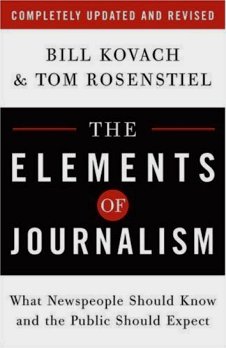
However, the notion of a “free press” has taken on additional consequences with the explosion of information in an electronic age.
“Certainly, the notion of the press as a gatekeeper,” Kovach and Rosenstiel write, “deciding what information the public should know and what it should not – no longer strictly defines journalism’s role. If the New York Times decides not to publish something, at least one of countless other websites, talk radio hosts, and partisans will. … when Newsweek delayed breaking the initial [Monica] Lewinsky scandal, Matt Drudge went ahead.
“The rise of the Internet and the coming of broadband, however, do not mean, as some have suggested, that the concept of applying judgment to the news – of trying to decide what people need and want to know to self-govern – is obsolete. They make the need all the greater.”
Today’s journalism has become a mine field of ethical issues. In 1991, ethicist Michael Josephson outlined six, critical, ethical principles for journalists to follow:
Credibility – The powers of the press should be treated as a public trust. Journalists must inspire credibility – faith and confidence in the honesty, accuracy and fairness of the information they convey.
Independence – Journalists should safeguard their independence and the ability to make news judgments free from improper influences and potential conflicts of interest created by economic, social, ideological, or political considerations. They should perform their obligations without fear, favoritism or prejudice.
Responsibility – The powers of the press should be used responsibly to advance public interest without causing unjustified harm. As a watchdog, the press should be fair, vigilant and aggressive in assuring that people of influence are held accountable. As a public conscience, it should remind citizens of their ideals and values and the way events bear on them. As teacher, it should inform, clarify and explain about matters of social consequence know without pandering unduly to public dispositions to be entertained or titillated.
Integrity – Journalists should be principled, honorable and upright; avoid self-righteousness, have the courage of their convictions, express and fight for their beliefs, and live by ethical principles to the best of their ability.
Respect – Journalists should demonstrate respect for human dignity, privacy, autonomy of others, and the right of self-determination by treating people with respect, courtesy and decency and by providing information needed to make informed decisions.
Accountability – Journalists should accept moral responsibility for the foreseeable consequences of actions and inactions, including the example set for others and when in error, they should make full, fair, prominent and prompt corrections.
When the Globe Magazine published the “last photo” of Gary Coleman, they abandoned any notion of respect or decency. When talk radio hosts put forth misinformation, they ignore responsibility. And when they fail to report corrections to that misinformation they are neglectful of the public’s trust.
Citizens should expect journalists and the media to be accurate, fair, honest, responsible, accountable, independent and decent. Today, the need for ethical judgment is greater than ever.
Comments
Recent Commentaries
I Am Not a Politician, and I Have No Partisan Loyalties
October 2, 2026
A Man of Incorruptible Integrity
September 29, 2026

HUMAN VALUES: NOT SPECIFIED
September 23, 2026
You Can’t Do That.
September 21, 2026
I AM SICKENED
September 18, 2026
The Courage to Defend a Principle
September 17, 2026
The Better Angels Among Us
September 14, 2026
We Remember
September 11, 2026
Mister Roberts!
September 8, 2026
Where’s the Character
August 7, 2026
Read More Articles
The Latest... And Sometimes Greatest
It Was Important Then. It is Important Today
Freedom of speech in America is under attack, not only when people are denied the right to speak, but when lies, intimidation and the deliberate...
August 3, 2026
When Political Identity Replaces Ethical Judgment
The political and cultural landscape has become a minefield of conflicting beliefs, many now rooted less in public policy than in personal identity. One of...
July 31, 2026
Principles Matter.
A few nights ago, I was watching The Way We Were, a film I’ve seen more times than I can count. This time, a single...
July 28, 2026
All the President’s Men 2.0
“Politics had infiltrated every corner of government—a strong-arm takeover of the agencies by the Nixon White House.” —Bob Woodward and Carl Bernstein, All the President’s...
July 23, 2026
The Threat to November Is Already Here
“Cunning, ambitious, and unprincipled men will be enabled to subvert the power of the people and to usurp for themselves the reins of government.”—George Washington’s...
July 20, 2026
Jon Ossoff and the Conscience of Atticus Finch
I’ve written about Georgia Senator Jon Ossoff before, but after watching his questioning of Jay Clayton, President Trump’s nominee for director of national intelligence (DNI),...
July 17, 2026