Published: April 6, 2009
By Jim Lichtman
Halfway through the Jim Carrey movie, The Majestic, the story takes a sharp turn away from romantic comedy to a drama that examines one man facing a moment of principle.
Blacklisted writer Peter Appleton must choose between reading a pre-arranged statement that provides a list of communist sympathizers or take a stand against the Committee on Un-American Activities and stand for the second amendment.
The fact that he’s even considering the choice is due to the influence of a small town that adopts him after a car accident caused him to be washed up on a beach without a friend or a memory.
Appleton bears an uncanny resemblance to long-lost, local war hero Luke Trimble. Unaware of his real identity, Appleton wants to believe this is his life. Even Trimble’s girlfriend is convinced it’s him, until Appleton begins to remember. And this is where his past catches up to him. It’s also when we realize what the movie is really about – having the courage to stand up for a principle.
A self-declared coward, Appleton reads the last letter Trimble writes to his girl explaining why he chose to enlist: “When bullies rise up, the rest of us have to beat them back down, whatever the cost.”
The words inspire Appleton to face the committee like the principled Luke.
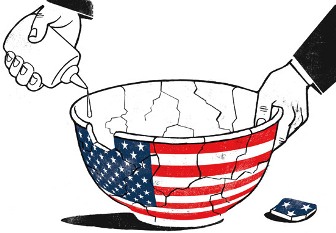
Greed, corruption, dishonesty – these are just of few of the bullies we face today. And the real question that we all face is: How do we restore America’s integrity?
On the brink of nuclear war, a calm but resolute President Kennedy assured the nation that “The path we have chosen for the present is full of hazards, as all paths are; but it is the one most consistent with our character and courage…”
Facing a nationwide depression, President Roosevelt gave us the strength that would assuage our deepest doubts and fears when he declared that “The only thing we have to fear is fear itself.”
Both Kennedy and Roosevelt succeeded, in large part, because the country believed in them – trusted them to lead us out of the crisis.
Today, trust is hard to come by in the midst of billion-dollar bailouts, grotesque corporate bonuses, banks on the brink of failure, and a growing segment of the media that has replaced rational dialog with loud-mouthed monologue.
Challenged with rising unemployment, and an economic crisis on multiple fronts, President Obama faces staggering expectations to not only solve these problems, but do it in a way that restores trust and confidence in the many varied and complex systems, both corporate and governmental that we depend upon.
But it’s not just his problem, it’s ours as well.
Today, we are facing our own “moment of principle.” And if we want to reclaim America’s integrity, it will require all of us to stand up and stand for the kind of change that requires both discipline and determination that are “…consistent with our character and courage,” as Kennedy said.
It’s about changing a culture from doing “whatever it takes to win” to doing the right thing even when it costs more than we want to pay.
I’m not suggesting that this is easy. Good character is formed by living under conditions that demand good conduct. But in such ethically challenged times, there are things we can all try to do.
Let’s try working with others in a truly cooperative way.
Let’s try elevating a reputation for honor more than we honor the bottom line.
Let’s understand that we may not get all the business we might want, but that the people we do work with will get the highest level of talent, performance and integrity possible.
Let’s recognize that we can be honest and fair and still be tough.
Let’s elevate leadership over salesmanship.
And let’s understand that we may be able to negotiate many things, but we will never negotiate our integrity.
We can achieve all these things and get the job done, if we think before we act; treat others as we expect to be treated.
We can, if we remember that it’s okay to be skeptical but destructive to be relentlessly cynical because it damages the long-term ideal that we can always be better than we are.
We can, if we embrace compassion not when it’s used as part of a catch phrase, but as the universal truth that it is and that the individual value of seeing ourselves in another is so critical to our progress.
“If I read the temper of our people correctly,” Roosevelt said in his first Inaugural address, “we now realize as we have never realized before our interdependence on each other; that we can not merely take but we must give as well; that if we are to go forward, we must move as a trained and loyal army willing to sacrifice for the good of a common discipline, because without such discipline no progress is made, no leadership becomes effective.”
Speaking with my 95-year-old uncle, a man who has experienced both good and bad in his life, I asked him, “What will it take to turn things around; for people to begin to demonstrate more integrity for themselves and their communities?”
“It’ll take a miracle,” he said.
A few days later, I happened on a quote by the American novelist, Thomas Wolfe. “America is a fabulous country,” Wolfe wrote. “It is the only place where miracles not only happen but where they happen all the time.”
Maybe the miracle lies within each of us. Maybe the greatest gift we could give each other is a stronger commitment to honesty, civility, tolerance, responsibility, fairness and compassion.
Maybe that’s the way we get back America’s integrity.
Comments
Recent Commentaries

Choreographer of Disaster
October 5, 2026
I Am Not a Politician, and I Have No Partisan Loyalties
October 2, 2026
A Man of Incorruptible Integrity
September 29, 2026

HUMAN VALUES: NOT SPECIFIED
September 23, 2026
You Can’t Do That.
September 21, 2026
I AM SICKENED
September 18, 2026
The Courage to Defend a Principle
September 17, 2026
The Better Angels Among Us
September 14, 2026
We Remember
September 11, 2026
Mister Roberts!
September 8, 2026
Read More Articles
The Latest... And Sometimes Greatest
Where’s the Character
In 1984, Wendy’s ran a television commercial featuring the redoubtable Clara Peller, staring at an enormous hamburger bun. Inside was a burger patty smaller than...
August 7, 2026
It Was Important Then. It is Important Today
Freedom of speech in America is under attack, not only when people are denied the right to speak, but when lies, intimidation and the deliberate...
August 3, 2026
When Political Identity Replaces Ethical Judgment
The political and cultural landscape has become a minefield of conflicting beliefs, many now rooted less in public policy than in personal identity. One of...
July 31, 2026
Principles Matter.
A few nights ago, I was watching The Way We Were, a film I’ve seen more times than I can count. This time, a single...
July 28, 2026
All the President’s Men 2.0
“Politics had infiltrated every corner of government—a strong-arm takeover of the agencies by the Nixon White House.” —Bob Woodward and Carl Bernstein, All the President’s...
July 23, 2026
The Threat to November Is Already Here
“Cunning, ambitious, and unprincipled men will be enabled to subvert the power of the people and to usurp for themselves the reins of government.”—George Washington’s...
July 20, 2026