Published: May 12, 2008
By Jim Lichtman
In the early 1940’s, Norman Corwin was nearly as well known as Franklin Delano Roosevelt and much admired. Author Ray Bradbury calls Corwin, “…the greatest director, the greatest writer and the greatest producer in the history of radio. His brilliant dramas, fantasies, and documentaries reached into American homes – and across an ocean – as far as the radio could carry his words.”
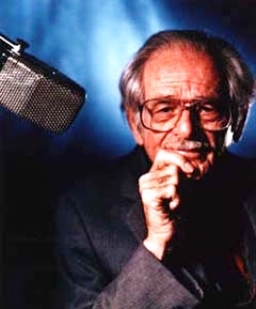
However, what made Corwin’s work truly inspiring was that it could reach beyond a simple box in a room and command your attention. He could get you to imagine, feel, and, more importantly, think. “We Hold These Truths” was written to be a celebration of The Bill of Rights. But airing just eight days after the Japanese bombing of Pearl Harbor, it became a timely reminder of what the country stands for.
What follows is a story Norman told me regarding a simple principle.
“Years ago, while watching a baseball game on TV, I saw Orel Hershiser, pitching for the Dodgers, throw a fastball that hit a batter. The camera was on a close-up of Hershiser, and I could read his lips as he mouthed, ‘I’m sorry.’ The batter, taking first base, nodded to the pitcher in a friendly way, and the game went on.
“Just two words and I felt good about Hershiser and the batter and the game all at once. Only a common courtesy, but it made an impression striking enough for me to remember after many a summer.
“Look, let’s not kid ourselves. It would be foolish to hope that kindness, consideration, and compassion will right wrongs, heal wounds, keep the peace, and set the new millennium on course to recover from inherited ills. That would be asking a lot from even a heaven-sent methodology, and heaven is not in that business.
“But why linger?
“Why wait to begin planting seeds, however long they take to germinate? It took us 200-plus years to get into the straits we now occupy, and it may take us long again to get out, but there must be a beginning.
“It comes down to the value of exemplars, which can be either positive or negative, and it works like this: Because of the principle that a calm sea and a prosperous voyage do not make news but a shipwreck does, most circulated news is bad news. The badness of it is publicized, and the negative publicity attracts more of the same through imitation.
“But good can be as communicable and catching as evil, and this is where kindness and compassion come into play. So long as conscionable and caring people are around, so long as they are not muted or exiled, so long as they remain alert in thought and action, there is a chance for contagions of the right stuff, whereby democracy becomes no longer a choice of lesser evils, whereby the right to vote is not betrayed by staying away from the polls, whereby the freedoms of speech, assembly, religion, and dissent are never forsaken.”
Norman Corwin just turned 98 this May.
Happy Birthday, Norman!
Comments

Recent Commentaries
A Man of Incorruptible Integrity
September 29, 2026

HUMAN VALUES: NOT SPECIFIED
September 23, 2026
You Can’t Do That.
September 21, 2026
I AM SICKENED
September 18, 2026
The Courage to Defend a Principle
September 17, 2026
The Better Angels Among Us
September 14, 2026

We Remember
September 11, 2026
Mister Roberts!
September 8, 2026

Where’s the Character
August 7, 2026
It Was Important Then. It is Important Today
August 3, 2026
Read More Articles
The Latest... And Sometimes Greatest
When Political Identity Replaces Ethical Judgment
The political and cultural landscape has become a minefield of conflicting beliefs, many now rooted less in public policy than in personal identity. One of...
July 31, 2026
Principles Matter.
A few nights ago, I was watching The Way We Were, a film I’ve seen more times than I can count. This time, a single...
July 28, 2026
All the President’s Men 2.0
“Politics had infiltrated every corner of government—a strong-arm takeover of the agencies by the Nixon White House.” —Bob Woodward and Carl Bernstein, All the President’s...
July 23, 2026
The Threat to November Is Already Here
“Cunning, ambitious, and unprincipled men will be enabled to subvert the power of the people and to usurp for themselves the reins of government.”—George Washington’s...
July 20, 2026
Jon Ossoff and the Conscience of Atticus Finch
I’ve written about Georgia Senator Jon Ossoff before, but after watching his questioning of Jay Clayton, President Trump’s nominee for director of national intelligence (DNI),...
July 17, 2026
Hearts and Minds
There’s a moment in Cool Hand Luke when Luke, played by Paul Newman, is returned to a prison camp after escaping. Determined to break his...
July 16, 2026