Published: May 22, 2019
By Jim Lichtman
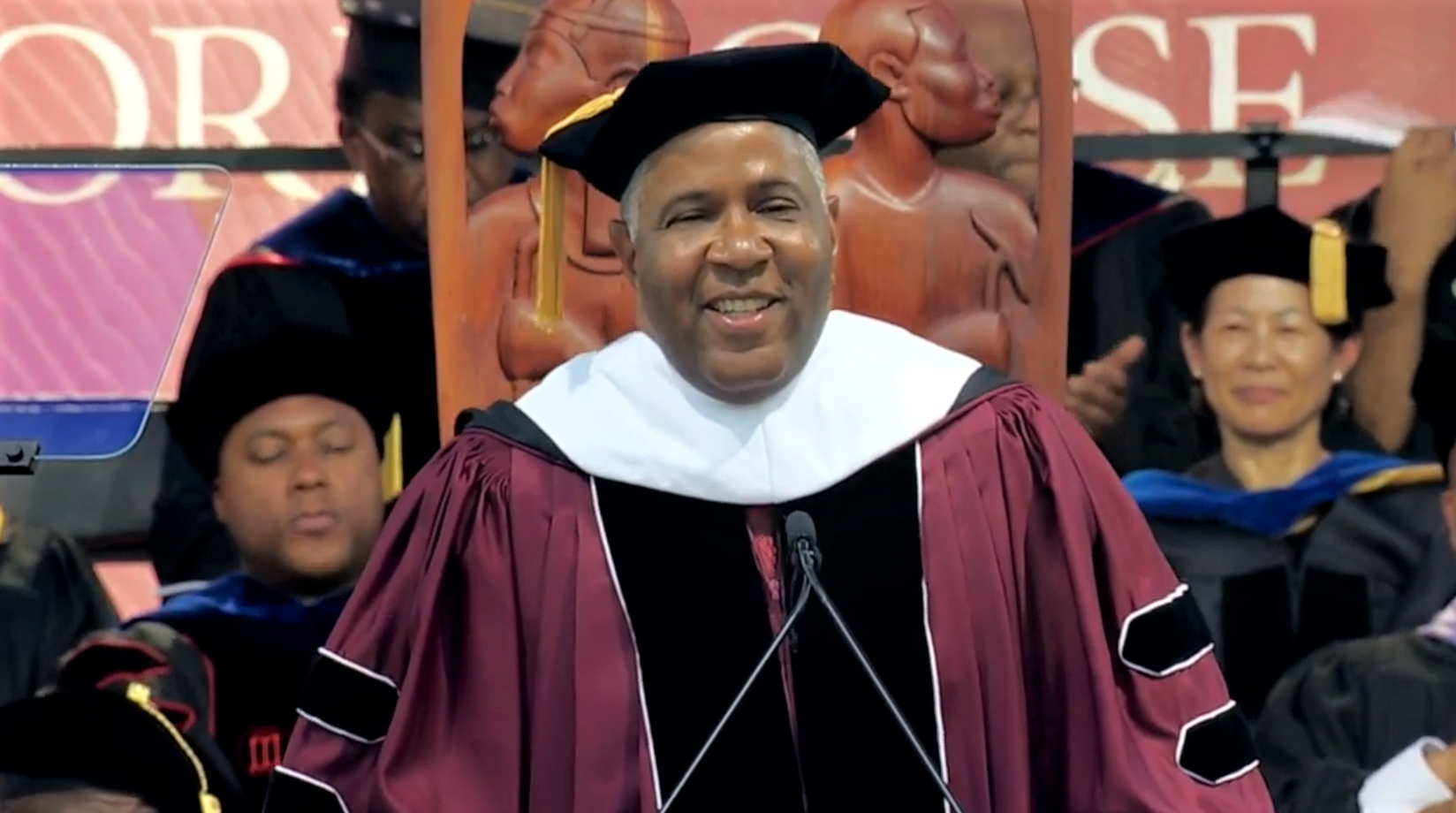
Commencement at colleges and universities around the country is a time for the well-known and lesser-known luminaries to make speeches that inspire a graduating class. Billionaire Robert F. Smith kicked it up a notch.
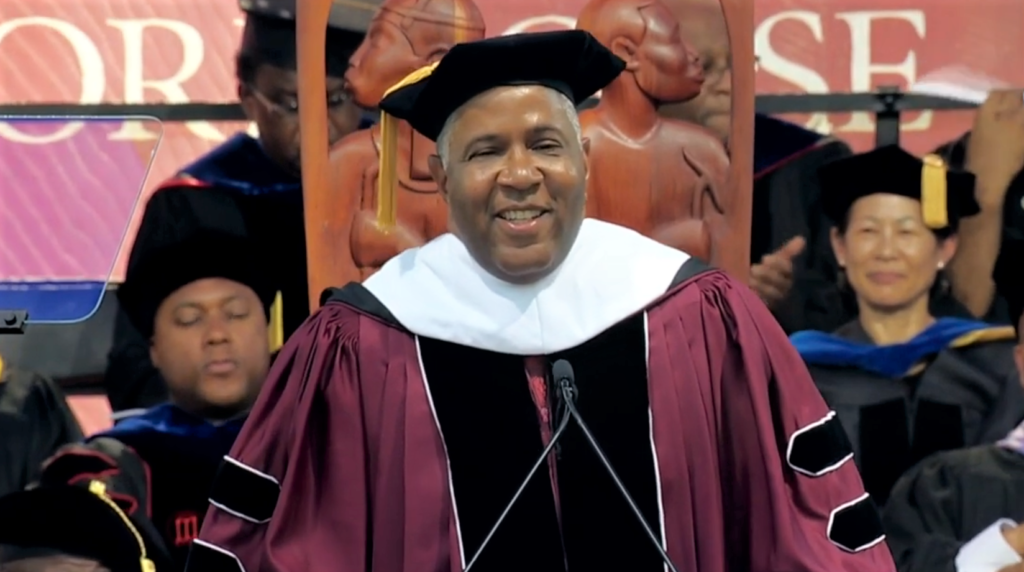
Smith, the founder, and CEO of the private equity firm Vista Equity Partners had already pledged $1.5 million to Atlanta’s Morehouse College when he announced that his family foundation would pay all student loan debt for the class of 2019.
“This is my class,” Smith told students, “and I know my class will pay this forward.”
The gift, covering nearly 400 students, is expected to cost Smith close to $40 million.
While the gesture of charity was met with enthusiastic applause, the larger question is what can be done about the rising cost of student debt?
“Economic growth,” The New York Times wrote in an editorial (May 20), “requires an educated work force. Americans who entered their working primes in the 1990s were far more likely to have college degrees than their peers in other developed nations. Now the United States has fallen behind much of the developed world — and one reason is that the average cost of obtaining a college degree is among the highest for any developed nation.”
While some Democratic candidates have policy positions that would pay for some or all of the debt, the simple fact, as The Times points out is “The federal government collected 16.5 percent of the nation’s economic output last year — well below the 17.4 percent average federal share over the last half century. The primary reason for the shortfall, of course, is the steady reduction of income taxation. No one has benefited more from that trend than financiers like Morehouse College’s 2019 graduation speaker.
“Mr. Smith,” The Times continues, “co-founded the private equity firm Vista Equity Partners, which invests in software companies, and he has amassed his fortune thanks in part to a provision of federal tax law known as the ‘carried interest loophole.’
“Private equity firms skim a percentage of the returns from the investments they manage. That money is their compensation, but instead of being taxed as earned income, at a rate of up to 37 percent, it is taxed as investment income, at a rate of no more than 20 percent.
“The loophole is projected to cost the government about $15.6 billion in lost revenue between 2016 and 2025. President Trump promised to close it during the 2016 campaign, and he promised to close it as part of his 2017 tax bill. But he did not keep that promise. Instead, the White House and congressional Republicans honored the wishes of the finance industry.”
Smith was under no obligation to pay all 396 students’ debt at Morehouse. He and his family did it as a gesture of charity that he hoped would inspire other alumni sitting in the audience, as well as reminding students to “pay it forward.”
However, one way to ensure that student debt is reduced is to close the “carried interest loophole.”
While Smith’s charitable act is worthy of applause, as The Times points out, “An affordable college education should not require an act of largess. … It merely requires adequate public investment, funded by equitable taxation.”
Closing that loophole would go a long way to “paying it forward” for future students.
Friday: Republicans are lost.
Comments
Leave a Comment

Recent Commentaries
I Am Not a Politician, and I Have No Partisan Loyalties
October 2, 2026
A Man of Incorruptible Integrity
September 29, 2026

HUMAN VALUES: NOT SPECIFIED
September 23, 2026
You Can’t Do That.
September 21, 2026
I AM SICKENED
September 18, 2026

The Courage to Defend a Principle
September 17, 2026

The Better Angels Among Us
September 14, 2026

We Remember
September 11, 2026
Mister Roberts!
September 8, 2026

Where’s the Character
August 7, 2026
Read More Articles
The Latest... And Sometimes Greatest
It Was Important Then. It is Important Today
Freedom of speech in America is under attack, not only when people are denied the right to speak, but when lies, intimidation and the deliberate...
August 3, 2026
When Political Identity Replaces Ethical Judgment
The political and cultural landscape has become a minefield of conflicting beliefs, many now rooted less in public policy than in personal identity. One of...
July 31, 2026
Principles Matter.
A few nights ago, I was watching The Way We Were, a film I’ve seen more times than I can count. This time, a single...
July 28, 2026
All the President’s Men 2.0
“Politics had infiltrated every corner of government—a strong-arm takeover of the agencies by the Nixon White House.” —Bob Woodward and Carl Bernstein, All the President’s...
July 23, 2026
The Threat to November Is Already Here
“Cunning, ambitious, and unprincipled men will be enabled to subvert the power of the people and to usurp for themselves the reins of government.”—George Washington’s...
July 20, 2026
Jon Ossoff and the Conscience of Atticus Finch
I’ve written about Georgia Senator Jon Ossoff before, but after watching his questioning of Jay Clayton, President Trump’s nominee for director of national intelligence (DNI),...
July 17, 2026
Jim, I learn something from your articles every time. Very interesting about the “carried interest” loophole. I didn’t know Trump had promised to close that. I hope he reconsiders. After reading more on this, it sounds like the lobbyists were too powerful in Washington. Thanks again Jim, for great article.