Published: July 7, 2023
By Jim Lichtman
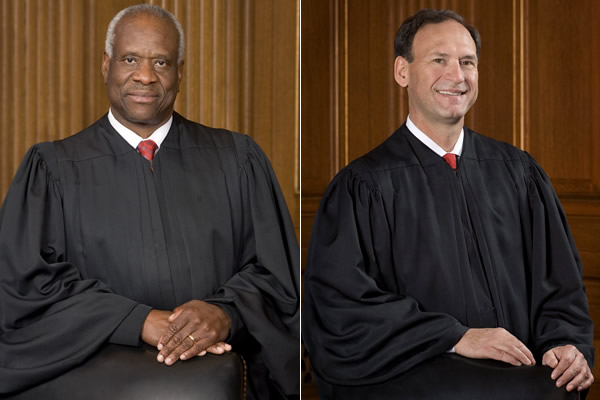
After recent reports of ethics scandals, it appears the two “learned” justices need a remedial course in ethics. It’s a good thing I’m here to help.
“Gentlemen, the study of law is something new and unfamiliar to most of you — unlike any other schooling you have ever known before… You teach yourselves the law, but I train your minds. You come in here with a skull full of mush; you leave thinking like a lawyer.” Prof. Kingsfield, “The Paper Chase”
“Let’s open our textbooks to the Code of Conduct for US Judges.
“Justice Thomas, you look a little lost. Justice Alito, could you help your classmate? It’s chapter one. Find it? Good.
“Now, since this is a remedial class, I will synthesize the key points, so you don’t have to read the entire text for homework tonight. That way you can focus on the key passages and still have time to do your research work for the Supreme Court.
“Ahem . . . ‘The Code of Conduct for United States Judges includes the . . . ethical canons . . . that apply to federal judges and provides guidance on their performance of official duties and engagement in a variety of outside activities.’
“Who knows what an ethical canon is? . . . . anyone, anyone at all? Mr. Alito.”
“I think it has something to do with . . . rules?”
“Yes. Webster’s Dictionary defines a canon as “a body of principles, rules, standards, or norms. Okay, here we go.
“Canon 1: ‘A Judge Should Uphold the Integrity and Independence of the Judiciary.’
“Can anyone tell me what the word ‘integrity’ means? . . . anyone, anyone at all? We haven’t heard from you, Mr. Thomas.”
“A firm adherence to a moral code.”
“Yes, we all know that you can read a dictionary. But what does that mean to you, personally? Mr. Alito?
“Well, it means following a ethical set of principles.”
“Very good, Mr. Alito. Let’s continue.
“An independent and honorable judiciary is indispensable to justice in our society. Nod if you agree.”
“Gooooood. I want to make sure that we’re all on the same page.”
“‘A judge. . .’ that’s both of you. ‘A judge should maintain and enforce high standards of conduct and should personally observe those standards. . .”
“Nod, if you agree.”
“Very good.”
“‘A judge should maintain and enforce high standards of conduct and should personally…. personally observe those standards. . . so that the integrity and independence of the judiciary may be preserved. The provisions of this Code should be construed and applied to further that objective.’
“Justice Alito, how does that apply to you?”
“Well . . . I think it means that . . . I should have the integrity to adhere to a set of ethical principles so that my decisions . . . will be viewed as . . .?”
“Will be viewed as . . . as what, Mr. Alito?
“Unbiased.”
“Thank you, Justice Thomas.”
“Thanks, Clarence.”
“No worries.”
“‘Canon 2: A Judge Should Avoid Im-pro-priety and the Appearance of Impropriety in all Activities.’
“What does the word, impropriety mean? Anyone?”
“Something that’s . . . wrong?”
“Well, it may not be illegal, but it’s likely unethical. ‘A judge should respect and comply with the law and should act at all times’ . . . at ALL times . . . ‘in a manner that promotes public confidence in the in-teg-rity—there’s that word again—and im-par-tia-lity of the judiciary.
“Right, gentlemen?”
“Right!”
“‘An appearance of impropriety occurs when reasonable minds—with knowledge of all the relevant circumstances disclosed by a reasonable inquiry—would conclude that the judge’s honesty, integrity, impartiality, temperament, or fitness to serve as a judge is impaired.’
“You two look confused, again. Do you know what that last sentence means. . . . anyone? Justice Thomas? Justice Alito?
“Okay, let’s begin again. Can either of you tell me what the word ‘integrity’ means? . . . anyone?
Comments
Leave a Comment

Recent Commentaries
Integrity Doesn’t Require a Megaphone
October 12, 2026

WHOSE PURPOSE DOES THIS SERVE?
October 9, 2026

Choreographer of Disaster
October 5, 2026
I Am Not a Politician, and I Have No Partisan Loyalties
October 2, 2026
A Man of Incorruptible Integrity
September 29, 2026

HUMAN VALUES: NOT SPECIFIED
September 23, 2026
You Can’t Do That.
September 21, 2026
I AM SICKENED
September 18, 2026
The Courage to Defend a Principle
September 17, 2026

The Better Angels Among Us
September 14, 2026
Read More Articles
The Latest... And Sometimes Greatest
We Remember
On September 11, 2001, nearly 3,000 people were killed in terrorist attacks in New York, at the Pentagon, and aboard Flight 93 in Pennsylvania. More...
September 11, 2026
Mister Roberts!
One of my favorite movies is Mister Roberts, the 1955 comedy-drama set aboard the USS Reluctant in the Pacific during World War II. Henry Fonda...
September 8, 2026
Where’s the Character
In 1984, Wendy’s ran a television commercial featuring the redoubtable Clara Peller, staring at an enormous hamburger bun. Inside was a burger patty smaller than...
August 7, 2026
It Was Important Then. It is Important Today
Freedom of speech in America is under attack, not only when people are denied the right to speak, but when lies, intimidation and the deliberate...
August 3, 2026
When Political Identity Replaces Ethical Judgment
The political and cultural landscape has become a minefield of conflicting beliefs, many now rooted less in public policy than in personal identity. One of...
July 31, 2026
Principles Matter.
A few nights ago, I was watching The Way We Were, a film I’ve seen more times than I can count. This time, a single...
July 28, 2026
Great commentary, Jim
“Scintilla” is a word that both justices should fully understand as in “…the mere scintilla of the appearance of impropriety or conflict of interest.”