Published: December 7, 2018
By Jim Lichtman
Looking back on his life and presidency, George H. W. Bush made decisions consistent with specific ethical values. Here are seven illustrations.
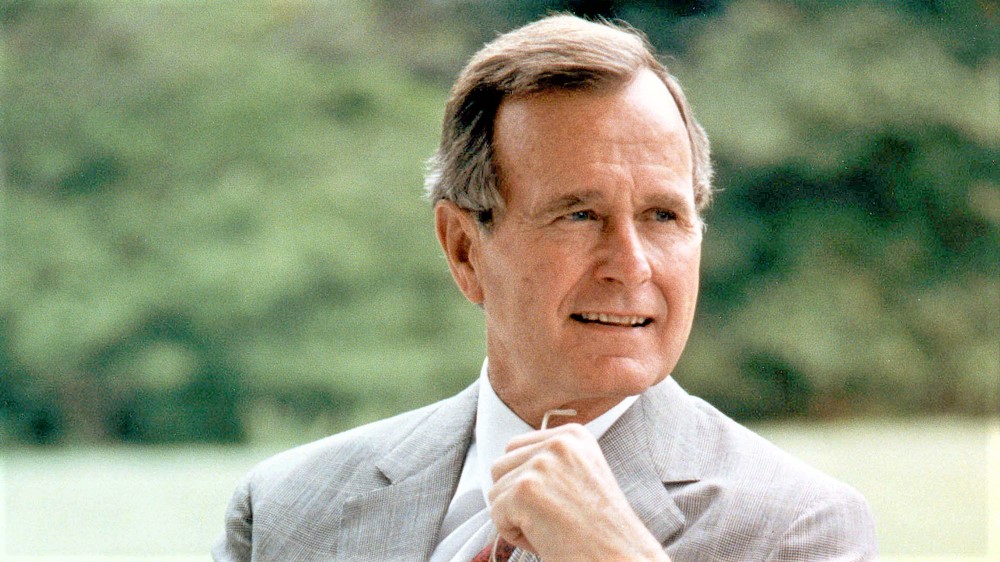
1: Nice Guys Don’t Finish Last (Respect, Compassion) – Bush was always respectful. Even in the political fray, he never ridiculed or berated opponents. He also understood how others felt and went above and beyond to support them.
The Secret Service posted this story on Twitter:
“Everyone’s #Tuesday Thoughts are on President Bush & we wanted to share a memory. In ’13, Timberwolf, [President Bush’s Secret Service code name], learned that the 2-year-old son of an agent on his detail was diagnosed with leukemia & the detail was going to shave their heads. You can see what happened, in classic 41 manner.”
2: In Doing Your Best, Remember Your Past (Pursuit of Excellence) – Bush never forgot the two crewmen who were lost after his Navy Avenger was shot down during World War II. After his rescue by a submarine, Bush “later told author James Bradley, ‘Why had I been spared and what did God have in store for me?’ ”
We now know why. Bush understood his responsibility to his past.
3: Unity is Vital (Civic Virtue and Loyalty) – At his inauguration, Bush didn’t wait for Democrats to approach him, he reached out to them in his address:
“To my friends, and, yes, I do mean friends — in the loyal opposition and, yes, I mean loyal — I put out my hand. I am putting out my hand to you, Mr. Speaker. I am putting out my hand to you, Mr. Majority Leader. For this is the thing: This is the age of the offered hand. And we can’t turn back clocks, and I don’t want to. But when our fathers were young, Mr. Speaker, our differences ended at the water’s edge. And we don’t wish to turn back time, but when our mothers were young, Mr. Majority Leader, the Congress and the Executive were capable of working together…”
In seeking common ground, Bush worked with others while maintaining his principles.
4: Admit Mistakes (Accountability) – In his first run for Congress, Bush “criticized the Civil Rights Act that was before Congress, denounced the 1963 nuclear test ban treaty and warned of a welfare state,” The New York Times writes (Nov. 30).
In 1966, however, “Surveying his electorate, he began moving to the center; he now spoke well of the Johnson agenda, declaring in a speech, ‘I generally favor the goals as outlined in the Great Society.’ He told his minister: ‘I took some of the far-right positions to get elected. I hope I never do it again. I regret it.’ ”
5: If Events Turn in Your Favor, Do Not Gratuitously Celebrate (Self-Restraint) – At the end of the Cold War between Russia and the U.S., as the Berlin Wall began to come down, many officials wanted President Bush to fly to Berlin and celebrate.
As Richard N. Haass, special assistant on the staff of the National Security Council, wrote (Dec. 1), “Bush was sensitive to the predicament of Gorbachev and later Boris Yeltsin, and he avoided making a difficult situation humiliating for Russia. He was careful not to gloat or to indulge in the rhetoric of triumphalism. He was widely criticized for this restraint, but he managed not to trigger just the sort of nationalist reaction that we are now seeing in Russia.”
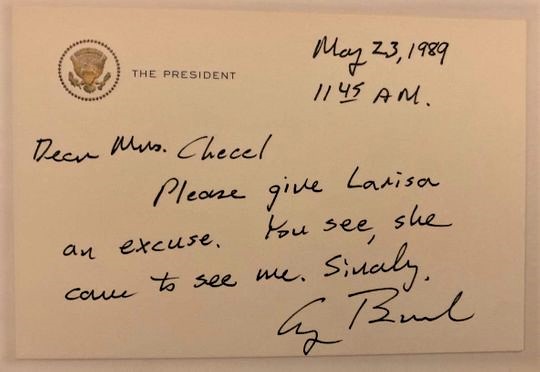
6: Write a “Thank You” Note or Letter of Support (Courtesy) – Bush never took anyone or anything for granted. Taking the time to write a handwritten letter or note, he showed others how much he appreciated their help or demonstrated support in their time of need.
The story of a young girl meeting Bush for the first time speaks volumes about the man.
On her visit to the White House for a meeting with President Bush as he signed the Americans with Disability Act, nine-year old Larisa DeSantis stricken with epilepsy, asked Mr. Bush if he would write an excuse for her absence from school that day. Bush didn’t hesitate.
7: Practice Forgiveness (Character) – Perhaps the most difficult of all. Despite all the criticisms Bush and his family received from Donald Trump, the 41st President requested Trump attend his state funeral.
“The essence of forgiveness,” ethicist Michael Josephson writes, “is a voluntary decision to abandon continuing resentment, to let go of anger, and to move on. It doesn’t require or imply condoning, excusing, or forgetting. Nor does it require that the forgiver re-establish a relationship with the wrongdoer.
“According to Dr. Ben Dean,” Josephson adds, “the capacity to forgive is related to the character strength of empathy.”
In these and many other ways, George Herbert Walker Bush was a role model of ethical values.
Comments
Recent Commentaries
A Man of Incorruptible Integrity
September 29, 2026

HUMAN VALUES: NOT SPECIFIED
September 23, 2026
You Can’t Do That.
September 21, 2026
I AM SICKENED
September 18, 2026
The Courage to Defend a Principle
September 17, 2026
The Better Angels Among Us
September 14, 2026

We Remember
September 11, 2026
Mister Roberts!
September 8, 2026
Where’s the Character
August 7, 2026
It Was Important Then. It is Important Today
August 3, 2026
Read More Articles
The Latest... And Sometimes Greatest
When Political Identity Replaces Ethical Judgment
The political and cultural landscape has become a minefield of conflicting beliefs, many now rooted less in public policy than in personal identity. One of...
July 31, 2026
Principles Matter.
A few nights ago, I was watching The Way We Were, a film I’ve seen more times than I can count. This time, a single...
July 28, 2026
All the President’s Men 2.0
“Politics had infiltrated every corner of government—a strong-arm takeover of the agencies by the Nixon White House.” —Bob Woodward and Carl Bernstein, All the President’s...
July 23, 2026
The Threat to November Is Already Here
“Cunning, ambitious, and unprincipled men will be enabled to subvert the power of the people and to usurp for themselves the reins of government.”—George Washington’s...
July 20, 2026
Jon Ossoff and the Conscience of Atticus Finch
I’ve written about Georgia Senator Jon Ossoff before, but after watching his questioning of Jay Clayton, President Trump’s nominee for director of national intelligence (DNI),...
July 17, 2026
Hearts and Minds
There’s a moment in Cool Hand Luke when Luke, played by Paul Newman, is returned to a prison camp after escaping. Determined to break his...
July 16, 2026