Published: March 17, 2008
By Jim Lichtman
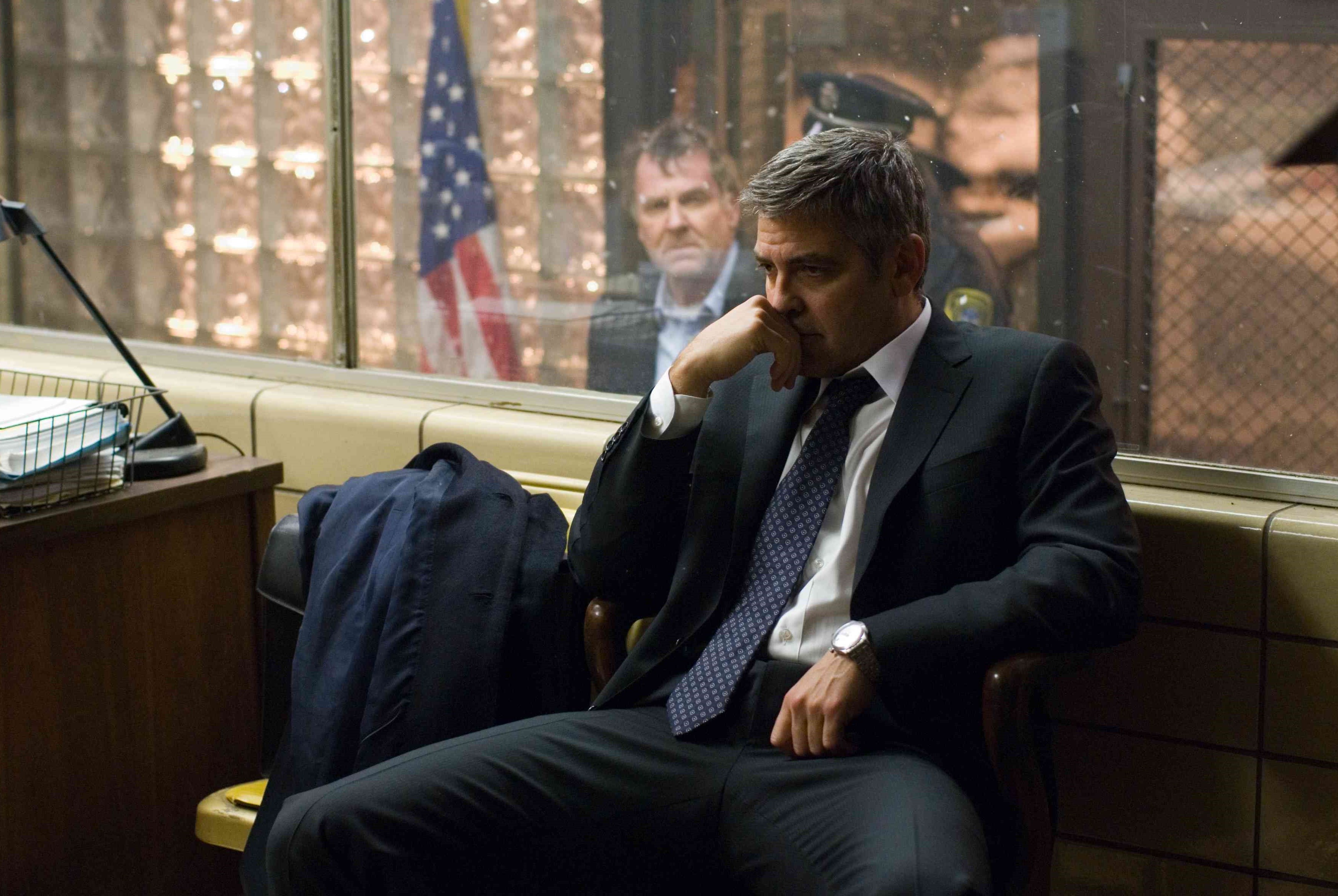
Michael Clayton is about a man who’s traded his moral compass for a GPS device fixed on rank and wealth. That emptiness you see in his eyes comes from the thousand-and-one compromises he’s made in his life until he wakes up one evening to a crisis of conscience.
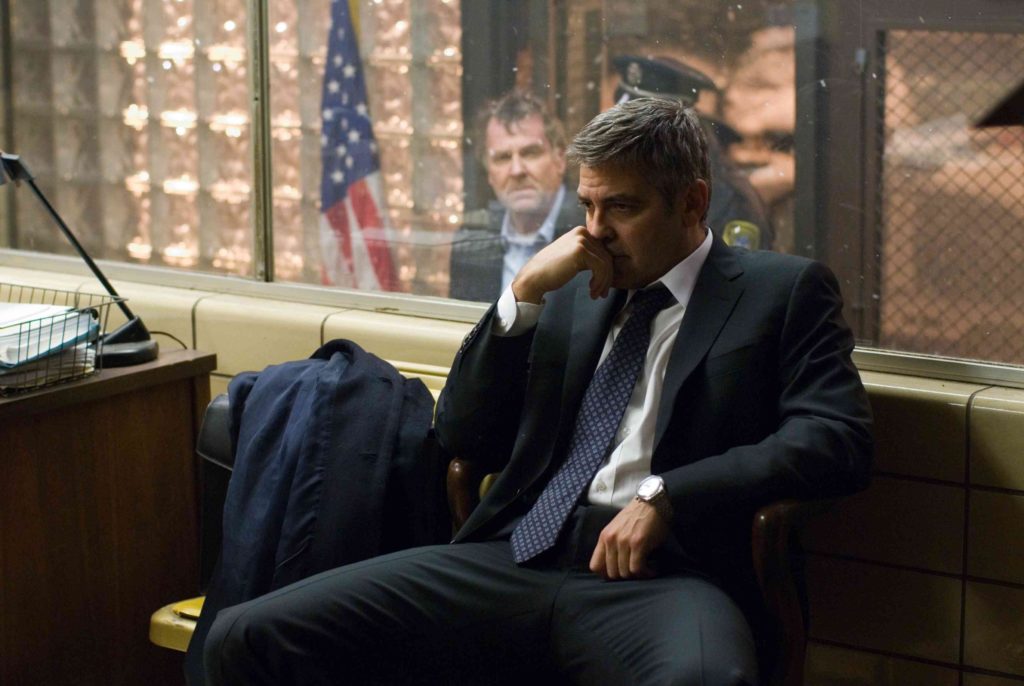
The crisis comes in the form of law partner and friend Arthur Edens who — after a lapse in his medication and six years spent defending a chemical company from a $3-billion class-action suit — arrives at his own epiphany about his work and quickly turns from corporate protector to raving whistleblower: “I have blood on my hands!”
After walking through the mess that has become Arthur’s life, Clayton not only begins to believe the truth of his friend’s story, but the larger truth behind his own life.
“You’ve got all these cops thinking you’re a lawyer,” his brother, a cop, bluntly tells him, “and you’ve got all these lawyers thinking you’re some kind of cop. You’ve got everybody fooled; everybody but you! You know exactly what you are.”
Michael Clayton is a rusted-out shell of a litigator whose “special” skill is in-house damage control; a “fixer” in a high-powered law firm, or as Clayton puts it, a janitor. And he seems resigned to the role in spite of the fact that every other aspect of his life is a mess that he can’t quite clean up. Saddled with $75,000 of debt from a lost restaurant and divorced, Clayton drives his young son around with him on some of his “errands.” While the son knows the father is struggling, he doesn’t suspect what his mother, the ex-wife, has known for sometime: that Clayton was a talented lawyer who sold-out years ago to the kind of prestige whose only allegiance is to the elite client base and bottom line.
In spite of movie star looks and Ocean’s Eleven charm, George Clooney shines brightest when he plays morally complex characters: the morally conflicted CIA agent in Syriana; the morally principled TV producer in Good Night, and Good Luck; and now the morally bankrupt lawyer in Michael Clayton. Each of these characters face a crisis of conscience that forces them to look within themselves to find their integrity.
What makes each of them compelling in their own way are the various shades of ethical relativism that color their lives and ultimately affect their decision making. In Syriana, Bob Barnes must choose between ethics and expediency. In Good Night, and Good Luck, Fred Friendly, with his job on the line, must take a stand to expose a fear-mongering Joe McCarthy. Michael Clayton must choose between toeing the company line or exposing a client with an incriminating memo.
All of us want to do the right thing. All of us want to be the kind of principled individuals our family, friends and colleagues can look up to. However, sometimes we lose our way. What makes Michael Clayton so convincing is that it shows us that even in the bleakest moments of our lives, each of us can find a way back.
Clayton is searching for his own way back, if for no other reason than to be the kind of father and role model his son knows he can be.
Comments
Leave a Comment

Recent Commentaries

Has America Lost Its Way?
October 16, 2026
All The President’s Targets
October 13, 2026
Integrity Doesn’t Require a Megaphone
October 12, 2026
WHOSE PURPOSE DOES THIS SERVE?
October 9, 2026

Choreographer of Disaster
October 5, 2026
I Am Not a Politician, and I Have No Partisan Loyalties
October 2, 2026
A Man of Incorruptible Integrity
September 29, 2026

HUMAN VALUES: NOT SPECIFIED
September 23, 2026
You Can’t Do That.
September 21, 2026
I AM SICKENED
September 18, 2026
Read More Articles
The Latest... And Sometimes Greatest
The Courage to Defend a Principle
In 1998, at the height of the Clinton-Lewinsky scandal, Secret Service Director Lewis Merletti was driving to work when a radio report stopped him cold....
September 17, 2026
The Better Angels Among Us
By all appearances, we are becoming less the land of the brave than the land of resentment. Every day is Groundhog Day: same arguments, same...
September 14, 2026
We Remember
On September 11, 2001, nearly 3,000 people were killed in terrorist attacks in New York, at the Pentagon, and aboard Flight 93 in Pennsylvania. More...
September 11, 2026
Mister Roberts!
One of my favorite movies is Mister Roberts, the 1955 comedy-drama set aboard the USS Reluctant in the Pacific during World War II. Henry Fonda...
September 8, 2026
Where’s the Character
In 1984, Wendy’s ran a television commercial featuring the redoubtable Clara Peller, staring at an enormous hamburger bun. Inside was a burger patty smaller than...
August 7, 2026
It Was Important Then. It is Important Today
Freedom of speech in America is under attack, not only when people are denied the right to speak, but when lies, intimidation and the deliberate...
August 3, 2026
Jim, your commentary made me realize that when I recently saw “Michael Clayton,” I wasn’t just watching a good story, I was actually watching a great morality play.