Published: January 17, 2011
By Jim Lichtman
Dr. Alvin F. Poussaint is the Director of the Media Center at the Judge Baker Children’s Center in Boston and one of the nation’s leading psychiatrists. He is also a Professor of Psychiatry at Harvard Medical School. A highly regarded specialist on race relations in America, Dr. Poussaint has served as a consultant to many corporations and government agencies. He has lectured and written on a wide range of social issues including the need for tolerance.
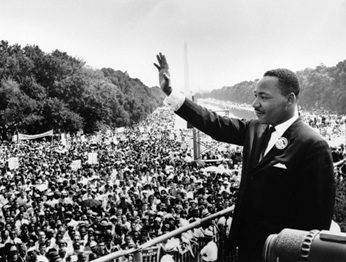
Dr. Poussaint’s story, regarding time spent with Dr. King, stresses a dedication to hard work, sound judgment, and perseverance to pull you through fearful times.
“The core principles in my life are to work hard to achieve my goals and always maintain a high level of commitment and integrity. Never quit. During difficult times, I always said to myself that if I’m going to fail, I’m going to go down fighting. One of my primary goals has been to fight for justice and an end to racial discrimination. I would not, however, let race become an obstacle to my success.
“During my work in the civil rights movement, there were many terrifying moments. There was only one, however, when my knees were literally shaking. On June 21, 1966, the second anniversary of the death of three civil rights workers – James Chaney, Andrew Goodman, and Michael Schwerner – Reverend Martin Luther King led a group of us from the Meredith March to the courthouse in Philadelphia, Mississippi. King wanted to pay tribute to these workers who had been killed in Philadelphia.
“Andy Young had asked me to walk next to King because I was the physician on the march and had the medical supplies to tend to King if anything happened. We were afraid something would happen because it was a very dangerous situation. The crowd of white townspeople was out of control, shouting and taunting at the marchers as we walked through the town.
“Sheriff Rainey and Deputy Sheriff Price, who had been implicated in the murder of the three workers, came out of the courthouse with their weapons and stopped King. Price or Rainey told King he could not proceed. As he stared at Rainey for a long moment, I thought King would keep going and we would all be injured or perhaps killed. Instead, King knelt down and said for everyone to kneel. He said a prayer to honor the three dead workers, then got up and turned around to leave. I was very relieved. Going back to the cars to return to the Meredith march was still frightening. A car driven by a group of white men almost hit Stokely Carmichael; he had to jump out of the way as the car drove straight into the marchers.
“In spite of my fear during this incident, I stayed with King and fulfilled what I felt was my duty and commitment to struggle for the rights of African Americans. I served as the Southern Field Director of the Medical Committee for Human Rights from 1965 to 1967 in Jackson, Mississippi. That choice set the course for my life since then.”
It’s important to remember that perhaps Dr. King’s greatest legacy is the many individuals he inspired to carry on The Dream.
Comments
Recent Commentaries

Choreographer of Disaster
October 5, 2026
I Am Not a Politician, and I Have No Partisan Loyalties
October 2, 2026
A Man of Incorruptible Integrity
September 29, 2026

HUMAN VALUES: NOT SPECIFIED
September 23, 2026

You Can’t Do That.
September 21, 2026
I AM SICKENED
September 18, 2026
The Courage to Defend a Principle
September 17, 2026
The Better Angels Among Us
September 14, 2026
We Remember
September 11, 2026
Mister Roberts!
September 8, 2026
Read More Articles
The Latest... And Sometimes Greatest
Where’s the Character
In 1984, Wendy’s ran a television commercial featuring the redoubtable Clara Peller, staring at an enormous hamburger bun. Inside was a burger patty smaller than...
August 7, 2026
It Was Important Then. It is Important Today
Freedom of speech in America is under attack, not only when people are denied the right to speak, but when lies, intimidation and the deliberate...
August 3, 2026
When Political Identity Replaces Ethical Judgment
The political and cultural landscape has become a minefield of conflicting beliefs, many now rooted less in public policy than in personal identity. One of...
July 31, 2026
Principles Matter.
A few nights ago, I was watching The Way We Were, a film I’ve seen more times than I can count. This time, a single...
July 28, 2026
All the President’s Men 2.0
“Politics had infiltrated every corner of government—a strong-arm takeover of the agencies by the Nixon White House.” —Bob Woodward and Carl Bernstein, All the President’s...
July 23, 2026
The Threat to November Is Already Here
“Cunning, ambitious, and unprincipled men will be enabled to subvert the power of the people and to usurp for themselves the reins of government.”—George Washington’s...
July 20, 2026