Published: February 9, 2009
By Jim Lichtman
When New York Federal District Judge Charles Brieant, Jr. died last summer the staff began packing up his chambers. However, among his personal items was a painting that has many people talking
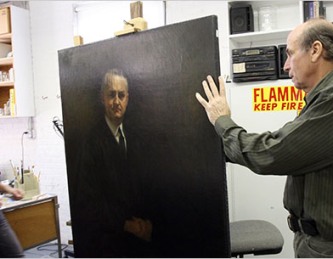
“Hanging on the wall,” the New York Times wrote, “along with portraits of Lincoln and Theodore Roosevelt, was an oil painting of an obscure judge… Martin T. Manton who sat for two decades on the prestigious federal appeals court for the Second Circuit in Manhattan… was almost appointed to the United States Supreme Court. But in 1939, he resigned in disgrace. He was accused of taking large sums in gifts and loans from parties in cases, was tried and convicted and spent 19 months in prison.”
Years earlier, “…Judge Brieant had rescued [the painting] from a courthouse storage room, paid to have cleaned and enjoyed showing visitors.
So, why would Judge Brieant have a painting of a corrupt judge hanging on his wall next to Lincoln and Roosevelt?
“Brieant told visitors that he displayed the painting as a reminder of the fallibility of judges, particularly those above him on the Second Circuit, whom he liked to needle and call the Second Circus.”
“In some ways,” the Times said, “the legacy of Judge Manton has already been erased from the legal annals: two federal judges in Manhattan recalled that when they were law clerks, their judges admonished them never to cite Judge Manton’s opinions. But some district court judges are not so ready to sweep the Manton story under the rug.
“Judge P. Kevin Castel, who has studied and written about the Manton case, said he agreed with Judge Brieant: ‘He viewed Manton as a scoundrel, but it was a morality tale and important to keep the story alive. You don’t hide that.’”
Years ago, I remember visiting Dachau, the Nazi concentration camp about ten miles outside Munich. I was surprised to find that the grounds and many of the original buildings were kept in good condition. I asked a similar question: why would local citizens restore and maintain, what has become, a shocking symbol of intolerance and death?
Answer: So that no one will ever forget.
While positive examples of ethical conduct can serve to reinforce good behavior, terrible, even horrific examples can serve as important reminders of the negative consequences of bad behavior and complacency.
So, what’s to be done with the Judge Manton portrait?
Judge Jacobs, the Second Circuit’s chief and friend of Judge Brieant said, “I’m kind of hoping that Judge Manton will disappear.”
I’m kind of hoping he hangs around.
Comments


Recent Commentaries

November 4, 2026
October 20, 2026

Has America Lost Its Way?
October 16, 2026

All The President’s Targets
October 13, 2026
Integrity Doesn’t Require a Megaphone
October 12, 2026

WHOSE PURPOSE DOES THIS SERVE?
October 9, 2026

Choreographer of Disaster
October 5, 2026
I Am Not a Politician, and I Have No Partisan Loyalties
October 2, 2026
A Man of Incorruptible Integrity
September 29, 2026

HUMAN VALUES: NOT SPECIFIED
September 23, 2026

You Can’t Do That.
September 21, 2026
Read More Articles
The Latest... And Sometimes Greatest
I AM SICKENED
Tonight, protesters are surrounding the Kennedy Center, the living memorial to John F. Kennedy and the heartbeat of Washington’s cultural life. They are there because...
September 18, 2026
The Courage to Defend a Principle
In 1998, at the height of the Clinton-Lewinsky scandal, Secret Service Director Lewis Merletti was driving to work when a radio report stopped him cold....
September 17, 2026
The Better Angels Among Us
By all appearances, we are becoming less the land of the brave than the land of resentment. Every day is Groundhog Day: same arguments, same...
September 14, 2026
We Remember
On September 11, 2001, nearly 3,000 people were killed in terrorist attacks in New York, at the Pentagon, and aboard Flight 93 in Pennsylvania. More...
September 11, 2026
Mister Roberts!
One of my favorite movies is Mister Roberts, the 1955 comedy-drama set aboard the USS Reluctant in the Pacific during World War II. Henry Fonda...
September 8, 2026
Where’s the Character
In 1984, Wendy’s ran a television commercial featuring the redoubtable Clara Peller, staring at an enormous hamburger bun. Inside was a burger patty smaller than...
August 7, 2026