Published: March 24, 2008
By Jim Lichtman
In his book, “A Higher Standard of Leadership” Keshavan Nair writes, “Today, many people believe that it is not possible to be successful in the world of business and politics and still to maintain one’s integrity – integrity not defined by absence of financial corruption, but by adherence to moral principles in all activities.
“The standard of leadership depends not only on the qualities and beliefs of our leaders but also on the expectations we have of them. As long as we believe that our leaders lack integrity, our expectations are likely to be mirrored in their conduct. Therefore, it is up to each of us to improve our own standard of leadership and thus raise our expectations of those who would lead us.”
In the midst of a national election, while it’s important to look at what each candidate stands for in terms of the issues, I would argue that it is even more important to assess who they are with respect to their ethical or moral beliefs. Who they are will determine how they will make decisions for us all.
In looking for a higher standard of leadership, Nair offers us this model:
1. Service is the purpose of leadership.
2. Moral principles must be the basis of goals, decisions and strategies.
3. A single standard of conduct needs to be employed in both public and private lives.
Hopelessly idealistic? Impossibly impractical?
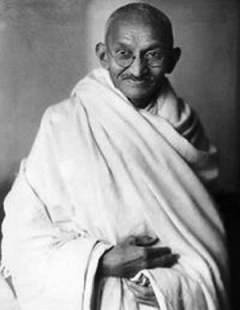
“In an era shaped by colonialism, dictatorships and two World Wars,” Nair writes, “[Mohandas] Gandhi demonstrated that an idealist could also be a practical and effective leader.
“Gandhi’s life was not governed by policies, it was governed by principles and values; the best political leaders have their country as the source of their passion. Business leaders have… the organization… Gandhi’s life was driven by his religion: truth and non-violence and a life of service to others.”
As India’s revered political and spiritual leader, two concepts were critical to Gandhi’s success: a single standard of conduct, and integrity of the process.
“We have come to accept,” Nair writes, “that a lower moral standard is necessary to get things done in the real world of politics and business. This is the gospel of expediency – the double standard of conduct.”
Gandhi’s success was based on the idea that leaders must set an example. “You must watch my life,” he said, “how I live, eat, sit, talk, behave in general. The sum total of all those in me is my religion.”
“This is not a call for perfection,” Nair reminds us. “It is something to measure our actions against – something to strive for and to help us control our imperfections.”
Additionally, Gandhi believed that there must be integrity in the process in order gain the trust and confidence of the people you are leading.
“In business, speed is a competitive weapon,” Nair writes, “But if we are to move to a higher standard of leadership, timeliness is not enough. The decision process must have, and be perceived to have integrity – not integrity based on compliance with legal and regulatory requirements, but integrity based on moral principles…”
Success in any area of business, politics, or life can be achieved through perseverance and adherence to ethical principles. Let’s use that framework to judge the candidates by. In determining what kind of leaders they will become, let’s examine their actions, not just their rhetoric. Similarly, if we are to reaise the ethical bar for our leaders, we should strive to live out ethical principles in our own lives.
When a journalist asked Gandhi for a message for the United States… Gandhi responded, ‘My life is its own message… Bethe change you wish to see in the world.”
Comments

Recent Commentaries
Why George Marshall Still Matters
February 2, 2026

The Most Sacred Thing
January 29, 2026

THIS Cannot Be Ignored
January 25, 2026
Year One
January 20, 2026

Removed
January 18, 2026
Clarence Darrow’s Warning to a Tired Democracy
January 15, 2026
Accountability, Optional
January 12, 2026
My Dinner with Jefferson, Hamilton and Madison
January 8, 2026

When the Story Becomes the Scandal
January 5, 2026

A Light from Christmas Past – Conclusion
December 24, 2025
Read More Articles
The Latest... And Sometimes Greatest
A Light From Christmas Past – Part II
Emily returned to the attic the next evening. The attic felt different, not mysterious, purposeful. She unlocked the small door again and stood for a...
December 23, 2025
A Light from Christmas Past
In the winter of his century, Charles Dickens walked a London powered by industry but running short on warmth. People moved past one another as...
December 22, 2025
Nothing Beside Remains
I have stopped watching national news about Donald Trump because the coverage now mirrors the damage itself. What once informed now exhausts; what once clarified...
December 16, 2025
Finding Common Ground, and Why It Matters
A national media organization has recognized the seriousness of our political division and offered something we’ve been missing… A REAL beginning toward ending the death...
December 15, 2025
What Dickens Meant Us to Remember
Every December, I look forward to reading and watching Dickens’ A Christmas Carol. While there are countless versions of the classic, I always return to...
December 11, 2025
Looking for America’s Soul
“At what point then is the approach of danger to be expected? I answer, if it ever reach us, it must spring up amongst us;...
December 8, 2025