Published: March 16, 2012
By Jim Lichtman
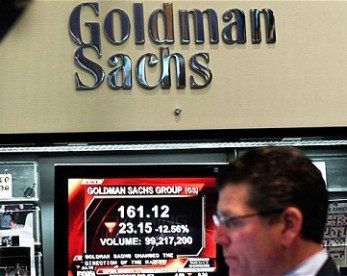
Global Investment banking giant Goldman Sachs lost $2.15billion of its market value the day after London-based employee Gregory Smith told the world in a New York Times Op-Ed that the company is not only “toxic and destructive,” but is only interested in “How much money did we make off the client?”
In 2009 Rolling Stone story, reporter Matt Taibbi called Goldman “a great vampire squid wrapped around the face of humanity…”
In 2010, the SEC accused Goldman “of creating a subprime mortgage product that was meant to fail,” the NY Times reported. “In July of that year, Goldman settles the matter for $550 million and agrees to change its business practices.”
In the opinion piece in Wednesday’s NY Times (Mar. 14), Smith writes, “It might sound surprising to a skeptical public, but culture was always a vital part of Goldman Sachs’s success. It revolved around teamwork, integrity, a spirit of humility, and always doing right by our clients. The culture was the secret sauce that made this place great and allowed us to earn our clients’ trust for 143 years.”
However, in recent years, apparently Goldman traded that trust for a bag of money.
“I attend derivatives sales meetings,” Smith says, “where not one single minute is spent asking questions about how we can help clients. It’s purely about how we can make the most possible money off of them…. It astounds me how little senior management gets a basic truth: If clients don’t trust you they will eventually stop doing business with you. It doesn’t matter how smart you are.”
“Even bankers who disagreed with Mr. Smith’s conclusions said the piece had struck a chord because it stirred up their own doubts,” the Times writes, “especially in the wake of the financial crisis.”
“He may have aired a few comments that are true, but he’s placed himself on a pedestal,” said Jason Kennedy, CEO of the Kennedy Group, a London-based recruitment firm in a story for the Washington Post. “The reason he’s been at Goldman Sachs for 12 years is that he liked the name and probably liked the money.”
“It’s rare for people on Wall Street,” the Post writes, “especially at Goldman Sachs, to speak out publicly against their employers or former employees, said Roy Smith, a former Goldman Sachs partner who’s now a finance professor at New York University’s Stern School of Business. “Who’s going to hire someone who would do that?” Smith said. “The industry will close ranks on such things as whistle- blowing in this context.”
And that’s the problem. Whistle-blowing has achieved the unenviable stature of traitor, conspirator, turncoat. Those who try to point out weak, or illicit work practices are branded with a scarlet letter and banned from their chosen field for life. Believe me I know several who were fired for doing the rightthing.
In my 2004 book, What Do You Stand For?, former Chairman of the Federal Reserve, Alan Greenspan, plainly pointed out what is important and why.
“I could urge you all to work hard, save, and prosper. And I do. But transcending all else is being principled in how you go about doing those things.
“I do not deny that many appear to have succeeded in a material way by cutting corners and manipulating associates, both in their professional and in their personal lives. But material success is possible in this world and far more satisfying when it comes without exploiting others. The true measure of a career is to be able to be content, even proud, that you succeeded through your own endeavors without leaving a trail of casualties in your wake.
“I cannot speak for others whose psyches I may not be able to comprehend, but, in my working life, I have found no greater satisfaction than achieving success through honest dealings and strict adherence to the view that for you to gain, those you deal with should gain as well. Human relations – be they personal or professional – should not be zero sum games.
“Trust is at the root of any economic system based on mutually beneficial exchange. In virtually all transactions, we rely on the word of those with whom we do business. Were this not the case, exchange of goods and services could not take place on any reasonable scale. …Without mutual trust, and market participants abiding by a rule of law, no economy can prosper.”
So, here’s my question: Do you believe that the culture, as described by Gregory Smith at Goldman Sachs, is the result of a few bad apples, or do you believe it’s a rotten barrel problem? If so, what can be done to change it?
Comments
Recent Commentaries
The Death of Shame
February 9, 2026
Because We Need It
February 5, 2026
Why George Marshall Still Matters
February 2, 2026
The Most Sacred Thing
January 29, 2026
THIS Cannot Be Ignored
January 25, 2026
Year One
January 20, 2026

Removed
January 18, 2026
Clarence Darrow’s Warning to a Tired Democracy
January 15, 2026
Accountability, Optional
January 12, 2026
My Dinner with Jefferson, Hamilton and Madison
January 8, 2026
Read More Articles
The Latest... And Sometimes Greatest
When the Story Becomes the Scandal
For nearly sixty years, the CBS News program 60 Minutes has stood as one of the few remaining institutions in American journalism recognized as serious,...
January 5, 2026
A Light from Christmas Past – Conclusion
I’ll be back on January 5th. Later that night, Emily returned home, warmed her hands around a cup of tea, and set the original lantern...
December 24, 2025
A Light From Christmas Past – Part II
Emily returned to the attic the next evening. The attic felt different, not mysterious, purposeful. She unlocked the small door again and stood for a...
December 23, 2025
A Light from Christmas Past
In the winter of his century, Charles Dickens walked a London powered by industry but running short on warmth. People moved past one another as...
December 22, 2025
Nothing Beside Remains
I have stopped watching national news about Donald Trump because the coverage now mirrors the damage itself. What once informed now exhausts; what once clarified...
December 16, 2025
Finding Common Ground, and Why It Matters
A national media organization has recognized the seriousness of our political division and offered something we’ve been missing… A REAL beginning toward ending the death...
December 15, 2025