Published: July 8, 2015
By Jim Lichtman
You would think that after being appointed a United States Supreme Court justice – a position held for life, mind you – that you would be fairly comfortable, even content.
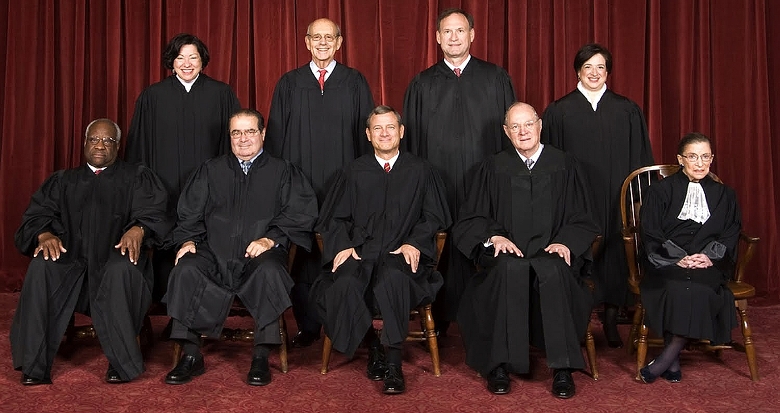
However, it might surprise you to learn that along with having a lifetime job, a parking space, invitations to things like special dinners, the State of the Union address, there are other perks that most of us are unaware of.
“As of January 1, 2014,” the Houston Chronicle reports, “the chief justice of the Supreme Court earns a salary of $255,500 per year and the associate justices earn $244,400 per year. A Supreme Court judge who chooses to retire at 70, with 10 years of service, or age 65, with 15 years of service, is eligible to receive his entire ending salary each year for the rest of his (or her) life. In return, retired judges without a disability are required to remain active and perform a certain amount of judicial obligations each year.”
That’s a pretty sweet deal, wouldn’t you think?
But according to a recent story (July 2), in an online newsletter from The Center for Public Integrity, the Supremes have many more perks available that they take full advantage of.
“Six of the court’s nine members received paid trips to Europe in 2014, including to Berlin, London and Zurich, as reported on the justices’ annual financial disclosure reports released Thursday. The excursions are just some of the many perks that come with having the final word on the nation’s laws. …
“The justices do not have to disclose the costs of their reimbursed travels, which included a three-week multi-stop trip that Justice Anthony Kennedy took to Salzburg, Austria, San Francisco and Aspen, Colorado, last July, paid for by the Aspen Institute and the University of the Pacific. New York University also paid for Sonia Sotomayor and Ruth Bader Ginsburg to travel to Florence, Italy. Chief Justice John Roberts taught a class on the history of the Supreme Court to students of the New England School of Law in London.
“All of the justices received at least some free travel, even if not international.
“Teaching and giving one-off lectures was a common side venture for the justices, seven of whom reported income from universities. Kennedy was an adjunct professor at the University of the Pacific’s McGeorge School of Law, Justice Samuel Alito taught at Duke University Law School and Justice Elena Kagan was a visiting professor at Harvard Law School.
“Justices Antonin Scalia and Stephen Breyer both reported income from book royalties, though Scalia’s books seem to be selling far better, earning more than $33,000 in 2014, compared with the $7,000 Breyer reported. However, Scalia’s books did not sell as well as they did the year before, when he reported nearly $77,000 in royalties.
“Besides their side gigs,” the Center writes, “as teachers and book authors, six of the nine justices were also landlords. For example, Scalia’s property in Charlottesville, Virginia, netted him at least $5,000 a year in rent, while Breyer’s property on the island of Nevis in the West Indies earned less than $1,000 a year in rent. Justice Clarence Thomas reported owning one third of a rental property in Georgia but said he received no rent in 2014.
“The reports reveal that the majority of the justices do not own individual stocks, reducing the likelihood that a conflict of interest would require a justice to remove him or herself from ruling on a case.
“Only Alito, Roberts and Breyer own individual stocks, and all three have recused themselves from cases involving companies in which they were invested. Roberts stepped aside in at least two cases involving Time Warner Inc., in which he owned at least $350,000 worth of stock. Breyer sat out of a patent case because of at least $50,000 in Cisco Systems Inc. stock.
“Alito sold his Coca-Cola Co. stock on April 16, 2014, just before the court heard oral arguments in a lawsuit against Coca-Cola on April 21, allowing him to rejoin the rest of the court for the case after recusing himself from the initial proceedings.”
I’m all for book sales, part time teaching, and a little rental income, but the fact that justices are not required to disclose their travel expenses is something that makes no sense from an ethical perspective.
If they, in fact, decide the fate of laws that affect us all, we should be able to know who may be influencing their decision making. While there may be no legal requirement for them to disclose, they should understand the ethical consequences of not disclosing. Having quoted him before, it bears repeating from one of their own, Justice Potter Stewart, who observed, “There’s a big difference between what you have a right to do and what is right to do.”
Comments
Leave a Comment

Recent Commentaries
Why George Marshall Still Matters
February 2, 2026

The Most Sacred Thing
January 29, 2026

THIS Cannot Be Ignored
January 25, 2026

Year One
January 20, 2026

Removed
January 18, 2026
Clarence Darrow’s Warning to a Tired Democracy
January 15, 2026
Accountability, Optional
January 12, 2026
My Dinner with Jefferson, Hamilton and Madison
January 8, 2026

When the Story Becomes the Scandal
January 5, 2026

A Light from Christmas Past – Conclusion
December 24, 2025
Read More Articles
The Latest... And Sometimes Greatest
A Light From Christmas Past – Part II
Emily returned to the attic the next evening. The attic felt different, not mysterious, purposeful. She unlocked the small door again and stood for a...
December 23, 2025
A Light from Christmas Past
In the winter of his century, Charles Dickens walked a London powered by industry but running short on warmth. People moved past one another as...
December 22, 2025
Nothing Beside Remains
I have stopped watching national news about Donald Trump because the coverage now mirrors the damage itself. What once informed now exhausts; what once clarified...
December 16, 2025
Finding Common Ground, and Why It Matters
A national media organization has recognized the seriousness of our political division and offered something we’ve been missing… A REAL beginning toward ending the death...
December 15, 2025
What Dickens Meant Us to Remember
Every December, I look forward to reading and watching Dickens’ A Christmas Carol. While there are countless versions of the classic, I always return to...
December 11, 2025
Looking for America’s Soul
“At what point then is the approach of danger to be expected? I answer, if it ever reach us, it must spring up amongst us;...
December 8, 2025
One should tread with great caution before entering the chorus of those who would criticize the well-paid. The Clintons stand as complete hypocrites pleading poverty, and at $10,416 dollars a pitch over a six-year $125 million dollar contract, Barry Zito now retired, was poorly paid by today’s standards. When you examine SF (for example) city employees, the Supremes would appear, despite perks, to be grossly underpaid. AS IN:
“Fire Lt. Gary Altenberg of Station 39 on Portola Avenue had the most overtime of any city employee, pulling in $191,172 in overtime, well above his salary of $131,101. With other pay perks, his total compensation was $343,730. Not far behind was firefighter and paramedic Frederick Binkley, who racked up $179,235 in overtime on top of a base pay of $129,141, the figures show. Binkley’s total pay last year was $326,140. The Chief and Ass’t Chief made over $300,000 each. Massive overtime isn’t confined to the Fire Department.
Sheriff’s Deputy Whitney Yee was the fourth highest overtime earner last year, raking in $156,843 in extra-hours pay. That amount was almost double his base salary of $90,545.”